01 / Morfologi

Ciri dan struktur

The thallus is somewhat fruticose and forms unattached, shrubby clumps that are typically 0.5 – 2 cm across. Branching is usually irregular (only rarely neatly forked), and the tips are often pale with a small blackened area where pycnidia are common. The surface is generally dull yellow-green to olive-green or olive-brown, sometimes gray-green, and pale pseudocyphellae (small, pale breaks in the surface) are usually most obvious toward the branch tips. In cross-section, the (outer "skin") is distinctly two-layered, with a thin outer layer of rounded cells and a thicker inner layer of elongated cells. Apothecia are uncommon. When present they are dark, often , and may become adnate to short-stalked, reaching about 2.5 mm in diameter. The ascospores are hyaline and , while the conidia are threadlike and typically about 7–16 μm long. No secondary metabolites were detected, and standard chemical spot tests are negative (K−, C−, KC−, P−).

Sebagian uraian ditampilkan dalam bahasa sumber; terjemahannya belum tersedia atau belum lolos pemeriksaan.

Rujukan: [1]

Pengukuran mengikuti objek, spesimen atau kultur, dan metode yang disebutkan sumber. Baca uraian asli untuk konteks lengkap.

02 / Kehidupan

Habitat dan peran ekologis

Aspicilia rogeri is an obligatory vagrant on calcareous soils in open shrub-steppe. It favors sites that are briefly moist in winter or spring but dry for most of the year, and it has often been recorded at elevations of about 1000 – 2000 m. It is associated with calcareous badlands landscapes, including habitats dominated by black sagebrush (Artemisia nova) and other Artemisia communities, and it may occur alongside other soil-crust lichens such as Aspicilia hispida. The species is known from western North America, with published records from Colorado, Idaho, Oregon, Utah, and Wyoming. In their global review of manna lichens and relatives, Sohrabi and coauthors treated it as restricted to North America (in contrast to several related vagrant species that are widespread in Eurasia).

Sebagian uraian ditampilkan dalam bahasa sumber; terjemahannya belum tersedia atau belum lolos pemeriksaan.

Rujukan: [1]

Habitat atau konteks temuan
Informasi belum tersedia pada sumber rilis ini.
Substrat
Informasi belum tersedia pada sumber rilis ini.
Peran atau konteks
Pembentuk liken
Temukan hubungan serupa
03 / Siklus hidup

Reproduksi

In cross-section, the (outer "skin") is distinctly two-layered, with a thin outer layer of rounded cells and a thicker inner layer of elongated cells. Apothecia are uncommon. When present they are dark, often , and may become adnate to short-stalked, reaching about 2.5 mm in diameter. The ascospores are hyaline and , while the conidia are threadlike and typically about 7–16 μm long. No secondary metabolites were detected, and standard chemical spot tests are negative (K−, C−, KC−, P−).

Sebagian uraian ditampilkan dalam bahasa sumber; terjemahannya belum tersedia atau belum lolos pemeriksaan.

Rujukan: [1]

Sinonim menurut acuan taksonomi rilis: Aspicilia rogeri
04 / Batas informasi

Catatan identitas dan cakupan

  • Nama diterima mengikuti Catalogue of Life Base2026-09-11; uraian mempertahankan konsep dan nama sumber aslinya.
  • Original geographic, specimen and life-cycle scope retained; source import awaits individual editorial review.
  • Impor dan terjemahan otomatis belum diperiksa editorial per profil. Struktur reproduktif yang disebutkan tidak membuktikan seluruh siklus hidup diketahui.
  • Pengukuran pada uraian mengikuti spesimen, kultur, dan metode sumber; angka tidak diperluas ke semua populasi.

Catatan distribusi dalam narasi mengikuti sumbernya. Dokumentasi spesimen atau foto mengikuti catatan sumber. Bukti wilayah Indonesia dan penilaian konservasi tidak disimpulkan dari gambar.

05 / Dokumentasi

Melihat dengan konteks

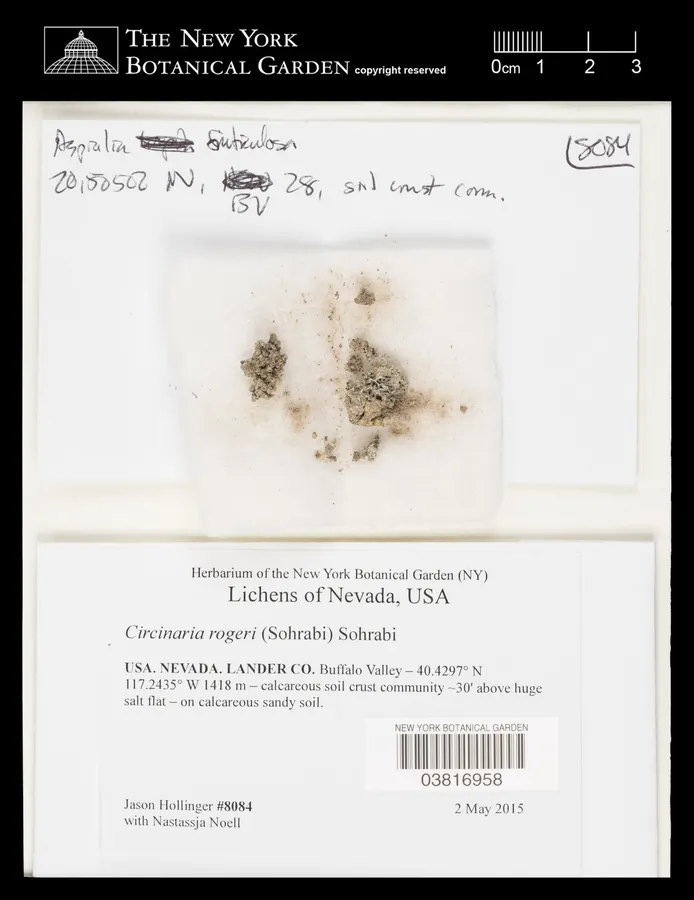
Voucher herbarium Circinaria rogeri (03816958), The New York Botanical Garden. Identifikasi mengikuti record spesimen sumber. Foto bahan, kemasan, atau label herbarium sebagaimana tersedia pada record institusi; bukan foto lapangan atau penentuan spesimen independen.

Jenis
Voucher herbarium
Kredit
The New York Botanical Garden
Lisensi
CC BY 4.0
Sumber media
Buka entri sumber

Gambar menunjukkan objek menurut identifikasi sumber, bukan verifikasi independen spesimen oleh Fungi. Tidak ada skala baru yang ditambahkan.

06 / Rujukan

Sumber profil

  1. [1] Circinaria rogeri — Wikipedia (en)Bagian sumber: Frozen revision 1353395274
    Tanggal penghimpunan sumber: 2026-10-12
    Teks sumber: CC BY-SA4.0 · Wikipedia contributors
  2. [2] Catalogue of Life Base2026-09-11 — Circinaria rogeriBagian sumber: ColDP NameUsage.tsv ID VFX4; accepted species; source 2073
    Tanggal penghimpunan sumber: 2026-10-12
  3. [3] Dokumentasi visual — Circinaria rogeriBagian sumber: Individual media record; identification follows the source, not independent determination
    Tanggal penghimpunan sumber: 2026-10-12
    Media sumber: CC BY 4.0 · The New York Botanical Garden

Adaptasi teks: CC BY-SA 4.0. Wikipedia contributors — Circinaria rogeri — Wikipedia (en)

Uraian asli dan riwayat sumber

Riwayat atau halaman sumber

Ringkasan sumber

Circinaria rogeri is a species of lichen in the family Megasporaceae. It is a vagrant lichen, meaning it grows unattached to any surface and is moved about by wind and water. The species forms small, shrubby clumps that are dull olive-green to yellowish-green. It occurs on calcareous soils in the sagebrush steppes of the western United States, where it has been recorded from Colorado, Idaho, Oregon, Utah, and Wyoming.

Revisi sumber

Morfologi sumber

The thallus is somewhat fruticose and forms unattached, shrubby clumps that are typically 0.5 – 2 cm across. Branching is usually irregular (only rarely neatly forked), and the tips are often pale with a small blackened area where pycnidia are common. The surface is generally dull yellow-green to olive-green or olive-brown, sometimes gray-green, and pale pseudocyphellae (small, pale breaks in the surface) are usually most obvious toward the branch tips. In cross-section, the (outer "skin") is distinctly two-layered, with a thin outer layer of rounded cells and a thicker inner layer of elongated cells. Apothecia are uncommon. When present they are dark, often , and may become adnate to short-stalked, reaching about 2.5 mm in diameter. The ascospores are hyaline and , while the conidia are threadlike and typically about 7–16 μm long. No secondary metabolites were detected, and standard chemical spot tests are negative (K−, C−, KC−, P−).

Revisi sumber

Ekologi sumber

Aspicilia rogeri is an obligatory vagrant on calcareous soils in open shrub-steppe. It favors sites that are briefly moist in winter or spring but dry for most of the year, and it has often been recorded at elevations of about 1000 – 2000 m. It is associated with calcareous badlands landscapes, including habitats dominated by black sagebrush (Artemisia nova) and other Artemisia communities, and it may occur alongside other soil-crust lichens such as Aspicilia hispida. The species is known from western North America, with published records from Colorado, Idaho, Oregon, Utah, and Wyoming. In their global review of manna lichens and relatives, Sohrabi and coauthors treated it as restricted to North America (in contrast to several related vagrant species that are widespread in Eurasia).

Revisi sumber

Struktur reproduksi sumber

In cross-section, the (outer "skin") is distinctly two-layered, with a thin outer layer of rounded cells and a thicker inner layer of elongated cells. Apothecia are uncommon. When present they are dark, often , and may become adnate to short-stalked, reaching about 2.5 mm in diameter. The ascospores are hyaline and , while the conidia are threadlike and typically about 7–16 μm long. No secondary metabolites were detected, and standard chemical spot tests are negative (K−, C−, KC−, P−).

Revisi sumber

Rujukan halaman ini

Fungi. Circinaria rogeri. Rilis data fungi-2026-10-12-expansion-2. https://fungi-atlas.mgadib.chatgpt.site/jamur/circinaria-rogeri/.

Status: impor sumber; pemeriksaan editorial per profil belum selesai. Untuk klaim biologis, gunakan rujukan pada bagian terkait dan periksa konteks sumber aslinya.