01 / Morfologi

Ciri dan struktur

Cladia inflata forms densely interwoven, spreading clumps or mats that are decumbent at the base, typically reaching 50 mm high and 4–6 mm wide. The thallus shows repeated branching with branches tapering rather abruptly at their tips. The surface is texture is glossy to faintly wavy (), and wrinkled or dimpled. It varies in colour from pale yellow-brown to olive-brown or reddish brown, and takes on a pale greenish colouration in deep shade. The angles where branches fork () lack holes and are not pinched or narrowed, with branches typically diverging smoothly rather than at sharp angles, especially on the upper surface. Perforations, when present, are round to oval and measure 0.2–2 mm wide. The medullary cavity is white and throughout. Reproductive stalks (fertile ) are rare and grow horizontally along the ground (). They are nearly identical to non-reproductive stalks but have slightly more branching and develop small holes near their tips. Apothecia develop apically on short branchlets and are mostly solitary or occur in groups of 2–3. They measure up to 0.2 mm wide and usually proliferate in 2–3 compressed tiers. Ascospores measure 8–10 × 3–4 micrometres (μm). The pseudopodetia are usually sterile (lacking apothecia); they are made of internally erect, stout, sterile hyphae and very deformed, weakly amyloid or non-amyloid asci. Conidia are common, occurring singly or in pairs at the tips of sterile and fertile pseudopodetia, and occasionally also . The conidia are threadlike () and hooked () with blunt tips, measuring 5–6 × 0.6–0.8 μm. The chemistry of C. inflata includes fumarprotocetraric acid, succinoprotocetraric acid (variably), protocetraric acid, and physodialic acid as medullary compounds, with spot test reactions of K−, KC−, C−, Pd+ (red) and UV−.

Sebagian uraian ditampilkan dalam bahasa sumber; terjemahannya belum tersedia atau belum lolos pemeriksaan.

Rujukan: [1]

Pengukuran mengikuti objek, spesimen atau kultur, dan metode yang disebutkan sumber. Baca uraian asli untuk konteks lengkap.

02 / Kehidupan

Habitat dan peran ekologis

Cladia inflata is widely distributed across Tasmania, mainland Australia, and New Zealand. In Australia, the species occurs in Tasmania, south-eastern regions, and alpine areas of the mainland. It is found at high-elevation sites, growing in areas with very high rainfall exceeding 3000 mm per annum. The lichen is often found growing on peaty or sandy soil in association with other species of Cladia, as well as Cladonia southlandica and Siphula decumbens. Detailed distribution records have been documented within Tasmania. The species is most readily recognised in the field when well-developed. It has been studied extensively through both laboratory and field observations, revealing that it inhabits the broadest ecological niche within its segregate group. C. inflata displays the widest ecological amplitude (the range of survivable environmental conditions) among members of its complex, occurring from lowland to alpine altitudes and growing in habitats ranging from relatively open sclerophyll woodlands to blanket bogs of south-western Tasmania.

Sebagian uraian ditampilkan dalam bahasa sumber; terjemahannya belum tersedia atau belum lolos pemeriksaan.

Rujukan: [1]

Habitat atau konteks temuan
Informasi belum tersedia pada sumber rilis ini.
Substrat
Informasi belum tersedia pada sumber rilis ini.
Peran atau konteks
Pembentuk liken
Temukan hubungan serupa
03 / Siklus hidup

Reproduksi

Reproductive stalks (fertile ) are rare and grow horizontally along the ground (). They are nearly identical to non-reproductive stalks but have slightly more branching and develop small holes near their tips. Apothecia develop apically on short branchlets and are mostly solitary or occur in groups of 2–3. They measure up to 0.2 mm wide and usually proliferate in 2–3 compressed tiers. Ascospores measure 8–10 × 3–4 micrometres (μm). The pseudopodetia are usually sterile (lacking apothecia); they are made of internally erect, stout, sterile hyphae and very deformed, weakly amyloid or non-amyloid asci. Conidia are common, occurring singly or in pairs at the tips of sterile and fertile pseudopodetia, and occasionally also .

Sebagian uraian ditampilkan dalam bahasa sumber; terjemahannya belum tersedia atau belum lolos pemeriksaan.

Rujukan: [1]

Sinonim menurut acuan taksonomi rilis: Cladonia aggregata f. inflata
04 / Batas informasi

Catatan identitas dan cakupan

  • Nama diterima mengikuti Catalogue of Life Base2026-09-11; uraian mempertahankan konsep dan nama sumber aslinya.
  • Original geographic, specimen and life-cycle scope retained; source import awaits individual editorial review.
  • Impor dan terjemahan otomatis belum diperiksa editorial per profil. Struktur reproduktif yang disebutkan tidak membuktikan seluruh siklus hidup diketahui.
  • Pengukuran pada uraian mengikuti spesimen, kultur, dan metode sumber; angka tidak diperluas ke semua populasi.

Catatan distribusi dalam narasi mengikuti sumbernya. Dokumentasi spesimen atau foto mengikuti catatan sumber. Bukti wilayah Indonesia dan penilaian konservasi tidak disimpulkan dari gambar.

05 / Dokumentasi

Melihat dengan konteks

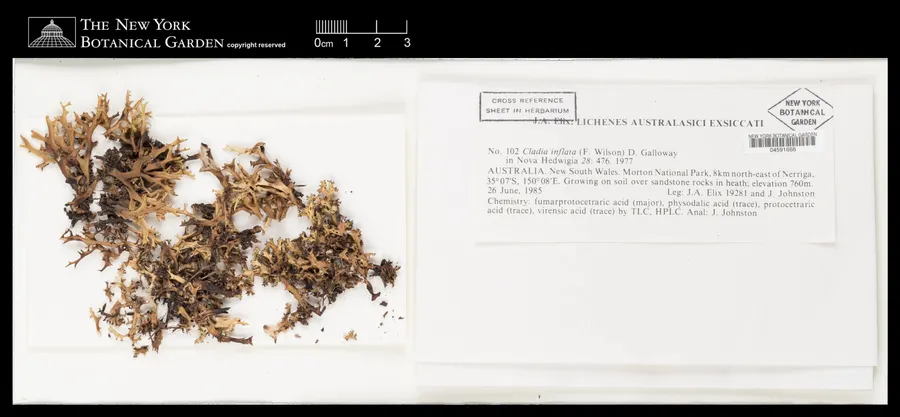
Voucher herbarium Cladia inflata (04591668), The New York Botanical Garden. Identifikasi mengikuti record spesimen sumber. Foto bahan, kemasan, atau label herbarium sebagaimana tersedia pada record institusi; bukan foto lapangan atau penentuan spesimen independen.

Jenis
Voucher herbarium
Kredit
The New York Botanical Garden
Lisensi
CC BY 4.0
Sumber media
Buka entri sumber

Gambar menunjukkan objek menurut identifikasi sumber, bukan verifikasi independen spesimen oleh Fungi. Tidak ada skala baru yang ditambahkan.

06 / Rujukan

Sumber profil

  1. [1] Cladia inflata — Wikipedia (en)Bagian sumber: Frozen revision 1328868146
    Tanggal penghimpunan sumber: 2026-10-12
    Teks sumber: CC BY-SA4.0 · Wikipedia contributors
  2. [2] Catalogue of Life Base2026-09-11 — Cladia inflataBagian sumber: ColDP NameUsage.tsv ID VN9X; accepted species; source 2073
    Tanggal penghimpunan sumber: 2026-10-12
  3. [3] Dokumentasi visual — Cladia inflataBagian sumber: Individual media record; identification follows the source, not independent determination
    Tanggal penghimpunan sumber: 2026-10-12
    Media sumber: CC BY 4.0 · The New York Botanical Garden

Adaptasi teks: CC BY-SA 4.0. Wikipedia contributors — Cladia inflata — Wikipedia (en)

Uraian asli dan riwayat sumber

Riwayat atau halaman sumber

Ringkasan sumber

Cladia inflata is a species of fruticose lichen in the family Cladoniaceae. This lichen forms densely interwoven, spreading mats up to 5 centimetres high, with swollen, glossy branches that vary from pale yellow-brown to olive-brown in colour. It grows on peaty or sandy soil in high-rainfall areas, typically in areas exceeding 3000 millimetres of annual precipitation, and is found across Tasmania, south-eastern mainland Australia, and New Zealand. The species is characterized by its inflated branches that are broader at the forks, a feature that distinguishes it from closely related species in the Cladia aggregata complex.

Revisi sumber

Morfologi sumber

Cladia inflata forms densely interwoven, spreading clumps or mats that are decumbent at the base, typically reaching 50 mm high and 4–6 mm wide. The thallus shows repeated branching with branches tapering rather abruptly at their tips. The surface is texture is glossy to faintly wavy (), and wrinkled or dimpled. It varies in colour from pale yellow-brown to olive-brown or reddish brown, and takes on a pale greenish colouration in deep shade. The angles where branches fork () lack holes and are not pinched or narrowed, with branches typically diverging smoothly rather than at sharp angles, especially on the upper surface. Perforations, when present, are round to oval and measure 0.2–2 mm wide. The medullary cavity is white and throughout. Reproductive stalks (fertile ) are rare and grow horizontally along the ground (). They are nearly identical to non-reproductive stalks but have slightly more branching and develop small holes near their tips. Apothecia develop apically on short branchlets and are mostly solitary or occur in groups of 2–3. They measure up to 0.2 mm wide and usually proliferate in 2–3 compressed tiers. Ascospores measure 8–10 × 3–4 micrometres (μm). The pseudopodetia are usually sterile (lacking apothecia); they are made of internally erect, stout, sterile hyphae and very deformed, weakly amyloid or non-amyloid asci. Conidia are common, occurring singly or in pairs at the tips of sterile and fertile pseudopodetia, and occasionally also . The conidia are threadlike () and hooked () with blunt tips, measuring 5–6 × 0.6–0.8 μm. The chemistry of C. inflata includes fumarprotocetraric acid, succinoprotocetraric acid (variably), protocetraric acid, and physodialic acid as medullary compounds, with spot test reactions of K−, KC−, C−, Pd+ (red) and UV−.

Revisi sumber

Ekologi sumber

Cladia inflata is widely distributed across Tasmania, mainland Australia, and New Zealand. In Australia, the species occurs in Tasmania, south-eastern regions, and alpine areas of the mainland. It is found at high-elevation sites, growing in areas with very high rainfall exceeding 3000 mm per annum. The lichen is often found growing on peaty or sandy soil in association with other species of Cladia, as well as Cladonia southlandica and Siphula decumbens. Detailed distribution records have been documented within Tasmania. The species is most readily recognised in the field when well-developed. It has been studied extensively through both laboratory and field observations, revealing that it inhabits the broadest ecological niche within its segregate group. C. inflata displays the widest ecological amplitude (the range of survivable environmental conditions) among members of its complex, occurring from lowland to alpine altitudes and growing in habitats ranging from relatively open sclerophyll woodlands to blanket bogs of south-western Tasmania.

Revisi sumber

Struktur reproduksi sumber

Reproductive stalks (fertile ) are rare and grow horizontally along the ground (). They are nearly identical to non-reproductive stalks but have slightly more branching and develop small holes near their tips. Apothecia develop apically on short branchlets and are mostly solitary or occur in groups of 2–3. They measure up to 0.2 mm wide and usually proliferate in 2–3 compressed tiers. Ascospores measure 8–10 × 3–4 micrometres (μm). The pseudopodetia are usually sterile (lacking apothecia); they are made of internally erect, stout, sterile hyphae and very deformed, weakly amyloid or non-amyloid asci. Conidia are common, occurring singly or in pairs at the tips of sterile and fertile pseudopodetia, and occasionally also .

Revisi sumber

Rujukan halaman ini

Fungi. Cladia inflata. Rilis data fungi-2026-10-12-expansion-2. https://fungi-atlas.mgadib.chatgpt.site/jamur/cladia-inflata/.

Status: impor sumber; pemeriksaan editorial per profil belum selesai. Untuk klaim biologis, gunakan rujukan pada bagian terkait dan periksa konteks sumber aslinya.