01 / Morfologi

Ciri dan struktur

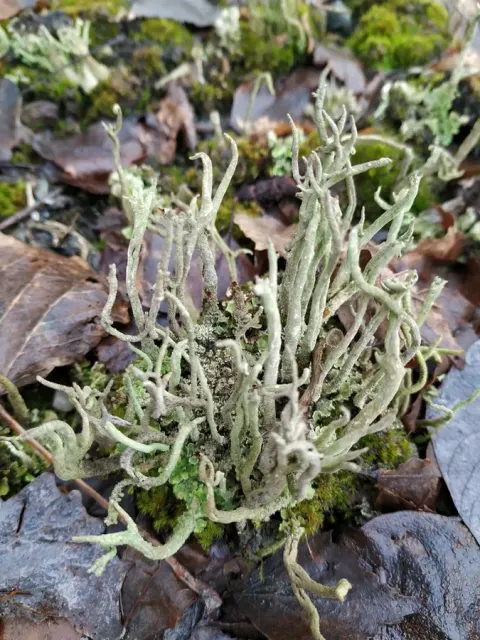
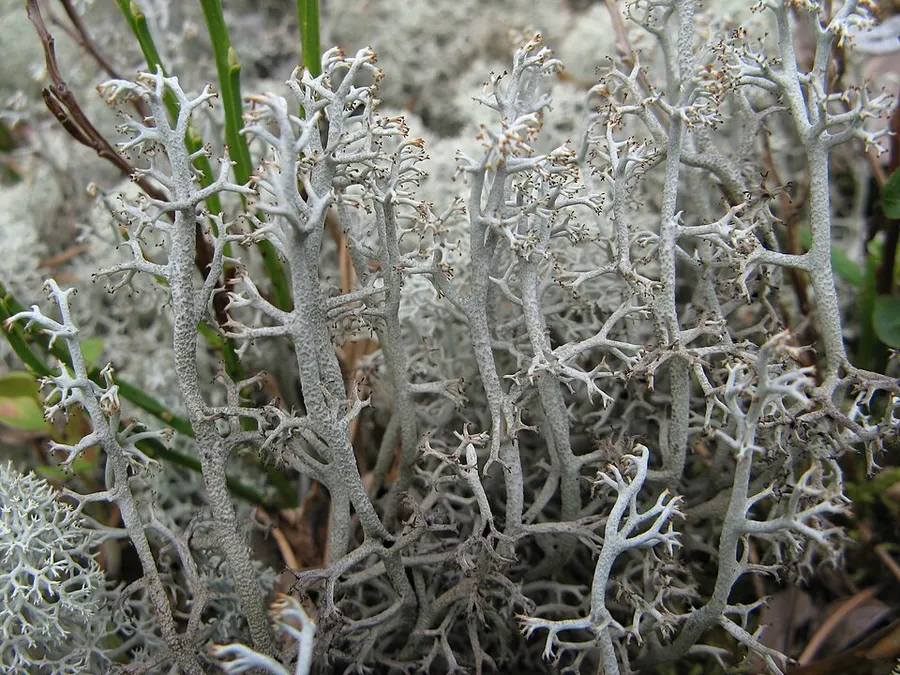
Like other members of its genus, C. stygia has a two-part () structure: it begins life with a crust-like layer growing on the substrate, but this eventually disappears as the more prominent upright, branching structures (the podetia) develop. The lichen is distinguished by several characteristic features of its structure. The podetia typically reach heights of 5–15 cm tall, occasionally reaching 30 cm, with the living (active) portion measuring up to 10 cm. The main stem is about 1 mm thick, with segments between branches about 5 mm long. The branching pattern is distinctive, typically dividing into three unequal branches (anisotomic trichotomous), though sometimes splitting into four or two branches. Where the branches divide, they form small holes or perforations called axils. The base of its branches shows a distinctive ash-grey to black colouration on the inside. This dark background is dotted with irregular patches of greenish-white outer tissue (known as the ectal layer), creating a distinctive speckled appearance. These patches often have uneven edges and can sometimes appear almost scale-like. While this mottled, darkened area typically covers the lower half of the branches, in some specimens it may be limited to just the very base. When wet, the lichen can take on an olive-grey colouration. The podetia of C. stygia often have a distinctive curvature near the tips, giving them a characteristic hooked or walking cane-like appearance. In contrast to the relatively smooth podetia of C. rangiferina, C. stygia has a notably wartier surface texture—a feature that assists in field identification.

Sebagian uraian ditampilkan dalam bahasa sumber; terjemahannya belum tersedia atau belum lolos pemeriksaan.

Rujukan: [1]

Pengukuran mengikuti objek, spesimen atau kultur, dan metode yang disebutkan sumber. Baca uraian asli untuk konteks lengkap.

02 / Kehidupan

Habitat dan peran ekologis

Cladonia stygia is widespread across the Northern Hemisphere but has a fragmented distribution in some regions. In Germany, although the species was recorded in Lower Saxony as early as 1908, it was not observed again until 2012—when new populations were discovered in the lichen‐rich pine forests of the Carrenziener Dünen. Since then, conservation efforts, including experimental lichen reintroduction, have successfully established additional populations within the dune system, where C. stygia co-occurs with other reindeer lichens such as C. portentosa, C. arbuscula, and C. rangiferina. It has also been confirmed in parts of Central Europe – including Germany (with recent reports from the federal state of Hesse) and the Czech Republic – as well as in Canada, Finland, and parts of Asia, suggesting a broad boreal or circumboreal distribution. In the Alps, it occurs from valley bottoms to the subalpine belt (mainly between 300 and 2400 m elevation), but is relatively rare and restricted to raised bogs. It has been documented across multiple Alpine regions, including parts of Austria, Germany, Switzerland, France, Italy, and Slovenia. Although primarily a boreal species, C. stygia extends into both arctic and temperate zones, becoming increasingly restricted to specialised habitats at its southern limits, for example in isolated mountain ranges such as the European Alps and the Blue Ridge Mountains in Virginia.

Sebagian uraian ditampilkan dalam bahasa sumber; terjemahannya belum tersedia atau belum lolos pemeriksaan.

Rujukan: [1]

Habitat atau konteks temuan
Informasi belum tersedia pada sumber rilis ini.
Substrat
Informasi belum tersedia pada sumber rilis ini.
Peran atau konteks
Pembentuk liken
Temukan hubungan serupa
03 / Siklus hidup

Reproduksi

The upper portions of the branches also have distinctive features. The terminal and near-terminal branches have a relatively rough surface texture with a felty but loosely fibrous covering, and they typically taper gradually to pointed tips. The branch tips are notably darkened and strongly deflexed to one side. The internal structure of the branches consists of several layers: the wall measures 225–275 micrometres (μm) in thickness, with a delicate cobweb-like surface layer (called the arachnoid layer) of 25–50 μm. One additional identifying feature is the red colour of its reproductive structures (called pycnidia), though this characteristic is rarely visible and can be difficult to observe in the field.

Sebagian uraian ditampilkan dalam bahasa sumber; terjemahannya belum tersedia atau belum lolos pemeriksaan.

Rujukan: [1]

Sinonim menurut acuan taksonomi rilis: Cenomyce gonorega f. scabrosa; Cenomyce rangiferina var. curta; Cenomyce squamosa var. scabrosa; Cladina rangiferina f. stygia; Cladina stygia; Cladonia degenerans f. scabrosa; Cladonia rangiferina f. curta; Cladonia rangiferina f. stygia; Cladonia squamosa var. scabrosa
04 / Batas informasi

Catatan identitas dan cakupan

  • Nama diterima mengikuti Catalogue of Life Base2026-09-11; uraian mempertahankan konsep dan nama sumber aslinya.
  • Original geographic, specimen and life-cycle scope retained; source import awaits individual editorial review.
  • Impor dan terjemahan otomatis belum diperiksa editorial per profil. Struktur reproduktif yang disebutkan tidak membuktikan seluruh siklus hidup diketahui.
  • Pengukuran pada uraian mengikuti spesimen, kultur, dan metode sumber; angka tidak diperluas ke semua populasi.

Catatan distribusi dalam narasi mengikuti sumbernya. Dokumentasi spesimen atau foto mengikuti catatan sumber. Bukti wilayah Indonesia dan penilaian konservasi tidak disimpulkan dari gambar.

05 / Dokumentasi

Melihat dengan konteks

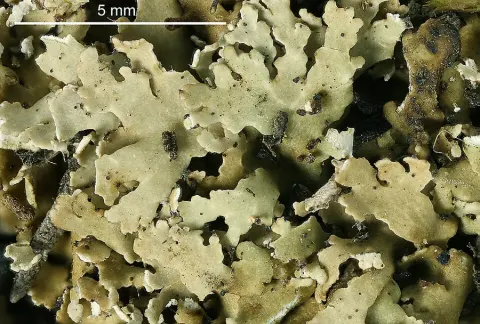
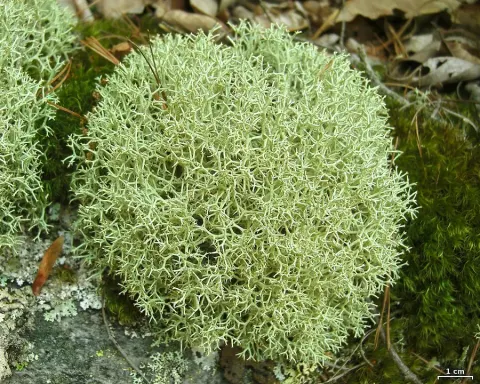
Dokumentasi Cladonia stygia dari Wikimedia Commons. Black-footed Reindeer Lichen ( Cladonia stygia ) Identifikasi mengikuti record berkas sumber.

Jenis
Fotografi
Kredit
Ilya Filippov
Lisensi
CC BY 4.0
Sumber media
Buka entri sumber

Gambar menunjukkan objek menurut identifikasi sumber, bukan verifikasi independen spesimen oleh Fungi. Tidak ada skala baru yang ditambahkan.

06 / Rujukan

Sumber profil

  1. [1] Cladonia stygia — Wikipedia (en)Bagian sumber: Frozen revision 1358060641
    Tanggal penghimpunan sumber: 2026-10-12
    Teks sumber: CC BY-SA4.0 · Wikipedia contributors
  2. [2] Catalogue of Life Base2026-09-11 — Cladonia stygiaBagian sumber: ColDP NameUsage.tsv ID VPM2; accepted species; source 2073
    Tanggal penghimpunan sumber: 2026-10-12
  3. [3] Dokumentasi visual — Cladonia stygiaBagian sumber: Individual media record; identification follows the source, not independent determination
    Tanggal penghimpunan sumber: 2026-10-12
    Media sumber: CC BY 4.0 · Ilya Filippov

Adaptasi teks: CC BY-SA 4.0. Wikipedia contributors — Cladonia stygia — Wikipedia (en)

Uraian asli dan riwayat sumber

Riwayat atau halaman sumber

Ringkasan sumber

Cladonia stygia, commonly known as the black‐footed reindeer lichen, is a species of fruticose lichen in the family Cladoniaceae. It is distributed across boreal, arctic and temperate regions of the Northern Hemisphere. Originally described by Elias Magnus Fries in 1826 as a form of Cladonia rangiferina, subsequent studies on its morphology and chemistry led to its elevation to full species status in 1985. The lichen is recognised by its dark, ash-grey to black base and its distinctive, uneven branching pattern, often accompanied by small red reproductive structures.

Revisi sumber

Morfologi sumber

Like other members of its genus, C. stygia has a two-part () structure: it begins life with a crust-like layer growing on the substrate, but this eventually disappears as the more prominent upright, branching structures (the podetia) develop. The lichen is distinguished by several characteristic features of its structure. The podetia typically reach heights of 5–15 cm tall, occasionally reaching 30 cm, with the living (active) portion measuring up to 10 cm. The main stem is about 1 mm thick, with segments between branches about 5 mm long. The branching pattern is distinctive, typically dividing into three unequal branches (anisotomic trichotomous), though sometimes splitting into four or two branches. Where the branches divide, they form small holes or perforations called axils. The base of its branches shows a distinctive ash-grey to black colouration on the inside. This dark background is dotted with irregular patches of greenish-white outer tissue (known as the ectal layer), creating a distinctive speckled appearance. These patches often have uneven edges and can sometimes appear almost scale-like. While this mottled, darkened area typically covers the lower half of the branches, in some specimens it may be limited to just the very base. When wet, the lichen can take on an olive-grey colouration. The podetia of C. stygia often have a distinctive curvature near the tips, giving them a characteristic hooked or walking cane-like appearance. In contrast to the relatively smooth podetia of C. rangiferina, C. stygia has a notably wartier surface texture—a feature that assists in field identification.

Revisi sumber

Ekologi sumber

Cladonia stygia is widespread across the Northern Hemisphere but has a fragmented distribution in some regions. In Germany, although the species was recorded in Lower Saxony as early as 1908, it was not observed again until 2012—when new populations were discovered in the lichen‐rich pine forests of the Carrenziener Dünen. Since then, conservation efforts, including experimental lichen reintroduction, have successfully established additional populations within the dune system, where C. stygia co-occurs with other reindeer lichens such as C. portentosa, C. arbuscula, and C. rangiferina. It has also been confirmed in parts of Central Europe – including Germany (with recent reports from the federal state of Hesse) and the Czech Republic – as well as in Canada, Finland, and parts of Asia, suggesting a broad boreal or circumboreal distribution. In the Alps, it occurs from valley bottoms to the subalpine belt (mainly between 300 and 2400 m elevation), but is relatively rare and restricted to raised bogs. It has been documented across multiple Alpine regions, including parts of Austria, Germany, Switzerland, France, Italy, and Slovenia. Although primarily a boreal species, C. stygia extends into both arctic and temperate zones, becoming increasingly restricted to specialised habitats at its southern limits, for example in isolated mountain ranges such as the European Alps and the Blue Ridge Mountains in Virginia.

Revisi sumber

Struktur reproduksi sumber

The upper portions of the branches also have distinctive features. The terminal and near-terminal branches have a relatively rough surface texture with a felty but loosely fibrous covering, and they typically taper gradually to pointed tips. The branch tips are notably darkened and strongly deflexed to one side. The internal structure of the branches consists of several layers: the wall measures 225–275 micrometres (μm) in thickness, with a delicate cobweb-like surface layer (called the arachnoid layer) of 25–50 μm. One additional identifying feature is the red colour of its reproductive structures (called pycnidia), though this characteristic is rarely visible and can be difficult to observe in the field.

Revisi sumber

Rujukan halaman ini

Fungi. Cladonia stygia. Rilis data fungi-2026-10-12-expansion-2. https://fungi-atlas.mgadib.chatgpt.site/jamur/cladonia-stygia/.

Status: impor sumber; pemeriksaan editorial per profil belum selesai. Untuk klaim biologis, gunakan rujukan pada bagian terkait dan periksa konteks sumber aslinya.