01 / Morfologi

Ciri dan struktur

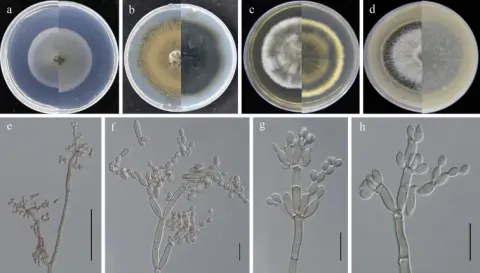
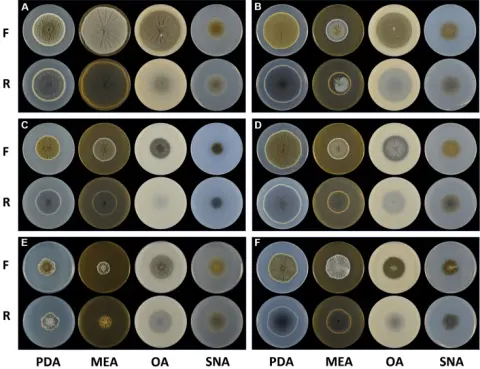
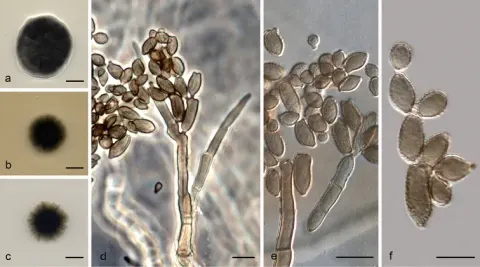
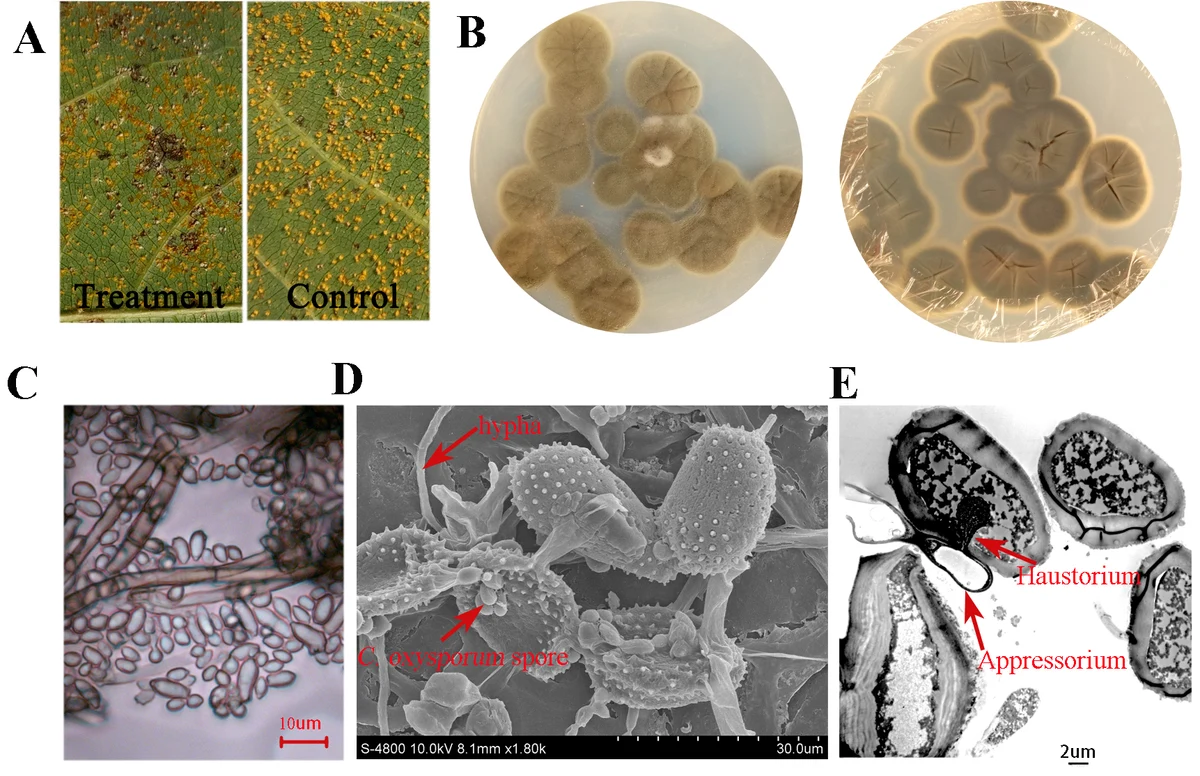
Cladosporium oxysporum expands moderately, often floccose at the center of the fungus that consists of woolly tufts, and it can grow up to 650 μm long and 4-5 μm wide. The colony is colored olive to olive-green on top with velvety surface, and greenish black at the bottom. The conidiophores are either straight or slightly bent, and the conidia range from oval to lemon-shaped. C. oxysporum produces conidia in unbranched or branched chains arising from cylindrical base cells. After the first spores have formed on the conidiophore, they bud apically to form secondary spores. They have pores connected in very fragile chains that can fall apart at the slightest movement of air, the spores are wind-dispersed and often extremely abundant in outdoor air under warm temperature.

Sebagian uraian ditampilkan dalam bahasa sumber; terjemahannya belum tersedia atau belum lolos pemeriksaan.

Rujukan: [1]

Pengukuran mengikuti objek, spesimen atau kultur, dan metode yang disebutkan sumber. Baca uraian asli untuk konteks lengkap.

02 / Kehidupan

Habitat dan peran ekologis

Cladosporium oxysporum is mostly located Asia and Africa, but it can also be found distributed throughout tropical and the subtropical regions. The fungus is commonly found on dead herbaceous and woody plants in the tropics as they are saprotrophs in warmer climates. In general, most Cladosporium species are widely distributed throughout the world In tropical and subtropical regions, and growing In soil or on organic matters. In a study conducted by Guan Et al., C. oxysporum was found to produce extracellular xylanase when grown on decaying agricultural waste. Production of extracellular xylanase was enhanced by elevated levels of Mg2+ ion in the soil or the surrounding environment, but inhibited by the high levels of Cu2+ ion. In the wild, C. oxysporum grows on hosts like Alnus, Bambusa, Citrus, Helianthus, and Pseudotsuga.

Sebagian uraian ditampilkan dalam bahasa sumber; terjemahannya belum tersedia atau belum lolos pemeriksaan.

Rujukan: [1]

Habitat atau konteks temuan
Informasi belum tersedia pada sumber rilis ini.
Substrat
tanah
Peran atau konteks
Pengurai
Temukan hubungan serupa
03 / Siklus hidup

Reproduksi

Cladosporium oxysporum expands moderately, often floccose at the center of the fungus that consists of woolly tufts, and it can grow up to 650 μm long and 4-5 μm wide. The colony is colored olive to olive-green on top with velvety surface, and greenish black at the bottom. The conidiophores are either straight or slightly bent, and the conidia range from oval to lemon-shaped. C. oxysporum produces conidia in unbranched or branched chains arising from cylindrical base cells. After the first spores have formed on the conidiophore, they bud apically to form secondary spores. They have pores connected in very fragile chains that can fall apart at the slightest movement of air, the spores are wind-dispersed and often extremely abundant in outdoor air under warm temperature.

Sebagian uraian ditampilkan dalam bahasa sumber; terjemahannya belum tersedia atau belum lolos pemeriksaan.

Rujukan: [1]

04 / Batas informasi

Catatan identitas dan cakupan

  • Nama diterima mengikuti Catalogue of Life Base2026-09-11; uraian mempertahankan konsep dan nama sumber aslinya.
  • Original geographic, specimen and life-cycle scope retained; source import awaits individual editorial review.
  • Impor dan terjemahan otomatis belum diperiksa editorial per profil. Struktur reproduktif yang disebutkan tidak membuktikan seluruh siklus hidup diketahui.
  • Pengukuran pada uraian mengikuti spesimen, kultur, dan metode sumber; angka tidak diperluas ke semua populasi.

Catatan distribusi dalam narasi mengikuti sumbernya. Dokumentasi spesimen atau foto mengikuti catatan sumber. Bukti wilayah Indonesia dan penilaian konservasi tidak disimpulkan dari gambar.

05 / Dokumentasi

Melihat dengan konteks

Pelat Cladosporium oxysporum yang menampilkan koloni, konidia, dan interaksinya dengan Melampsora larici-populina. Panel B–E memperlihatkan materi atau struktur jamur; identifikasi mengikuti Gambar 5 pada sumber.

Jenis
Pelat ilmiah
Kredit
Chen, Penghua; Shen, Kuocheng; Zhang, Yadan; Yu, Zhongdong; Li, Qiangfeng
Lisensi
CC BY 4.0
Sumber media
Buka entri sumber

Gambar menunjukkan objek menurut identifikasi sumber, bukan verifikasi independen spesimen oleh Fungi. Tidak ada skala baru yang ditambahkan.

06 / Rujukan

Sumber profil

  1. [1] Cladosporium oxysporum — Wikipedia (en)Bagian sumber: Frozen revision 1313923916
    Tanggal penghimpunan sumber: 2026-10-12
    Teks sumber: CC BY-SA4.0 · Wikipedia contributors
  2. [2] Catalogue of Life Base2026-09-11 — Cladosporium oxysporumBagian sumber: ColDP NameUsage.tsv ID VQ95; accepted species; source 2073
    Tanggal penghimpunan sumber: 2026-10-12
  3. [3] Dokumentasi visual — Cladosporium oxysporumBagian sumber: Identitas mengikuti sumber dokumentasi; bukan penentuan spesimen independen.
    Tanggal penghimpunan sumber: 2026-10-17
    Media sumber: CC BY 4.0 · Chen, Penghua; Shen, Kuocheng; Zhang, Yadan; Yu, Zhongdong; Li, Qiangfeng

Adaptasi teks: CC BY-SA 4.0. Wikipedia contributors — Cladosporium oxysporum — Wikipedia (en)

Uraian asli dan riwayat sumber

Riwayat atau halaman sumber

Ringkasan sumber

Cladosporium oxysporum is an airborne fungus that is commonly found outdoors and is distributed throughout the tropical and subtropical region, it is mostly located In Asia and Africa. It spreads through airborne spores and is often extremely abundant in outdoor air during the spring and summer seasons. It mainly feeds on decomposing organic matter in warmer climates, but can also be parasitic and feed on living plants. The airborne spores can occasionally cause cutaneous infections in humans, and the high prevalence of C. oxysporum in outdoor air during warm seasons contributes to its importance as an etiological agent of allergic disease and possibly human cutaneous phaeohyphomycosis in tropical regions.

Revisi sumber

Morfologi sumber

Cladosporium oxysporum expands moderately, often floccose at the center of the fungus that consists of woolly tufts, and it can grow up to 650 μm long and 4-5 μm wide. The colony is colored olive to olive-green on top with velvety surface, and greenish black at the bottom. The conidiophores are either straight or slightly bent, and the conidia range from oval to lemon-shaped. C. oxysporum produces conidia in unbranched or branched chains arising from cylindrical base cells. After the first spores have formed on the conidiophore, they bud apically to form secondary spores. They have pores connected in very fragile chains that can fall apart at the slightest movement of air, the spores are wind-dispersed and often extremely abundant in outdoor air under warm temperature.

Revisi sumber

Ekologi sumber

Cladosporium oxysporum is mostly located Asia and Africa, but it can also be found distributed throughout tropical and the subtropical regions. The fungus is commonly found on dead herbaceous and woody plants in the tropics as they are saprotrophs in warmer climates. In general, most Cladosporium species are widely distributed throughout the world In tropical and subtropical regions, and growing In soil or on organic matters. In a study conducted by Guan Et al., C. oxysporum was found to produce extracellular xylanase when grown on decaying agricultural waste. Production of extracellular xylanase was enhanced by elevated levels of Mg2+ ion in the soil or the surrounding environment, but inhibited by the high levels of Cu2+ ion. In the wild, C. oxysporum grows on hosts like Alnus, Bambusa, Citrus, Helianthus, and Pseudotsuga.

Revisi sumber

Struktur reproduksi sumber

Cladosporium oxysporum expands moderately, often floccose at the center of the fungus that consists of woolly tufts, and it can grow up to 650 μm long and 4-5 μm wide. The colony is colored olive to olive-green on top with velvety surface, and greenish black at the bottom. The conidiophores are either straight or slightly bent, and the conidia range from oval to lemon-shaped. C. oxysporum produces conidia in unbranched or branched chains arising from cylindrical base cells. After the first spores have formed on the conidiophore, they bud apically to form secondary spores. They have pores connected in very fragile chains that can fall apart at the slightest movement of air, the spores are wind-dispersed and often extremely abundant in outdoor air under warm temperature.

Revisi sumber

Rujukan halaman ini

Fungi. Cladosporium oxysporum. Rilis data fungi-2026-10-12-expansion-2. https://fungi-atlas.mgadib.chatgpt.site/jamur/cladosporium-oxysporum/.

Status: impor sumber; pemeriksaan editorial per profil belum selesai. Untuk klaim biologis, gunakan rujukan pada bagian terkait dan periksa konteks sumber aslinya.