01 / Morfologi

Ciri dan struktur

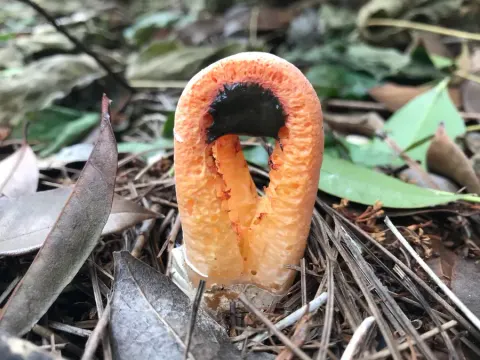
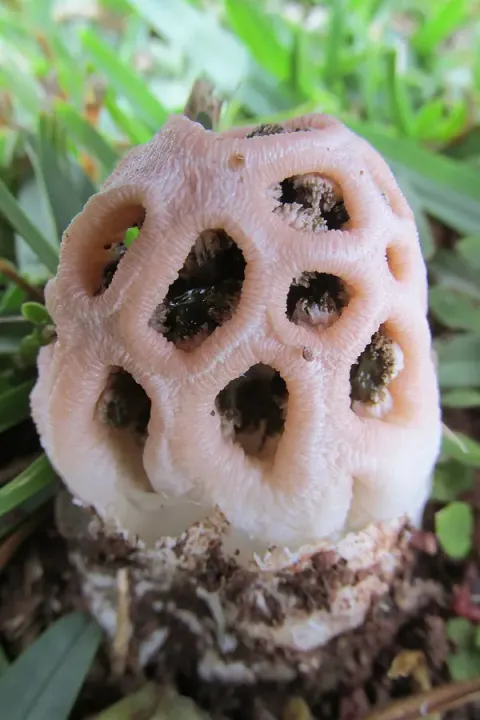
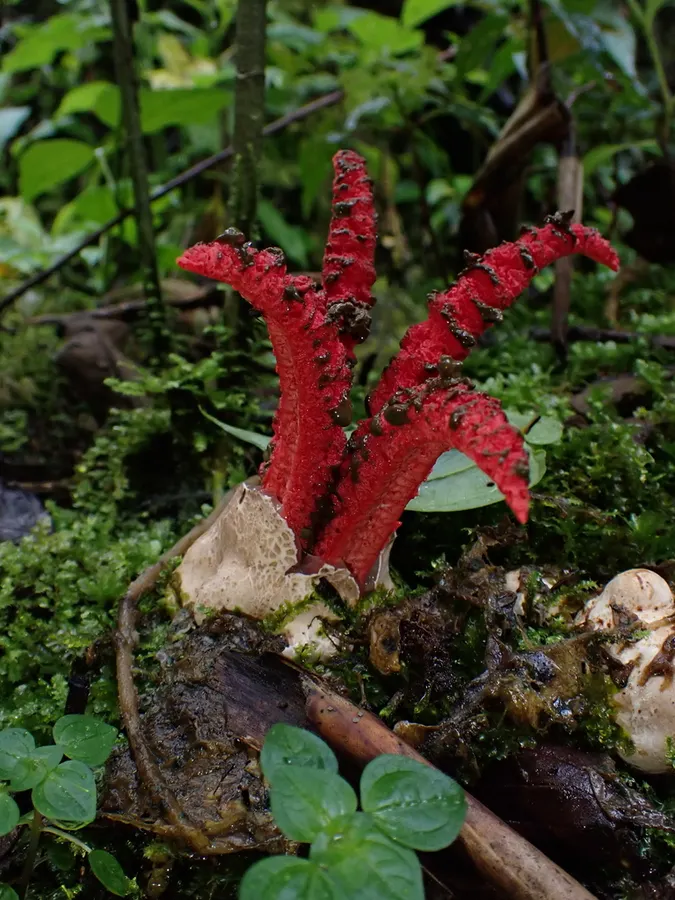
Clathrus archeri grows in two distinct stages, first an "egg stage" followed by the fungal "arms" emerging. In the first stage, it forms a white spherical to ovoid egg shape, usually 3-4 cm tall, with thread-like mycelium at the base. Next, between 4 and 8 pinkish-red arms emerge from the egg. Each arm can grow up to 10 cm in length and is coated in spore-bearing gleba on the upper surface which is dark greenish-brown in colour (becoming black when dry). Fruiting bodies have a lifespan of a day or two. The spores are elliptical, smooth, and 3.5–6 × 1.5–2 μm in size. Like other members of the family Phallaceae, the strong putrid smell of the gleba shows convergent evolution with some angiosperm flowers called sapromyophilous flowers. Sisson (2023) notes the peak season of the fungus in New Zealand is from October to June. The species, Aseroe rubra, is sometimes confused with C. archeri. It differs from Aseroe rubra in its larger size and the presence of gleba along the arms; in Aseroe rubra, the gleba is confined to the central area. Clathrus archeri also generally has thick, unfused arms, although the tips are sometimes fused before maturity. In laboratory settings, C. archeri was found to grow best in 26 C on a compost agar medium with a pH of 6.0. Under these conditions, the thallus grew up to 2.9 mm a day over four weeks and in a radial shape. C. archeri produces white mycelium and eventually turns a pink colour. On the surface of the hyphae, calcium oxalate crystals are secreted. It is hypothesised that this outer layer of crystals creates a protective hydrophobic layer around the hyphae.

Sebagian uraian ditampilkan dalam bahasa sumber; terjemahannya belum tersedia atau belum lolos pemeriksaan.

Rujukan: [1]

Pengukuran mengikuti objek, spesimen atau kultur, dan metode yang disebutkan sumber. Baca uraian asli untuk konteks lengkap.

02 / Kehidupan

Habitat dan peran ekologis

Clathrus archeris kisaran distribusi asli diperdebatkan. Pietras et al. (2021) dan Johnson & Jürgens (2010) mencantumkan bahwa Afrika, Australia, dan New Zealand are daerah distribusi asli. New Zealand mycologist Jerry Cooper said bahwa spesies ini diperkenalkan ke New Zealand from Australia, dan spesies di kedua negara spesies ini dianggap tidak biasa pada tahun 1930-an. Cooper also mengatakan bahwa "mungkin tidak ada Australia nor Baru Zealand represent rentang asli spesies ini". The fungus has been spreading to other continents, such as Europe and North America, and is potentially considered an invasive species in accordance with the International Union for Conservation of Nature's definition of an invasive species. The species has been present in Europe since the early 20th century, with the first discovery of the fungus being in 1914 in Britain and France. Jamur ini kemungkinan diperkenalkan ke Europe from Australian wool impor atau dalam pasokan untuk Perang Dunia I. Awalnya menyebar dari France to Belgia, dan kemudian ke Austria, Jerman, Swiss, dan Italia. C. archeri telah tercatat di Bosnia and Herzegovina, Ceko, Kroasia, Polandia, Slovenia, Rumania, dan Ukraina.

Sebagian uraian ditampilkan dalam bahasa sumber; terjemahannya belum tersedia atau belum lolos pemeriksaan.

Rujukan: [1]

Habitat atau konteks temuan
Informasi belum tersedia pada sumber rilis ini.
Substrat
Informasi belum tersedia pada sumber rilis ini.
Peran atau konteks
Pembentuk liken
Temukan hubungan serupa
03 / Siklus hidup

Reproduksi

Clathrus archeri grows in two distinct stages, first an "egg stage" followed by the fungal "arms" emerging. In the first stage, it forms a white spherical to ovoid egg shape, usually 3-4 cm tall, with thread-like mycelium at the base. Next, between 4 and 8 pinkish-red arms emerge from the egg. Each arm can grow up to 10 cm in length and is coated in spore-bearing gleba on the upper surface which is dark greenish-brown in colour (becoming black when dry). Fruiting bodies have a lifespan of a day or two. The spores are elliptical, smooth, and 3.5–6 × 1.5–2 μm in size. Like other members of the family Phallaceae, the strong putrid smell of the gleba shows convergent evolution with some angiosperm flowers called sapromyophilous flowers.

Sebagian uraian ditampilkan dalam bahasa sumber; terjemahannya belum tersedia atau belum lolos pemeriksaan.

Rujukan: [1]

Sinonim menurut acuan taksonomi rilis: Anthurus archeri; Aserophallus archeri; Lysurus archeri; Pseudocolus archeri
04 / Batas informasi

Catatan identitas dan cakupan

  • Nama diterima mengikuti Catalogue of Life Base2026-09-11; uraian mempertahankan konsep dan nama sumber aslinya.
  • Original geographic, specimen and life-cycle scope retained; source import awaits individual editorial review.
  • Impor dan terjemahan otomatis belum diperiksa editorial per profil. Struktur reproduktif yang disebutkan tidak membuktikan seluruh siklus hidup diketahui.
  • Pengukuran pada uraian mengikuti spesimen, kultur, dan metode sumber; angka tidak diperluas ke semua populasi.

Catatan distribusi dalam narasi mengikuti sumbernya. Dokumentasi spesimen atau foto mengikuti catatan sumber. Bukti wilayah Indonesia dan penilaian konservasi tidak disimpulkan dari gambar.

05 / Dokumentasi

Melihat dengan konteks

Dokumentasi Clathrus archeri menurut asosiasi foto pada record takson iNaturalist. Kredit: Nolan Exe. Identitas mengikuti sumber; bukan penentuan spesimen independen.

Jenis
Fotografi
Kredit
(c) Nolan Exe, some rights reserved (CC BY), uploaded by Nolan Exe
Lisensi
CC BY 4.0
Sumber media
Buka entri sumber

Gambar menunjukkan objek menurut identifikasi sumber, bukan verifikasi independen spesimen oleh Fungi. Tidak ada skala baru yang ditambahkan.

06 / Rujukan

Sumber profil

  1. [1] Clathrus archeri — Wikipedia (en)Bagian sumber: Frozen revision 1379723444
    Tanggal penghimpunan sumber: 2026-10-12
    Teks sumber: CC BY-SA4.0 · Wikipedia contributors
  2. [2] Catalogue of Life Base2026-09-11 — Clathrus archeriBagian sumber: ColDP NameUsage.tsv ID VT9Z; accepted species; source 2073
    Tanggal penghimpunan sumber: 2026-10-12
  3. [3] Dokumentasi visual — Clathrus archeriBagian sumber: Individual media record; identification follows the source, not independent determination
    Tanggal penghimpunan sumber: 2026-10-12
    Media sumber: CC BY 4.0 · (c) Nolan Exe, some rights reserved (CC BY), uploaded by Nolan Exe

Adaptasi teks: CC BY-SA 4.0. Wikipedia contributors — Clathrus archeri — Wikipedia (en)

Uraian asli dan riwayat sumber

Riwayat atau halaman sumber

Ringkasan sumber

Clathrus archeri, commonly known as octopus stinkhorn or devil's fingers, is a species of fungus in the family Phallaceae. First described in 1859 in a collection from Tasmania by Miles Joseph Berkeley, its current binomial name, Clathrus archeri, was established in 1980. The fruiting bodies undergo two stages; first it resembles a white egg, and it later hatches into four to six arms, which can reach 10 cm in length. The arms are pinkish-red in colour and are covered with a dark-olive spore-bearing gleba.

Revisi sumber

Morfologi sumber

Clathrus archeri grows in two distinct stages, first an "egg stage" followed by the fungal "arms" emerging. In the first stage, it forms a white spherical to ovoid egg shape, usually 3-4 cm tall, with thread-like mycelium at the base. Next, between 4 and 8 pinkish-red arms emerge from the egg. Each arm can grow up to 10 cm in length and is coated in spore-bearing gleba on the upper surface which is dark greenish-brown in colour (becoming black when dry). Fruiting bodies have a lifespan of a day or two. The spores are elliptical, smooth, and 3.5–6 × 1.5–2 μm in size. Like other members of the family Phallaceae, the strong putrid smell of the gleba shows convergent evolution with some angiosperm flowers called sapromyophilous flowers. Sisson (2023) notes the peak season of the fungus in New Zealand is from October to June. The species, Aseroe rubra, is sometimes confused with C. archeri. It differs from Aseroe rubra in its larger size and the presence of gleba along the arms; in Aseroe rubra, the gleba is confined to the central area. Clathrus archeri also generally has thick, unfused arms, although the tips are sometimes fused before maturity. In laboratory settings, C. archeri was found to grow best in 26 C on a compost agar medium with a pH of 6.0. Under these conditions, the thallus grew up to 2.9 mm a day over four weeks and in a radial shape. C. archeri produces white mycelium and eventually turns a pink colour. On the surface of the hyphae, calcium oxalate crystals are secreted. It is hypothesised that this outer layer of crystals creates a protective hydrophobic layer around the hyphae.

Revisi sumber

Ekologi sumber

Clathrus archeris native distribution range is disputed. Pietras et al. (2021) and Johnson & Jürgens (2010) list that Africa, Australia, and New Zealand are the native distribution areas. New Zealand mycologist Jerry Cooper said that the species was introduced to New Zealand from Australia, and the species in both countries the species was considered uncommon in the 1930s. Cooper also said that "it is quite possible that neither Australia nor New Zealand represent the indigenous range of this species". The fungus has been spreading to other continents, such as Europe and North America, and is potentially considered an invasive species in accordance with the International Union for Conservation of Nature's definition of an invasive species. The species has been present in Europe since the early 20th century, with the first discovery of the fungus being in 1914 in Britain and France. The fungus was presumably introduced to Europe from Australian wool imports or in supplies for World War I. It initially spread from France to Belgium, and later to Austria, Germany, Switzerland, and Italy. C. archeri has been recorded in Bosnia and Herzegovina, Czechia, Croatia, Poland, Slovenia, Romania, and Ukraine.

Revisi sumber

Struktur reproduksi sumber

Clathrus archeri grows in two distinct stages, first an "egg stage" followed by the fungal "arms" emerging. In the first stage, it forms a white spherical to ovoid egg shape, usually 3-4 cm tall, with thread-like mycelium at the base. Next, between 4 and 8 pinkish-red arms emerge from the egg. Each arm can grow up to 10 cm in length and is coated in spore-bearing gleba on the upper surface which is dark greenish-brown in colour (becoming black when dry). Fruiting bodies have a lifespan of a day or two. The spores are elliptical, smooth, and 3.5–6 × 1.5–2 μm in size. Like other members of the family Phallaceae, the strong putrid smell of the gleba shows convergent evolution with some angiosperm flowers called sapromyophilous flowers.

Revisi sumber

Rujukan halaman ini

Fungi. Clathrus archeri. Rilis data fungi-2026-10-12-expansion-2. https://fungi-atlas.mgadib.chatgpt.site/jamur/clathrus-archeri/.

Status: impor sumber; pemeriksaan editorial per profil belum selesai. Untuk klaim biologis, gunakan rujukan pada bagian terkait dan periksa konteks sumber aslinya.