Ciri dan struktur
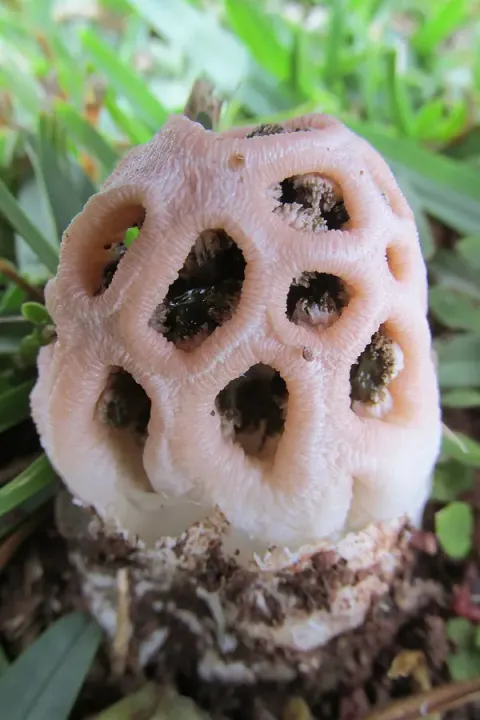
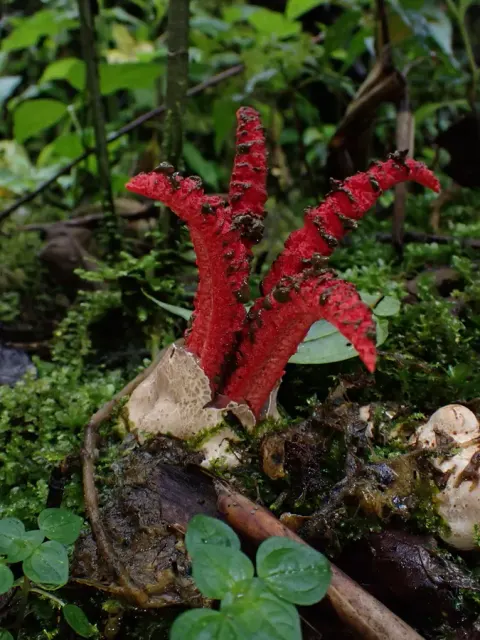
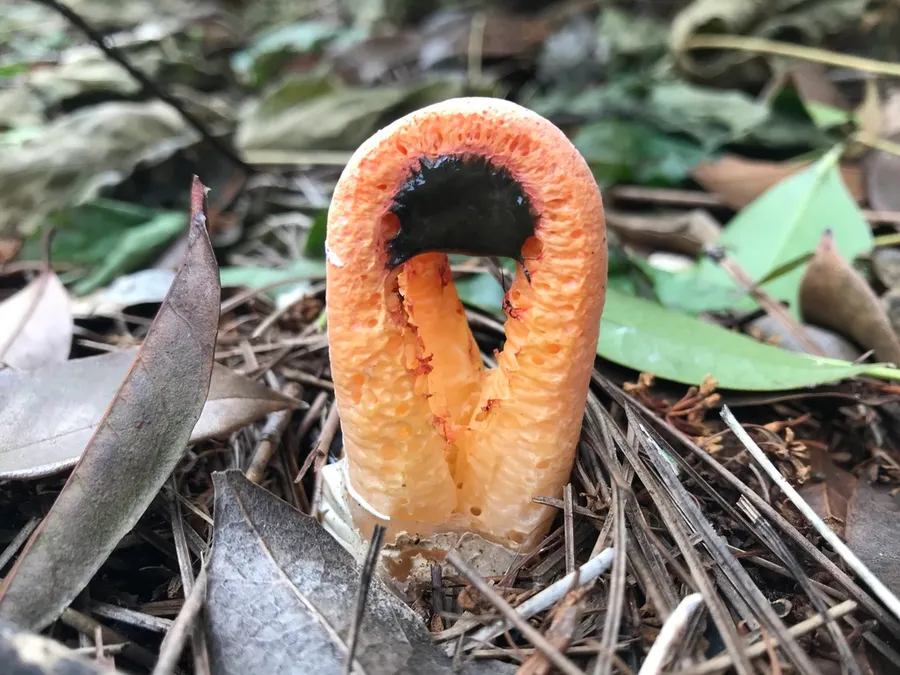
The fruit body, or receptaculum, of Clathrus columnatus consists of two to five (usually four) spongy vertical columns, which are separate where they arise from the volva, but joined at the top in an arch. The columns are joined in pairs; the opposite pairs are joined by a short and broad arch similar in structure to the columns. The columns, which are narrower at the base than above, are reddish-orange above and yellowish-pink below. Young specimens have the fruit body compressed into the small interior space of an "egg", which consists of a peridium that is surrounded by a gelatinous layer that encloses the compressed fruiting body. The egg, usually gray or grayish-brown, typically reaches diameters of 3 to 5 cm before the columns grow. The volva remains at the base of the fruit body as a thick, loose, whitish sack. The mycelial cords found at the base of the volva are made of two types of tissues: a central bundle of fine hyphae that extend in a longitudinal direction, and an outer cortical layer of coarser hyphae that form a loose but highly interwoven structure. Full-grown columns can extend to 5 to 8 cm above the ground, a location that optimizes spore dispersal. The fetid-smelling gleba, the spore-bearing mass, is smeared on the upper inner surface of the columns. The spores are elliptical, smooth, and have dimensions of 3.5–5 by 2–2.5 μm. They have thin walls, and are covered by a transparent envelope.
Habitat dan peran ekologis
Like all Phallaceae species, C. columnatus is saprobic, and uses extracellular digestion to acquire nutrients from dead and decaying organic matter, like wood. As a consequence of its predilection for dead wood, the fungus is often associated with disturbed habitats. It can often be found growing in and around gardens and residences where areas of cultivation or landscaping have resulted in accumulations of mulch, wood chips or other cellulose-rich materials. The mycelial cords can be traced to buried roots, stumps, and other woody material. The species grows in sandy soil, near woody debris, in lawns, gardens, and cultivated soil. Fruit bodies appear singly, or scattered, and can arise in the summer, autumn, and early winter, especially after wet weather. The fungus has been collected in Oceania (including New Zealand and New Guinea), Africa, China, and North and South America. In China, it is found in Jiangsu, Fujian, and Guangdong. The North American distribution extends north to New York and south to Mexico as well as Costa Rica; it is also in Hawaii. The fungus is less common in the southeastern and southern United States. It is thought to have been introduced to North America, as it typically appear in landscaped areas or other locations where exotic plants have been established.
- Habitat atau konteks temuan
- Informasi belum tersedia pada sumber rilis ini.
- Substrat
- Informasi belum tersedia pada sumber rilis ini.
- Peran atau konteks
- Pengurai
Reproduksi
The fruit body, or receptaculum, of Clathrus columnatus consists of two to five (usually four) spongy vertical columns, which are separate where they arise from the volva, but joined at the top in an arch. The columns are joined in pairs; the opposite pairs are joined by a short and broad arch similar in structure to the columns. The columns, which are narrower at the base than above, are reddish-orange above and yellowish-pink below. Young specimens have the fruit body compressed into the small interior space of an "egg", which consists of a peridium that is surrounded by a gelatinous layer that encloses the compressed fruiting body. The egg, usually gray or grayish-brown, typically reaches diameters of 3 to 5 cm before the columns grow.
Catatan identitas dan cakupan
- Nama diterima mengikuti Catalogue of Life Base2026-09-11; uraian mempertahankan konsep dan nama sumber aslinya.
- Original geographic, specimen and life-cycle scope retained; source import awaits individual editorial review.
- Impor dan terjemahan otomatis belum diperiksa editorial per profil. Struktur reproduktif yang disebutkan tidak membuktikan seluruh siklus hidup diketahui.
- Pengukuran pada uraian mengikuti spesimen, kultur, dan metode sumber; angka tidak diperluas ke semua populasi.
Catatan distribusi dalam narasi mengikuti sumbernya. Dokumentasi spesimen atau foto mengikuti catatan sumber. Bukti wilayah Indonesia dan penilaian konservasi tidak disimpulkan dari gambar.
Melihat dengan konteks
Dokumentasi Clathrus columnatus menurut asosiasi foto pada record takson iNaturalist. Kredit: Amber M. King. Identitas mengikuti sumber; bukan penentuan spesimen independen.
- Jenis
- Fotografi
- Kredit
- (c) Amber M. King, some rights reserved (CC BY), uploaded by Amber M. King
- Lisensi
- CC BY 4.0
- Sumber media
- Buka entri sumber
Dokumentasi tambahan
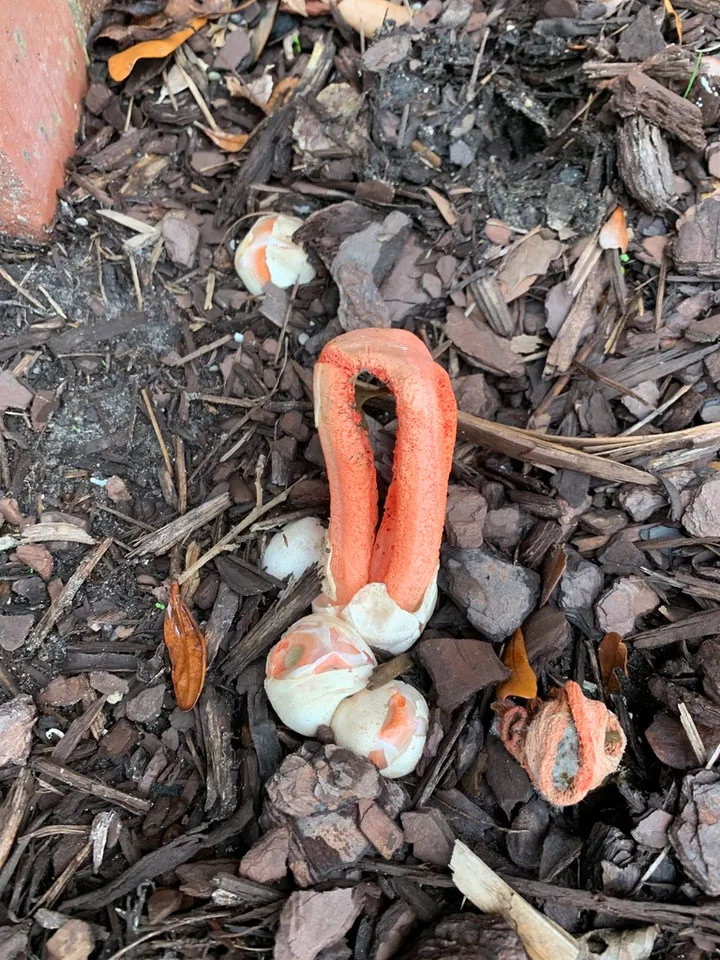
Foto yang diasosiasikan dengan Clathrus columnatus pada iNaturalist. Identifikasi mengikuti sumber; bukan penentuan spesimen independen.
Kredit dan penggunaan
(c) Andrew Ryan Ramírez, some rights reserved (CC BY), uploaded by Andrew Ryan Ramírez
Ukuran dan format gambar disesuaikan tanpa pemotongan, retus, atau penambahan skala. Lisensi sumber dipertahankan.
Sumber profil
- [1] Clathrus columnatus — Wikipedia (en)
- [2] Catalogue of Life Base2026-09-11 — Clathrus columnatus
- [3] Dokumentasi visual — Clathrus columnatus
- [4] Dokumentasi visual — Clathrus columnatus
Rujukan halaman ini
Fungi. Clathrus columnatus. Rilis data fungi-2026-10-12-expansion-2. https://fungi-atlas.mgadib.chatgpt.site/jamur/clathrus-columnatus/.
Status: impor sumber; pemeriksaan editorial per profil belum selesai. Untuk klaim biologis, gunakan rujukan pada bagian terkait dan periksa konteks sumber aslinya.