Ciri dan struktur
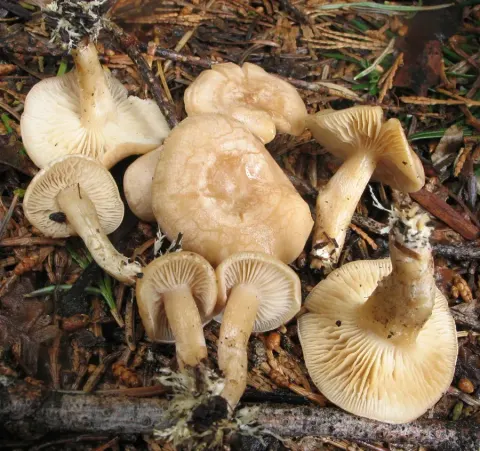
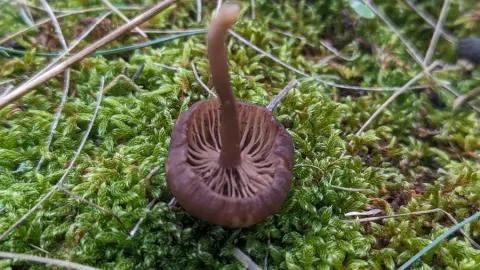
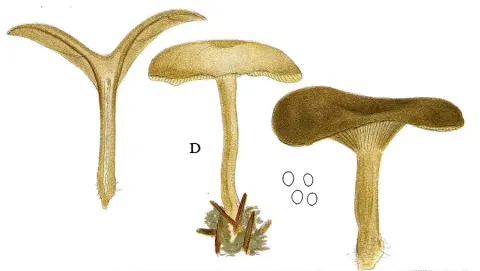
The cap (pileus measures 2–5 cm across and is hygrophanous—that is, it changes shade as it dries—and translucent‑striate up to halfway from the margin to the disc. When moist the cap is various shades of beige, with a slightly paler, bent‑down margin; in dried specimens it becomes a dull, dirty brown. Young caps are slightly convex, flattening to plane and eventually developing a shallow central depression. The stipe is 2–4 cm long and 2–5 mm thick, typically matching the cap in colour or a touch paler. It tapers little or not at all, remains solid for some time before hollowing out, and bears a sparse whitish tomentum and occasional rhizoids at the base. The surface is dry, matt and smooth. The lamellae are obliquely adnate to faintly decurrent, forming an angle of 35–60°. They occur in three tiers, about 30 reach the stipe, and are often triangular, broadest (4–5 mm) near the stipe and narrowing towards the edge. When fresh they are whitish to faintly brownish; in dried specimens they acquire dirty brown tones similar to the cap and stipe. The smell is faintly fruity—often likened to strawberries—and becomes more pronounced as the fruit bodies dry. The taste is mild and fungoid. Microscopically, the spores measure 4.5–5.8 by 2.9–3.3 μm, are broadly ellipsoid to oblong with an obtuse base, and often occur in tetrads; the apiculus is about 0.6–0.7 by 0.3–0.4 μm. The spore print is pinkish‑buff. The cap cuticle (epicutis) is 60–100 μm thick, comprising subparallel to interwoven hyphae 1.5–4.5 μm wide with faint intracellular pigment; the underlying subcutis is not clearly differentiated.
Habitat dan peran ekologis
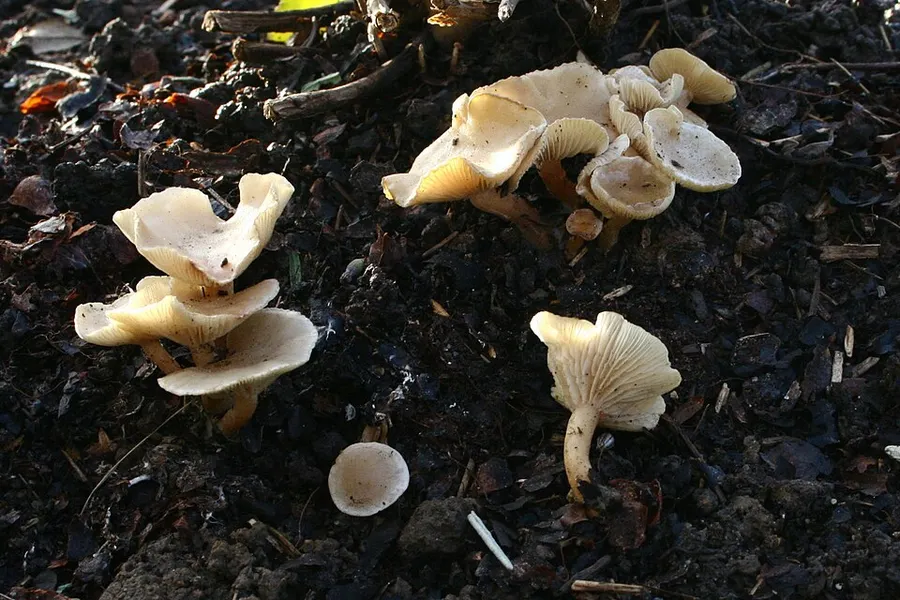
C. agrestis is saprotrophic fruiting gregariously to in small tufts in man‑made open habitats such as stubble fields (oats, rye), pastures and roadsides, always on bare, nutrient‑rich soil. It may occur among grasses, herbs or mosses like Ceratodon purpureus and Brachythecium albicans. Fruiting bodies appear from mid‑August to early November. The species is known from hemiboreal to middle boreal zones of southern Sweden and Finland, up to about 250 m elevation, but is generally regarded as rare.
- Habitat atau konteks temuan
- Informasi belum tersedia pada sumber rilis ini.
- Substrat
- Informasi belum tersedia pada sumber rilis ini.
- Peran atau konteks
- Pengurai
Reproduksi
Microscopically, the spores measure 4.5–5.8 by 2.9–3.3 μm, are broadly ellipsoid to oblong with an obtuse base, and often occur in tetrads; the apiculus is about 0.6–0.7 by 0.3–0.4 μm. The spore print is pinkish‑buff. The cap cuticle (epicutis) is 60–100 μm thick, comprising subparallel to interwoven hyphae 1.5–4.5 μm wide with faint intracellular pigment; the underlying subcutis is not clearly differentiated.
Catatan identitas dan cakupan
- Nama diterima mengikuti Catalogue of Life Base2026-09-11; uraian mempertahankan konsep dan nama sumber aslinya.
- Original geographic, specimen and life-cycle scope retained; source import awaits individual editorial review.
- Impor dan terjemahan otomatis belum diperiksa editorial per profil. Struktur reproduktif yang disebutkan tidak membuktikan seluruh siklus hidup diketahui.
- Pengukuran pada uraian mengikuti spesimen, kultur, dan metode sumber; angka tidak diperluas ke semua populasi.
Catatan distribusi dalam narasi mengikuti sumbernya. Dokumentasi spesimen atau foto mengikuti catatan sumber. Bukti wilayah Indonesia dan penilaian konservasi tidak disimpulkan dari gambar.
Melihat dengan konteks
Dokumentasi Clitocybe agrestis dari Wikimedia Commons. Clitocybe agrestis in a flower bed in Massy, France. Identifikasi mengikuti record berkas sumber.
- Jenis
- Fotografi
- Kredit
- Strobilomyces
- Lisensi
- CC BY-SA 3.0
- Sumber media
- Buka entri sumber
Sumber profil
- [1] Clitocybe agrestis — Wikipedia (en)
- [2] Catalogue of Life Base2026-09-11 — Clitocybe agrestis
- [3] Dokumentasi visual — Clitocybe agrestis
Rujukan halaman ini
Fungi. Clitocybe agrestis. Rilis data fungi-2026-10-12-expansion-2. https://fungi-atlas.mgadib.chatgpt.site/jamur/clitocybe-agrestis/.
Status: impor sumber; pemeriksaan editorial per profil belum selesai. Untuk klaim biologis, gunakan rujukan pada bagian terkait dan periksa konteks sumber aslinya.