01 / Morfologi

Ciri dan struktur

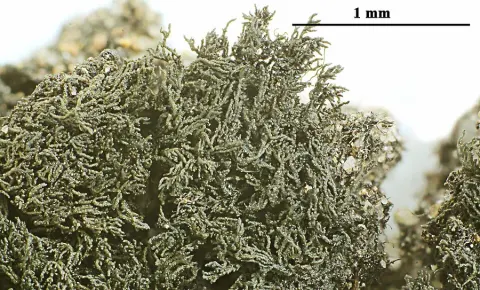
The thallus begins as a roughly circular, leaf-like patch on bark and later expands into irregular colonies up to 5 cm across. Its primary are narrow, flat, and repeatedly branched, usually 0.2–0.4 mm wide, with gaps between them; the tips are often forked and somewhat ascending. A second set of even narrower lobes rises from the first and branches freely, giving the lichen a layered, almost shrubby appearance. When wet, the upper surface is blue-green, but when dry it becomes brownish, greenish, or lead-gray and is usually marked by fine white longitudinal lines. The underside is pale and bears numerous white rhizines that project beyond the margins. Small rounded may sometimes develop within the thallus, and apothecia are uncommon, usually central, orange-brown structures up to 3 mm across that become convex with age. The ascospores are more or less spherical and about 4–5 μm in diameter. No lichen substances were detected by thin-layer chromatography.

Sebagian uraian ditampilkan dalam bahasa sumber; terjemahannya belum tersedia atau belum lolos pemeriksaan.

Rujukan: [1]

Pengukuran mengikuti objek, spesimen atau kultur, dan metode yang disebutkan sumber. Baca uraian asli untuk konteks lengkap.

02 / Kehidupan

Habitat dan peran ekologis

Coccocarpia prostrata is chiefly a species of humid to very wet forests, growing on bark and occasionally on rock, often among mats of mosses and liverworts. It has also been reported growing lichenicolously on Parmotrema. Although most strongly associated with submontane and montane elevations, the ecological analysis in the original species description showed a broader range, from lowland and foothill sites up to upper montane and subparamo habitats. The species is widely distributed in the Neotropics and extends into the southeastern United States. Outside Costa Rica, the describing authors cited specimens from the Dominican Republic, Colombia, Venezuela, French Guiana, Brazil, Bolivia, and Florida. In Colombia it has been reported from the departments of Caldas, Chocó, and Risaralda at 168–1,700 m elevation, chiefly in humid, exposed, and often disturbed habitats around 1,000 m, where it grows on bark including that of Mangifera indica. A Bolivian survey of the order Peltigerales recorded it from the departments of Cochabamba, La Paz, and Santa Cruz at about 1,120–2,800 m, on both bark and rock in Yungas montane forests. It has also been recorded from Santa Cruz Island in the Galápagos and, in the United States, from the Ocala National Forest in Florida, including the Mormon Branch Research Natural Area in Lake County, north of Orlando.

Sebagian uraian ditampilkan dalam bahasa sumber; terjemahannya belum tersedia atau belum lolos pemeriksaan.

Rujukan: [1]

Habitat atau konteks temuan
hutan
Substrat
kulit kayu
Peran atau konteks
Pembentuk liken
Temukan hubungan serupa
03 / Siklus hidup

Reproduksi

The thallus begins as a roughly circular, leaf-like patch on bark and later expands into irregular colonies up to 5 cm across. Its primary are narrow, flat, and repeatedly branched, usually 0.2–0.4 mm wide, with gaps between them; the tips are often forked and somewhat ascending. A second set of even narrower lobes rises from the first and branches freely, giving the lichen a layered, almost shrubby appearance. When wet, the upper surface is blue-green, but when dry it becomes brownish, greenish, or lead-gray and is usually marked by fine white longitudinal lines. The underside is pale and bears numerous white rhizines that project beyond the margins. Small rounded may sometimes develop within the thallus, and apothecia are uncommon, usually central, orange-brown structures up to 3 mm across that become convex with age.

Sebagian uraian ditampilkan dalam bahasa sumber; terjemahannya belum tersedia atau belum lolos pemeriksaan.

Rujukan: [1]

04 / Batas informasi

Catatan identitas dan cakupan

  • Nama diterima mengikuti Catalogue of Life Base2026-09-11; uraian mempertahankan konsep dan nama sumber aslinya.
  • Original geographic, specimen and life-cycle scope retained; source import awaits individual editorial review.
  • Impor dan terjemahan otomatis belum diperiksa editorial per profil. Struktur reproduktif yang disebutkan tidak membuktikan seluruh siklus hidup diketahui.
  • Pengukuran pada uraian mengikuti spesimen, kultur, dan metode sumber; angka tidak diperluas ke semua populasi.

Catatan distribusi dalam narasi mengikuti sumbernya. Dokumentasi spesimen atau foto mengikuti catatan sumber. Bukti wilayah Indonesia dan penilaian konservasi tidak disimpulkan dari gambar.

05 / Dokumentasi

Melihat dengan konteks

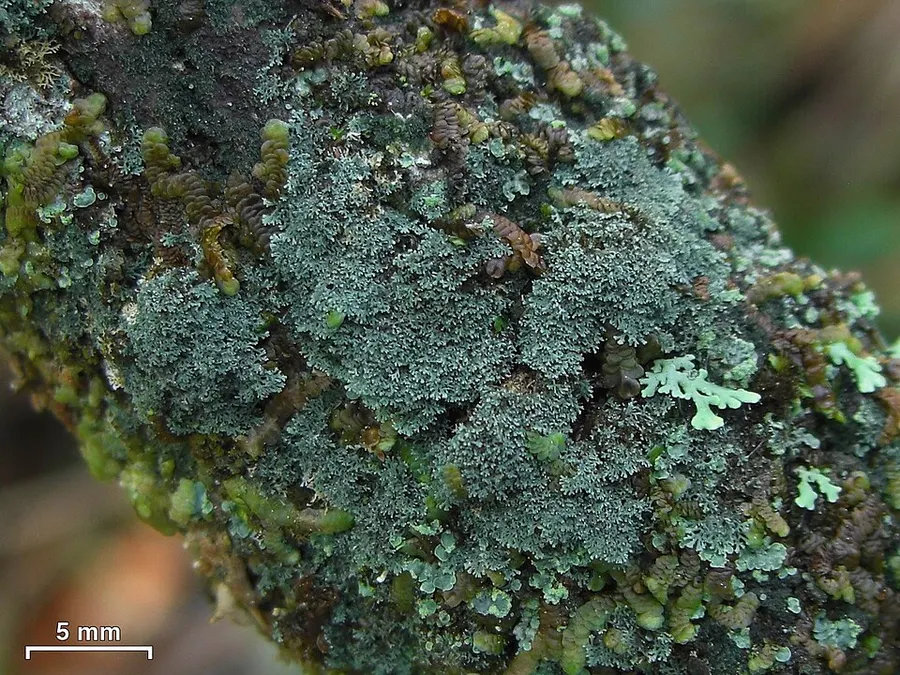
Dokumentasi Coccocarpia prostrata dari Wikimedia Commons. Ocala National Forest, Florida, 20131216 Identifikasi mengikuti record berkas sumber.

Jenis
Fotografi
Kredit
Jason Hollinger
Lisensi
CC BY 2.0
Sumber media
Buka entri sumber

Gambar menunjukkan objek menurut identifikasi sumber, bukan verifikasi independen spesimen oleh Fungi. Tidak ada skala baru yang ditambahkan.

06 / Rujukan

Sumber profil

  1. [1] Coccocarpia prostrata — Wikipedia (en)Bagian sumber: Frozen revision 1347632063
    Tanggal penghimpunan sumber: 2026-10-12
    Teks sumber: CC BY-SA4.0 · Wikipedia contributors
  2. [2] Catalogue of Life Base2026-09-11 — Coccocarpia prostrataBagian sumber: ColDP NameUsage.tsv ID WKLP; accepted species; source 2073
    Tanggal penghimpunan sumber: 2026-10-12
  3. [3] Dokumentasi visual — Coccocarpia prostrataBagian sumber: Individual media record; identification follows the source, not independent determination
    Tanggal penghimpunan sumber: 2026-10-12
    Media sumber: CC BY 2.0 · Jason Hollinger

Adaptasi teks: CC BY-SA 4.0. Wikipedia contributors — Coccocarpia prostrata — Wikipedia (en)

Uraian asli dan riwayat sumber

Riwayat atau halaman sumber

Ringkasan sumber

Coccocarpia prostrata is a species of lichen-forming fungus in the family Coccocarpiaceae. It was described in 2007 from material collected in Costa Rica. The lichen forms small, intricately branched, leaf-like patches on bark in humid forests, chiefly at submontane and montane elevations. It is widely distributed in the Neotropics, from the Caribbean and Central America to Bolivia and Brazil, and also occurs in Florida.

Revisi sumber

Morfologi sumber

The thallus begins as a roughly circular, leaf-like patch on bark and later expands into irregular colonies up to 5 cm across. Its primary are narrow, flat, and repeatedly branched, usually 0.2–0.4 mm wide, with gaps between them; the tips are often forked and somewhat ascending. A second set of even narrower lobes rises from the first and branches freely, giving the lichen a layered, almost shrubby appearance. When wet, the upper surface is blue-green, but when dry it becomes brownish, greenish, or lead-gray and is usually marked by fine white longitudinal lines. The underside is pale and bears numerous white rhizines that project beyond the margins. Small rounded may sometimes develop within the thallus, and apothecia are uncommon, usually central, orange-brown structures up to 3 mm across that become convex with age. The ascospores are more or less spherical and about 4–5 μm in diameter. No lichen substances were detected by thin-layer chromatography.

Revisi sumber

Ekologi sumber

Coccocarpia prostrata is chiefly a species of humid to very wet forests, growing on bark and occasionally on rock, often among mats of mosses and liverworts. It has also been reported growing lichenicolously on Parmotrema. Although most strongly associated with submontane and montane elevations, the ecological analysis in the original species description showed a broader range, from lowland and foothill sites up to upper montane and subparamo habitats. The species is widely distributed in the Neotropics and extends into the southeastern United States. Outside Costa Rica, the describing authors cited specimens from the Dominican Republic, Colombia, Venezuela, French Guiana, Brazil, Bolivia, and Florida. In Colombia it has been reported from the departments of Caldas, Chocó, and Risaralda at 168–1,700 m elevation, chiefly in humid, exposed, and often disturbed habitats around 1,000 m, where it grows on bark including that of Mangifera indica. A Bolivian survey of the order Peltigerales recorded it from the departments of Cochabamba, La Paz, and Santa Cruz at about 1,120–2,800 m, on both bark and rock in Yungas montane forests. It has also been recorded from Santa Cruz Island in the Galápagos and, in the United States, from the Ocala National Forest in Florida, including the Mormon Branch Research Natural Area in Lake County, north of Orlando.

Revisi sumber

Struktur reproduksi sumber

The thallus begins as a roughly circular, leaf-like patch on bark and later expands into irregular colonies up to 5 cm across. Its primary are narrow, flat, and repeatedly branched, usually 0.2–0.4 mm wide, with gaps between them; the tips are often forked and somewhat ascending. A second set of even narrower lobes rises from the first and branches freely, giving the lichen a layered, almost shrubby appearance. When wet, the upper surface is blue-green, but when dry it becomes brownish, greenish, or lead-gray and is usually marked by fine white longitudinal lines. The underside is pale and bears numerous white rhizines that project beyond the margins. Small rounded may sometimes develop within the thallus, and apothecia are uncommon, usually central, orange-brown structures up to 3 mm across that become convex with age.

Revisi sumber

Rujukan halaman ini

Fungi. Coccocarpia prostrata. Rilis data fungi-2026-10-12-expansion-2. https://fungi-atlas.mgadib.chatgpt.site/jamur/coccocarpia-prostrata/.

Status: impor sumber; pemeriksaan editorial per profil belum selesai. Untuk klaim biologis, gunakan rujukan pada bagian terkait dan periksa konteks sumber aslinya.