Ciri dan struktur
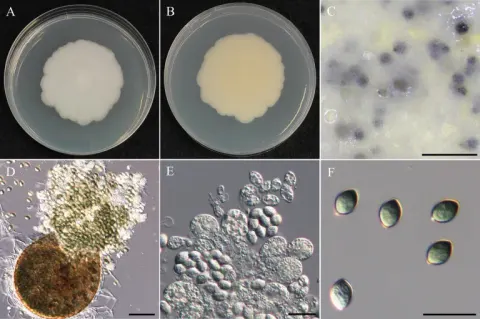
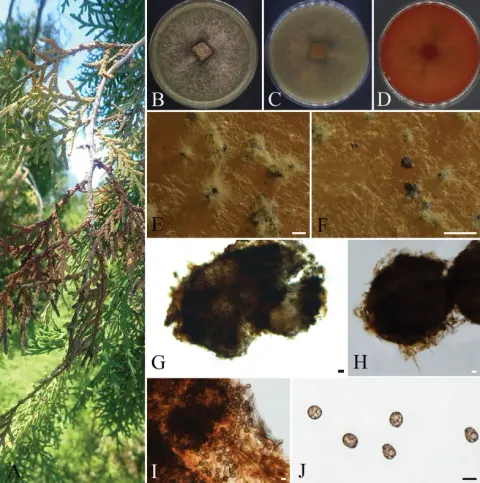
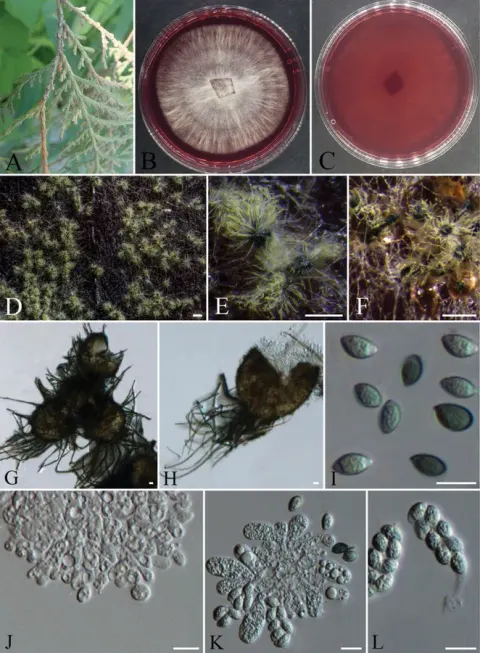
Colonies of C. bostrychodes can grow 2.5 to 3.5 mm daily, usually without developing aerial mycelium. It can sometimes grow with pale green exudates and a green or uncoloured reverse. When young, C. bostrychodes appears as colourless and dextrinoid, but upon maturity, turns pale bluish grey or olivaceous with an apical germ pore . C. bostrychodes often are darkened around the 25 to 35 μm wide ostiolar pore, giving the genus its name of Collariella. Chaetomium convolutum can have a disposition to develop into some forms of C. bostrychodes, developing narrowly ellipsoidal or narrowly ovoidal perithecia restricted just below the darkened periostiolar collar. Similarly, C. bostrychodes appears similar morphologically to Collariella hilkhuijsenii, but C. bostrychodes can be distinguished via their larger ascospores and thicker terminal ascomatal hairs compared to those of C. hilkhuijsenii. The ascomatal walls are brown or ochraceous and composed of angular 5 to 12 μm cells. These tend to fracture underneath the terminal hairs, which then break away as a unit. Brown ascomatal hairs grow mainly from the apical disc, usually appearing as helically coiled in the apical region with little branching. The hairs are either verrucose or warty, which are about 4.5 to 6.5 μm thick with occasionally coiled branches. Lateral seta-like hairs are often also present and have tapered or clavate terminal ends with septate. These hairs break away at maturity with no aerial mycelium. C. bostrychodes develops perithecia late and possesses tightly coiled black terminal setae. The terminal hairs are branched, forming one spiral on another.
Habitat dan peran ekologis
Collariella bostrychodes is considered a lignin, lignocellose, and carbohydrate decomposer but shows a significant preference for lignin, with a high frequency of occurrence in the fermentation layers of the forest. It can be isolated from soil, dung, decaying stems, roots, and seeds, but very rarely in woody materials. It has been isolated and found to be saprobic both in and on dung or excretions of dung of Oryctolagus cuniculu. C. bostrychodes is not limited to forest ecosystems. While not a marine fungi, it has been isolated in the ocean and sediments in the marine muds, which suggests that the fungus can be wind-carried. C. bostrychodes has been rarely isolated from food products, but it has been isolated in contaminated oat grains, okra, pea seeds and pepper. When C. bostrychodes is found in food products, it is typically a result of simple contamination.
- Habitat atau konteks temuan
- hutan
- Substrat
- kotoran hewan
- Peran atau konteks
- Pengurai
Reproduksi
Colonies of C. bostrychodes can grow 2.5 to 3.5 mm daily, usually without developing aerial mycelium. It can sometimes grow with pale green exudates and a green or uncoloured reverse. When young, C. bostrychodes appears as colourless and dextrinoid, but upon maturity, turns pale bluish grey or olivaceous with an apical germ pore . C. bostrychodes often are darkened around the 25 to 35 μm wide ostiolar pore, giving the genus its name of Collariella. Chaetomium convolutum can have a disposition to develop into some forms of C. bostrychodes, developing narrowly ellipsoidal or narrowly ovoidal perithecia restricted just below the darkened periostiolar collar. Similarly, C. bostrychodes appears similar morphologically to Collariella hilkhuijsenii, but C. bostrychodes can be distinguished via their larger ascospores and thicker terminal ascomatal hairs compared to those of C. hilkhuijsenii.
Catatan identitas dan cakupan
- Nama diterima mengikuti Catalogue of Life Base2026-09-11; uraian mempertahankan konsep dan nama sumber aslinya.
- Original geographic, specimen and life-cycle scope retained; source import awaits individual editorial review.
- Impor dan terjemahan otomatis belum diperiksa editorial per profil. Struktur reproduktif yang disebutkan tidak membuktikan seluruh siklus hidup diketahui.
- Pengukuran pada uraian mengikuti spesimen, kultur, dan metode sumber; angka tidak diperluas ke semua populasi.
Catatan distribusi dalam narasi mengikuti sumbernya. Dokumentasi spesimen atau foto mengikuti catatan sumber. Bukti wilayah Indonesia dan penilaian konservasi tidak disimpulkan dari gambar.
Melihat dengan konteks
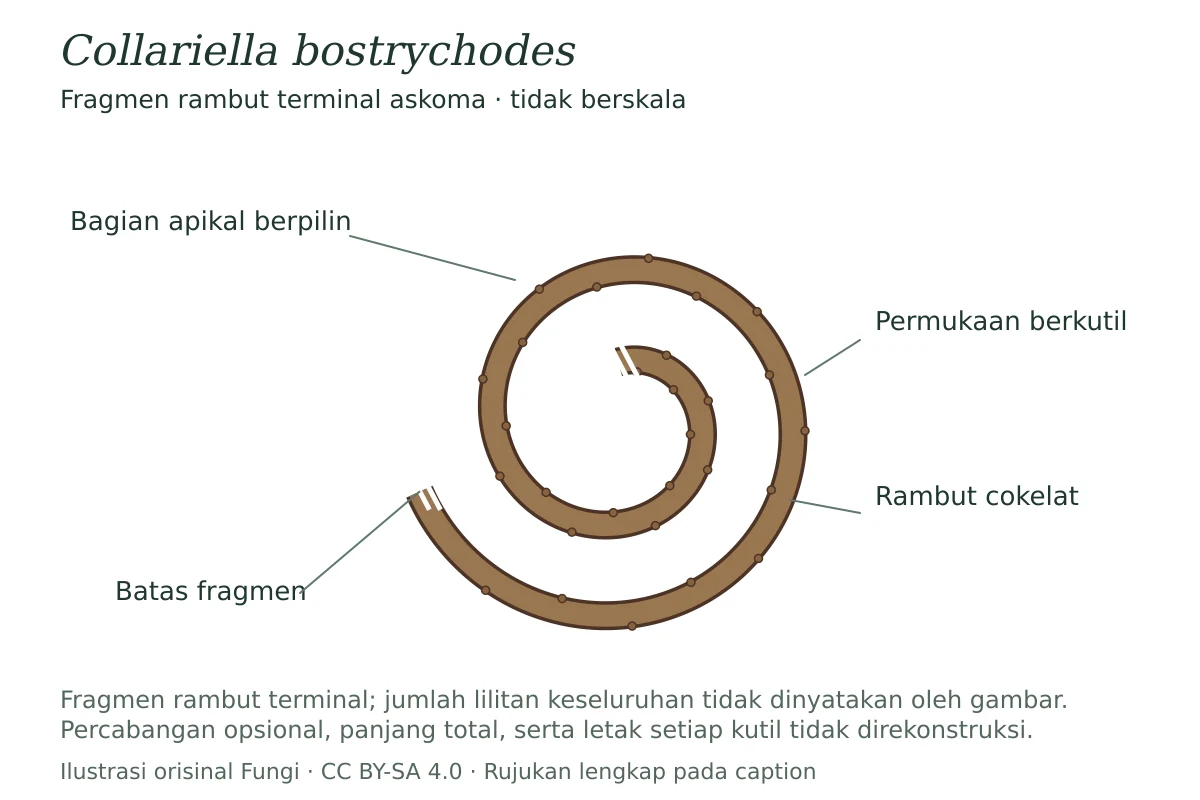
Skema fragmen rambut terminal askoma Collariella bostrychodes: berwarna cokelat, berpilin pada bagian apikal, dan berpermukaan berkutil. Tidak berskala; fragmen tidak menunjukkan jumlah lilitan keseluruhan, letak setiap kutil, atau percabangan yang kadang dilaporkan. Bukan gambar seluruh askoma atau alat identifikasi.
- Jenis
- Ilustrasi skematis
- Kredit
- Ilustrasi orisinal Fungi berdasarkan uraian: Wikipedia contributors — Collariella bostrychodes — Wikipedia (en). Sumber: CC BY-SA4.0. Perubahan: skema anatomi konseptual, label dan caption Indonesia; bukan penyalinan gambar sumber.
- Lisensi
- CC BY-SA 4.0
- Sumber media
- Buka entri sumber
Sumber profil
- [1] Collariella bostrychodes — Wikipedia (en)
- [2] Catalogue of Life Base2026-09-11 — Collariella bostrychodes
Rujukan halaman ini
Fungi. Collariella bostrychodes. Rilis data fungi-2026-10-12-expansion-2. https://fungi-atlas.mgadib.chatgpt.site/jamur/collariella-bostrychodes/.
Status: impor sumber; pemeriksaan editorial per profil belum selesai. Untuk klaim biologis, gunakan rujukan pada bagian terkait dan periksa konteks sumber aslinya.