01 / Morfologi

Ciri dan struktur

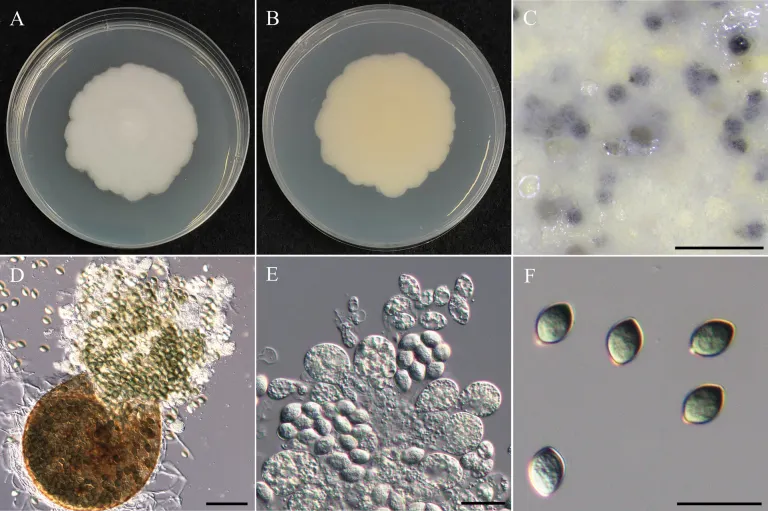
Sexual morph Cleistothecia 105–145 µm diam, non-ostiolate, globose, glabrous, black when mature, solitary to aggregated, mostly superficial, some submerged in PDA, aerial mycelium covered. Peridium brown, semi-translucent, membranous, textura epidermoidea. Asci subglobose to pyriform, hyaline when immature, eight-spored, 23.7–27.0 µm × 20.5–23.5 µm (x̄ = 25.5 × 22.5 µm, L/W ratio = 1.13, n = 10). Ascospores 1 celled, olivaceous brown when mature, subglobose to ellipsoidal, some smooth, apical germ pore, 9.3–11.7 µm × 6.7–9.0 µm (x̄ = 10.5 × 7.6 µm, L/W ratio = 1.39, n = 20). Asexual morph undetermined. Colony reaching 50 mm diam with thick white aerial mycelium, fluffy, edge irregularly, wavy margin, and similar to reverse side of the colony.

Sebagian uraian ditampilkan dalam bahasa sumber; terjemahannya belum tersedia atau belum lolos pemeriksaan.

Rujukan: [1]

Pengukuran mengikuti objek, spesimen atau kultur, dan metode yang disebutkan sumber. Baca uraian asli untuk konteks lengkap.

02 / Kehidupan

Habitat dan peran ekologis

The fungus is a cosmopolitan species and is mainly found in soil, fecal matter, plant seeds, and roots of decaying plant. The distribution of the species is noted to concentrate along tropical regions, with documented appearances in multiple parts of Africa (such as Sudan, Sierra Leone, and Nigeria), Kuwait, Pakistan, India, Nepal, New Guinea, Japan and others. Distribution in regions distant from the tropics are also present, countries such as the Netherlands, Britain, and the United States also have been reported to show the presence of this species. In terms of habitat, the fungus has been reported to grow on a variety of soils. To list a few, the species have been found in forest soils, grassland, grass plots with Dichanthium annulatum, rice fields, and saline soil. In addition, the species has been isolated from other miscellaneous material of plant and animal origin. The species has been found on materials such as decaying strawberry plant, decaying Cordia dichotoma fruit, barley, seeds of wheat and groundnuts, cotton, kernels of Arachis hypogaea, and the dung of various animals (monkey, sheep, cow, elephant).

Sebagian uraian ditampilkan dalam bahasa sumber; terjemahannya belum tersedia atau belum lolos pemeriksaan.

Rujukan: [2]

Habitat atau konteks temuan
hutan; padang rumput
Substrat
tanah
Peran atau konteks
Belum dikategorikan pada rilis ini.
Temukan hubungan serupa
03 / Siklus hidup

Reproduksi

Sexual morph Cleistothecia 105–145 µm diam, non-ostiolate, globose, glabrous, black when mature, solitary to aggregated, mostly superficial, some submerged in PDA, aerial mycelium covered. Peridium brown, semi-translucent, membranous, textura epidermoidea. Asci subglobose to pyriform, hyaline when immature, eight-spored, 23.7–27.0 µm × 20.5–23.5 µm (x̄ = 25.5 × 22.5 µm, L/W ratio = 1.13, n = 10). Ascospores 1 celled, olivaceous brown when mature, subglobose to ellipsoidal, some smooth, apical germ pore, 9.3–11.7 µm × 6.7–9.0 µm (x̄ = 10.5 × 7.6 µm, L/W ratio = 1.39, n = 20). Asexual morph undetermined.

Sebagian uraian ditampilkan dalam bahasa sumber; terjemahannya belum tersedia atau belum lolos pemeriksaan.

Rujukan: [1]

Sinonim menurut acuan taksonomi rilis: Coniothyrium terricola; Thielavia minor; Thielavia terricola; Thielavia terricola f. minor; Thielavia terricola var. minor
04 / Batas informasi

Catatan identitas dan cakupan

  • Nama diterima mengikuti Catalogue of Life Base2026-09-11; uraian mempertahankan konsep dan nama sumber aslinya.
  • Uraian digabungkan dari sumber spesies yang sama; lingkup geografis, bahan, dan kultur setiap sumber dipertahankan. Preserve original treatment localities, hosts and substrate scope. Materials examined describe documented specimens, not the full global range. Original geographic, specimen and life-cycle scope retained; source import awaits individual editorial review.
  • Impor dan terjemahan otomatis belum diperiksa editorial per profil. Struktur reproduktif yang disebutkan tidak membuktikan seluruh siklus hidup diketahui.
  • Pengukuran pada uraian mengikuti spesimen, kultur, dan metode sumber; angka tidak diperluas ke semua populasi.

Catatan distribusi dalam narasi mengikuti sumbernya. Dokumentasi spesimen atau foto mengikuti catatan sumber. Bukti wilayah Indonesia dan penilaian konservasi tidak disimpulkan dari gambar.

05 / Dokumentasi

Melihat dengan konteks

Morphology of Pseudothielavia terricola NTUPPMCC 22-294. A, B 14-days-old colony on PDA; C Ascomata; D Squashed ascomata; E Immature ascus; F Ascospores. Scale bars: 1 mm (C); 50 µm (D); 20 µm (E, F).

Jenis
Pelat ilmiah
Kredit
Kai-Wen Cheng, Jiue-in Yang, Piroonporn Srimongkol, Marc Stadler, Aphichart Karnchanatat, Hiran A. Ariyawansa
Lisensi
CC BY 4.0
Sumber media
Buka entri sumber

Gambar menunjukkan objek menurut identifikasi sumber, bukan verifikasi independen spesimen oleh Fungi. Tidak ada skala baru yang ditambahkan.

06 / Rujukan

Sumber profil

  1. [1] Fungal frontiers in toxic terrain: Revealing culturable fungal communities in Serpentine paddy fields of Taiwan — Pseudothielavia terricolaBagian sumber: PMC12355036_section_151
    Tanggal penghimpunan sumber: 2026-10-12
    Teks sumber: CC BY 4.0 · Cheng KW, Yang JI, Srimongkol P, Stadler M, Karnchanatat A, Ariyawansa HA.
  2. [2] Pseudothielavia terricola — Wikipedia (en)Bagian sumber: Frozen revision 1331319666
    Tanggal penghimpunan sumber: 2026-10-12
    Teks sumber: CC BY-SA4.0 · Wikipedia contributors
  3. [3] Catalogue of Life Base2026-09-11 — Pseudothielavia terricolaBagian sumber: ColDP NameUsage.tsv ID 4PDC3; accepted species; source 2073
    Tanggal penghimpunan sumber: 2026-10-12
  4. [4] Dokumentasi visual — Pseudothielavia terricolaBagian sumber: Individual media record; identification follows the source, not independent determination
    Tanggal penghimpunan sumber: 2026-10-12
    Media sumber: CC BY 4.0 · Kai-Wen Cheng, Jiue-in Yang, Piroonporn Srimongkol, Marc Stadler, Aphichart Karnchanatat, Hiran A. Ariyawansa

Adaptasi teks: CC BY-SA 4.0. Cheng KW, Yang JI, Srimongkol P, Stadler M, Karnchanatat A, Ariyawansa HA. — Fungal frontiers in toxic terrain: Revealing culturable fungal communities in Serpentine paddy fields of Taiwan — Pseudothielavia terricola; Wikipedia contributors — Pseudothielavia terricola — Wikipedia (en)

Uraian asli dan riwayat sumber

Riwayat atau halaman sumber

Ringkasan sumber

Sexual morph Cleistothecia 105–145 µm diam, non-ostiolate, globose, glabrous, black when mature, solitary to aggregated, mostly superficial, some submerged in PDA, aerial mycelium covered. Peridium brown, semi-translucent, membranous, textura epidermoidea. Asci subglobose to pyriform, hyaline when immature, eight-spored, 23.7–27.0 µm × 20.5–23.5 µm (x̄ = 25.5 × 22.5 µm, L/W ratio = 1.13, n = 10). Ascospores 1 celled, olivaceous brown when mature, subglobose to ellipsoidal, some smooth, apical germ pore, 9.3–11.7 µm × 6.7–9.0 µm (x̄ = 10.5 × 7.6 µm, L/W ratio = 1.39, n = 20).

Revisi sumber

Morfologi sumber

Sexual morph Cleistothecia 105–145 µm diam, non-ostiolate, globose, glabrous, black when mature, solitary to aggregated, mostly superficial, some submerged in PDA, aerial mycelium covered. Peridium brown, semi-translucent, membranous, textura epidermoidea. Asci subglobose to pyriform, hyaline when immature, eight-spored, 23.7–27.0 µm × 20.5–23.5 µm (x̄ = 25.5 × 22.5 µm, L/W ratio = 1.13, n = 10). Ascospores 1 celled, olivaceous brown when mature, subglobose to ellipsoidal, some smooth, apical germ pore, 9.3–11.7 µm × 6.7–9.0 µm (x̄ = 10.5 × 7.6 µm, L/W ratio = 1.39, n = 20). Asexual morph undetermined. Colony reaching 50 mm diam with thick white aerial mycelium, fluffy, edge irregularly, wavy margin, and similar to reverse side of the colony.

Revisi sumber

Ekologi sumber

The fungus is a cosmopolitan species and is mainly found in soil, fecal matter, plant seeds, and roots of decaying plant. The distribution of the species is noted to concentrate along tropical regions, with documented appearances in multiple parts of Africa (such as Sudan, Sierra Leone, and Nigeria), Kuwait, Pakistan, India, Nepal, New Guinea, Japan and others. Distribution in regions distant from the tropics are also present, countries such as the Netherlands, Britain, and the United States also have been reported to show the presence of this species. In terms of habitat, the fungus has been reported to grow on a variety of soils. To list a few, the species have been found in forest soils, grassland, grass plots with Dichanthium annulatum, rice fields, and saline soil. In addition, the species has been isolated from other miscellaneous material of plant and animal origin. The species has been found on materials such as decaying strawberry plant, decaying Cordia dichotoma fruit, barley, seeds of wheat and groundnuts, cotton, kernels of Arachis hypogaea, and the dung of various animals (monkey, sheep, cow, elephant).

Revisi sumber

Struktur reproduksi sumber

Sexual morph Cleistothecia 105–145 µm diam, non-ostiolate, globose, glabrous, black when mature, solitary to aggregated, mostly superficial, some submerged in PDA, aerial mycelium covered. Peridium brown, semi-translucent, membranous, textura epidermoidea. Asci subglobose to pyriform, hyaline when immature, eight-spored, 23.7–27.0 µm × 20.5–23.5 µm (x̄ = 25.5 × 22.5 µm, L/W ratio = 1.13, n = 10). Ascospores 1 celled, olivaceous brown when mature, subglobose to ellipsoidal, some smooth, apical germ pore, 9.3–11.7 µm × 6.7–9.0 µm (x̄ = 10.5 × 7.6 µm, L/W ratio = 1.39, n = 20). Asexual morph undetermined.

Revisi sumber

Rujukan halaman ini

Fungi. Pseudothielavia terricola. Rilis data fungi-2026-10-12-expansion-2. https://fungi-atlas.mgadib.chatgpt.site/jamur/pseudothielavia-terricola/.

Status: impor sumber; pemeriksaan editorial per profil belum selesai. Untuk klaim biologis, gunakan rujukan pada bagian terkait dan periksa konteks sumber aslinya.