01 / Morfologi

Ciri dan struktur

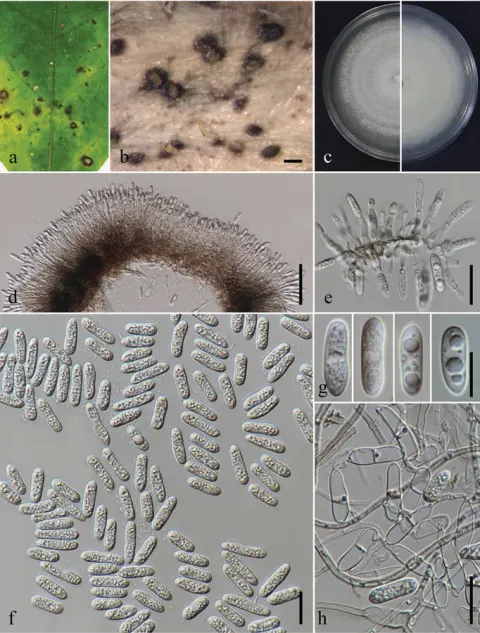
Untuk mengidentifikasi Colletotrichum higginsianum, Anda harus terlebih dahulu mulai mencari bintik-bintik kecil yang gelap atau luka yang terendam air pada daun, batang, atau buah. Reasoning one akan mencari identifikasi ini karena Colletotrichum higginsianum menghasilkan spora di acervuli, yang merupakan struktur berbuah jamur yang menembus permukaan jaringan inang. While the struktur berbuah jamur ini tumbuh di inangnya, menyebabkan kerusakan parah pada jaringan dan sel inang. To make yang lebih menarik, Colletotrichum higginsianum juga melalui beberapa tahap ketika menginfeksi inangnya. Pada tahap awal, jamur menyusui permukaan inang dengan appressoria. As time progresses, the hyphae inside the host cells will become bulbous biotrophic, which they can then proceed and transition into their final stage. During this tahap akhir, jamur muncul sepenuhnya, menyerap semua nutrisi dari tanaman, pada dasarnya membunuh dan menghancurkan jaringan inang. Ini akan mendefinisikan tahap akhirnya sebagai nectrotrophy (proses parasit di mana organisme membunuh sel-sel hidup dari inangnya dan kemudian makan materi mati).

Sebagian uraian ditampilkan dalam bahasa sumber; terjemahannya belum tersedia atau belum lolos pemeriksaan.

Rujukan: [1]

Pengukuran mengikuti objek, spesimen atau kultur, dan metode yang disebutkan sumber. Baca uraian asli untuk konteks lengkap.

02 / Kehidupan

Habitat dan peran ekologis

Colletotrichum higginsianum adalah jamur hemobiotrophic. Ini berarti bahwa agar jamur ini memperoleh energi, ia "pertama-tama membangun interaksi biotropik dengan menghindari mekanisme pertahanan tanaman dan kemudian beralih ke fase necrotropik, di mana ia membunuh sel inang dan makan dari mereka. Through research dan penelitian, kami sekarang telah mengamati bahwa peran terpenoid dalam memanipulasi respon pertahanan inang ditemukan melalui pendekatan genetik kimia maju, menggunakan Arabidopsis thaliana dan C. higginsianum sebagai pasangan plantepathogen. " Since this spesies adalah jamur patogen, dapat ditemukan menginfeksi spesies Brassicaceae family, termasuk Arabidopsis thaliana, Brassica, dan Raphanus. "Brassicaceae contains beberapa 338 genus dan lebih dari 3,700 spesies tanaman berbunga yang didistribusikan di seluruh dunia". Selain itu, Colletotrichum higginsianum dapat ditemukan di berbagai tempat di seluruh dunia karena mereka menularkan tanaman umum yang ditemukan di seluruh dunia. Data has menunjukkan kepada kita bahwa jamur memang lebih suka tumbuh di lingkungan yang tropis atau subtropis. Some examples dari negara-negara akan menjadi Tunisia, China, dan Hubei. Selain itu, jamur ini ditemukan di berbagai negara di Eropa.

Rujukan: [1]

Habitat atau konteks temuan
Informasi belum tersedia pada sumber rilis ini.
Substrat
Informasi belum tersedia pada sumber rilis ini.
Peran atau konteks
Belum dikategorikan pada rilis ini.
Temukan hubungan serupa
03 / Siklus hidup

Reproduksi

Untuk mengidentifikasi Colletotrichum higginsianum, Anda harus terlebih dahulu mulai mencari bintik-bintik kecil yang gelap atau luka yang terendam air pada daun, batang, atau buah. Reasoning one akan mencari identifikasi ini karena Colletotrichum higginsianum menghasilkan spora di acervuli, yang merupakan struktur berbuah jamur yang menembus permukaan jaringan inang. While the struktur berbuah jamur ini tumbuh di inangnya, menyebabkan kerusakan parah pada jaringan dan sel inang. To make yang lebih menarik, Colletotrichum higginsianum juga melalui beberapa tahap ketika menginfeksi inangnya. Pada tahap awal, jamur menyusui permukaan inang dengan appressoria.

Rujukan: [1]

04 / Batas informasi

Catatan identitas dan cakupan

  • Nama diterima mengikuti Catalogue of Life Base2026-09-11; uraian mempertahankan konsep dan nama sumber aslinya.
  • Original geographic, specimen and life-cycle scope retained; source import awaits individual editorial review.
  • Impor dan terjemahan otomatis belum diperiksa editorial per profil. Struktur reproduktif yang disebutkan tidak membuktikan seluruh siklus hidup diketahui.
  • Pengukuran pada uraian mengikuti spesimen, kultur, dan metode sumber; angka tidak diperluas ke semua populasi.

Catatan distribusi dalam narasi mengikuti sumbernya. Dokumentasi spesimen atau foto mengikuti catatan sumber. Bukti wilayah Indonesia dan penilaian konservasi tidak disimpulkan dari gambar.

05 / Dokumentasi

Melihat dengan konteks

Dokumentasi visual yang memenuhi pemeriksaan subjek dan hak penggunaan belum tersedia. Foto gejala, label, dan gambar yang meragukan tidak dihitung.

06 / Rujukan

Sumber profil

  1. [1] Colletotrichum higginsianum — Wikipedia (en)Bagian sumber: Frozen revision 1364370163
    Tanggal penghimpunan sumber: 2026-10-12
    Teks sumber: CC BY-SA4.0 · Wikipedia contributors
  2. [2] Catalogue of Life Base2026-09-11 — Colletotrichum higginsianumBagian sumber: ColDP NameUsage.tsv ID X3XK; accepted species; source 2073
    Tanggal penghimpunan sumber: 2026-10-12

Adaptasi teks: CC BY-SA 4.0. Wikipedia contributors — Colletotrichum higginsianum — Wikipedia (en)

Uraian asli dan riwayat sumber

Riwayat atau halaman sumber

Ringkasan sumber

In order to identify Colletotrichum higginsianum, you would first start off searching for small, dark spots or water-soaked lesions on leaves, stems, or fruits. Reasoning one would look for these identifications is because Colletotrichum higginsianum produces spores in acervuli, which are fungal fruiting structures that break through the surface of the host tissue. While the fruiting structure of this fungus is growing on its host, it causes severe damage to the hosts tissue and cells. To make it even more interesting, Colletotrichum higginsianum additionally goes through multiple stages when infecting its host.

Revisi sumber

Morfologi sumber

In order to identify Colletotrichum higginsianum, you would first start off searching for small, dark spots or water-soaked lesions on leaves, stems, or fruits. Reasoning one would look for these identifications is because Colletotrichum higginsianum produces spores in acervuli, which are fungal fruiting structures that break through the surface of the host tissue. While the fruiting structure of this fungus is growing on its host, it causes severe damage to the hosts tissue and cells. To make it even more interesting, Colletotrichum higginsianum additionally goes through multiple stages when infecting its host. In the initial stage, the fungus punctures through the host surface with appressoria. As time progresses, the hyphae inside the host cells will become bulbous biotrophic, which they can then proceed and transition into their final stage. During this final stage, the fungusi fully emerges, absorbing all the nutrients of the plant, essentially killing and destroying the host tissue. This would define its final stage as nectrotrophy (a parasitic process where an organism kills the living cells of its host and then feeds on the dead matter).

Revisi sumber

Ekologi sumber

Colletotrichum higginsianum is a hemibiotrophic fungus. This means that in order for this fungus to obtain energy, it "first establishes a biotrophic interaction by evading the plant's defense mechanisms and later switches to a necrotrophic phase, in which it kills the host cells and feeds on them. Through research and studies, we have now observed that the role of a terpenoid in manipulating the host defense response was discovered through a forward chemical genetics approach, using Arabidopsis thaliana and C. higginsianum as the plantepathogen pair." Since this species is a pathogenic fungus, it can be found infecting species of the Brassicaceae family, including Arabidopsis thaliana, Brassica, and Raphanus. "Brassicaceae contains some 338 genera and more than 3,700 species of flowering plants distributed throughout the world". Additionally, Colletotrichum higginsianum can be found on multiple parts around the world since they infect common crops found globally. Data has shown us that the fungus does prefer to grow in environments that are tropical or subtropical. Some examples of countries would be Tunisia, China, and Hubei. Additionally, this fungusi is found in various countries in Europe.

Revisi sumber

Struktur reproduksi sumber

In order to identify Colletotrichum higginsianum, you would first start off searching for small, dark spots or water-soaked lesions on leaves, stems, or fruits. Reasoning one would look for these identifications is because Colletotrichum higginsianum produces spores in acervuli, which are fungal fruiting structures that break through the surface of the host tissue. While the fruiting structure of this fungus is growing on its host, it causes severe damage to the hosts tissue and cells. To make it even more interesting, Colletotrichum higginsianum additionally goes through multiple stages when infecting its host. In the initial stage, the fungus punctures through the host surface with appressoria.

Revisi sumber

Rujukan halaman ini

Fungi. Colletotrichum higginsianum. Rilis data fungi-2026-10-12-expansion-2. https://fungi-atlas.mgadib.chatgpt.site/jamur/colletotrichum-higginsianum/.

Status: impor sumber; pemeriksaan editorial per profil belum selesai. Untuk klaim biologis, gunakan rujukan pada bagian terkait dan periksa konteks sumber aslinya.