Ciri dan struktur
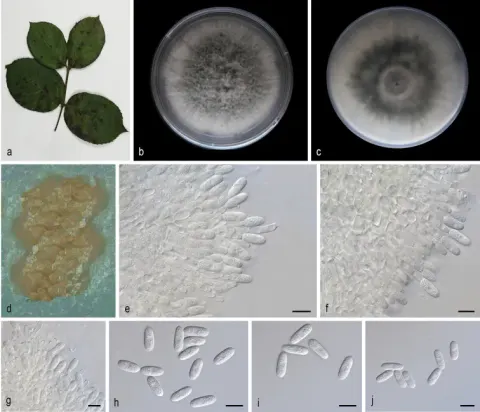
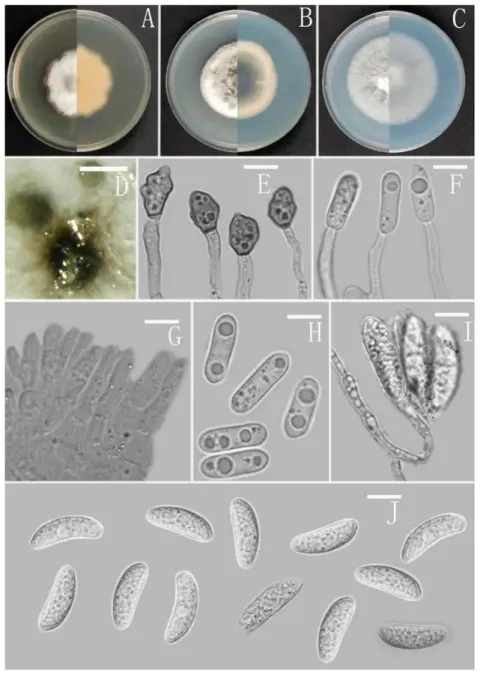
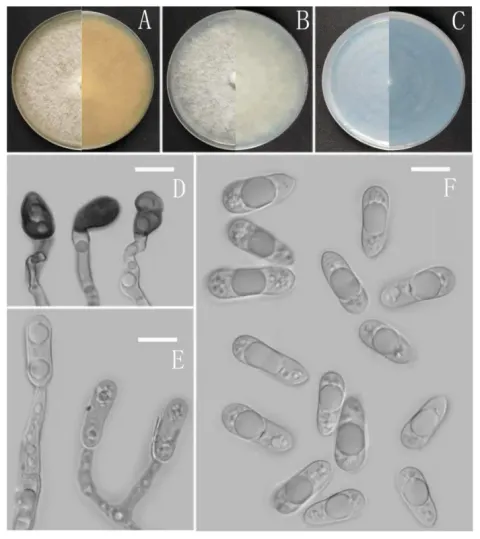
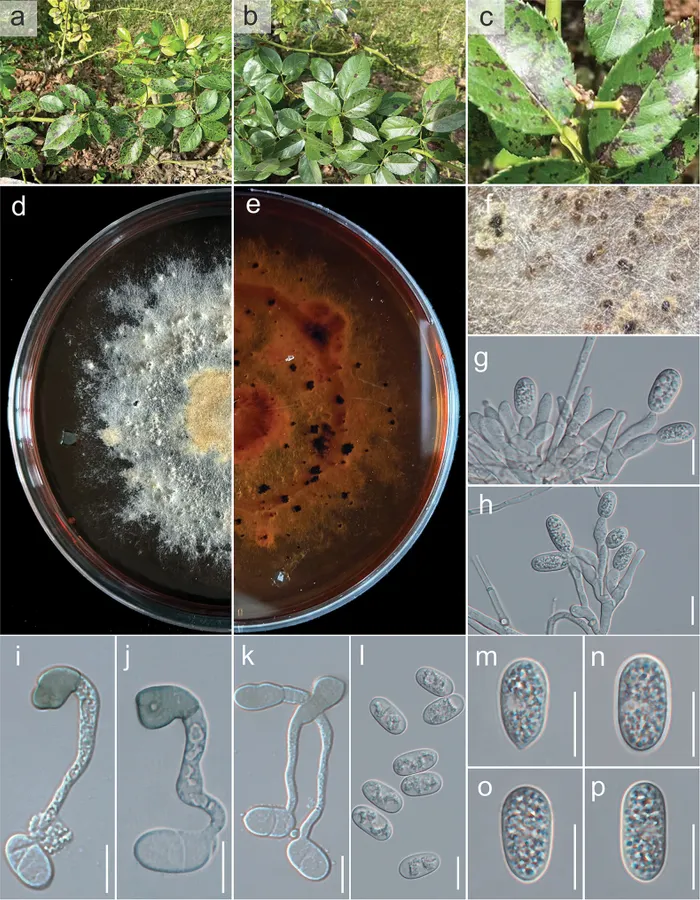
Isolated from a leaf spot of Rosa chinensis Jacq. Sexual morph: undetermined. Asexual morph: Conidiomata pycnidial, globose, dark brown, superficial on PDA, releasing conidia in a yellow mass, slimy, globose. Conidiophores produce conidiogenous cells, either directly formed from hyphae or from a cushion of spherical hyaline cells, septate, and branched. Conidiogenous cells hyaline, cylindrical to clavate, straight to flask-shaped, (17.4–)18–50(–53.2) × (3.2–)4–5(–5.8) μm (mean ± SD = 33 ± 0.9 × 4 ± 0.2 μm). Setae not observed. Conidia (12.6–)13–14.8(–15) × (6.2–)6.3–7.9(–8.4) μm (mean ± SD = 14 ± 0.8 × 7 ± 0.2 μm), n = 30, L/W ratio = 2.1, hyaline, aseptate, smooth-walled, ellipsoidal to cylindrical, one end rounded and one end acute or both ends rounded, sometimes the base slightly pointed with a prominent scar, guttulate, granular. Appressoria single in short chains, pale brown, thick-walled, entire edge, rarely lobate, smooth-walled. Colonies on PDA reach 5 cm in diameter after 7 days at room temperature (±25 °C), exposed to 12 hours of light and 12 hours of darkness. The colonies are rhizoid to filamentous, dense, with a filamentous margin. After 14 days, the colony appears white to pale-yellow from above, producing grouped dark brown pycnidia and a white to yellow reverse (Fig. 5a, b).
Habitat dan peran ekologis
Isolated from a leaf spot of Rosa chinensis Jacq. Sexual morph: undetermined. Asexual morph: Conidiomata pycnidial, globose, dark brown, superficial on PDA, releasing conidia in a yellow mass, slimy, globose. Conidiophores produce conidiogenous cells, either directly formed from hyphae or from a cushion of spherical hyaline cells, septate, and branched. Conidiogenous cells hyaline, cylindrical to clavate, straight to flask-shaped, (17.4–)18–50(–53.2) × (3.2–)4–5(–5.8) μm (mean ± SD = 33 ± 0.9 × 4 ± 0.2 μm). Setae not observed. Conidia (12.6–)13–14.8(–15) × (6.2–)6.3–7.9(–8.4) μm (mean ± SD = 14 ± 0.8 × 7 ± 0.2 μm), n = 30, L/W ratio = 2.1, hyaline, aseptate, smooth-walled, ellipsoidal to cylindrical, one end rounded and one end acute or both ends rounded, sometimes the base slightly pointed with a prominent scar, guttulate, granular. Appressoria single in short chains, pale brown, thick-walled, entire edge, rarely lobate, smooth-walled. Colonies on PDA reach 5 cm in diameter after 7 days at room temperature (±25 °C), exposed to 12 hours of light and 12 hours of darkness. The colonies are rhizoid to filamentous, dense, with a filamentous margin. After 14 days, the colony appears white to pale-yellow from above, producing grouped dark brown pycnidia and a white to yellow reverse (Fig. 5a, b).
- Habitat atau konteks temuan
- kultur yang didokumentasikan
- Substrat
- Informasi belum tersedia pada sumber rilis ini.
- Peran atau konteks
- Belum dikategorikan pada rilis ini.
Reproduksi
Isolated from a leaf spot of Rosa chinensis Jacq. Sexual morph: undetermined. Asexual morph: Conidiomata pycnidial, globose, dark brown, superficial on PDA, releasing conidia in a yellow mass, slimy, globose. Conidiophores produce conidiogenous cells, either directly formed from hyphae or from a cushion of spherical hyaline cells, septate, and branched. Conidiogenous cells hyaline, cylindrical to clavate, straight to flask-shaped, (17.4–)18–50(–53.2) × (3.2–)4–5(–5.8) μm (mean ± SD = 33 ± 0.9 × 4 ± 0.2 μm). Setae not observed. Conidia (12.6–)13–14.8(–15) × (6.2–)6.3–7.9(–8.4) μm (mean ± SD = 14 ± 0.8 × 7 ± 0.2 μm), n = 30, L/W ratio = 2.1, hyaline, aseptate, smooth-walled, ellipsoidal to cylindrical, one end rounded and one end acute or both ends rounded, sometimes the base slightly pointed with a prominent scar, guttulate, granular.
Catatan identitas dan cakupan
- Nama diterima mengikuti Catalogue of Life Base2026-09-11; uraian mempertahankan konsep dan nama sumber aslinya.
- Preserve original treatment localities, hosts and substrate scope. Materials examined describe documented specimens, not the full global range.
- Impor dan terjemahan otomatis belum diperiksa editorial per profil. Struktur reproduktif yang disebutkan tidak membuktikan seluruh siklus hidup diketahui.
- Pengukuran pada uraian mengikuti spesimen, kultur, dan metode sumber; angka tidak diperluas ke semua populasi.
Catatan distribusi dalam narasi mengikuti sumbernya. Dokumentasi spesimen atau foto mengikuti catatan sumber. Bukti wilayah Indonesia dan penilaian konservasi tidak disimpulkan dari gambar.
Melihat dengan konteks
Colletotrichum karsti (GUCC 25-0060, new host record); a–c. Rosa chinensis, host and habitat; d, e. Culture on PDA (a-above, b-reverse); f. Conidiomata on PDA; g, h. Conidiophore, conidiogenous cells giving rise to conidia; i–k. Appressorium; l–p. Conidia. Scale bars: 10 µm (g–p).
- Jenis
- Pelat ilmiah
- Kredit
- Chada Norphanphoun, Jia-Ping Wang, Xing-Chang Wang, Herbert Dustin Aumentado, Feng-Quan Liu, Yong Wang
- Lisensi
- CC BY 4.0
- Sumber media
- Buka entri sumber
Sumber profil
- [1] Two new species of Colletotrichum (Glomerellaceae, Glomerellales) and a new host record for Colletotrichum karsti on Rosa chinensis from southwestern China — Colletotrichum karsti
- [2] Catalogue of Life Base2026-09-11 — Colletotrichum karsti
- [3] Dokumentasi visual — Colletotrichum karsti
Rujukan halaman ini
Fungi. Colletotrichum karsti. Rilis data fungi-2026-10-12-expansion-2. https://fungi-atlas.mgadib.chatgpt.site/jamur/colletotrichum-karsti/.
Status: impor sumber; pemeriksaan editorial per profil belum selesai. Untuk klaim biologis, gunakan rujukan pada bagian terkait dan periksa konteks sumber aslinya.