01 / Morfologi

Ciri dan struktur

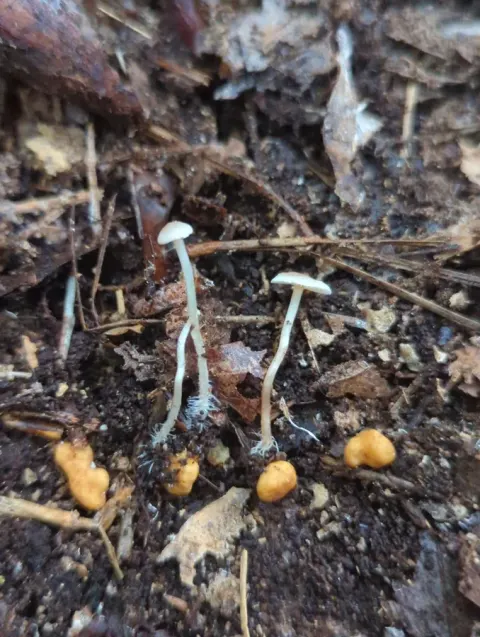
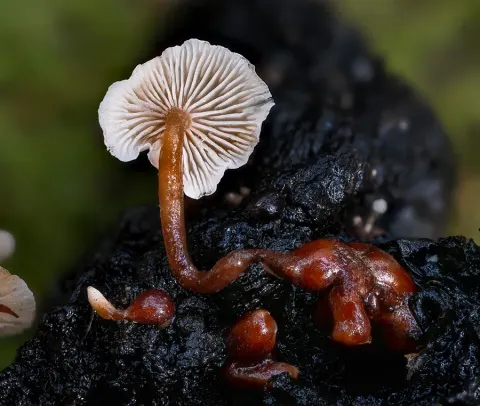
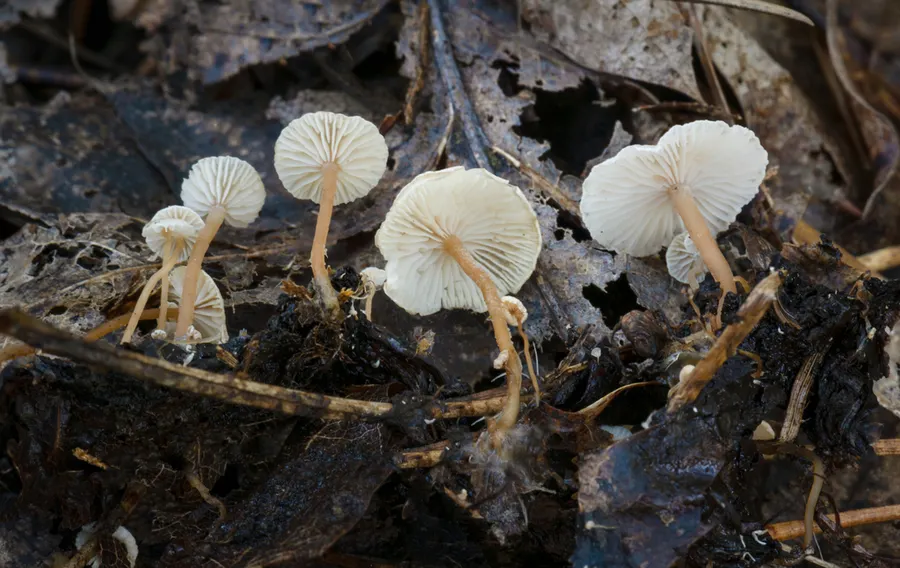
The cap is initially convex when young, later becoming convex to flattened or slightly depressed in the center, reaching a diameter of 3 – 11 mm. The cap margin starts out rolled or curved inward, but straightens out as it matures. The cap surface ranges from dry to moist, smooth to covered with fine whitish hairs, and is mostly even with translucent radial grooves at the margin. It is subhygrophanous (changing color somewhat depending on hydration), becoming a grayish-orange when watery or old, and usually is white with a very faint pinkish flush when fresh. The flesh is whitish, quite thin, and has no distinctive taste or odor. The gills are adnate to slightly arcuate (curved into the shape of a bow) with a tooth (meaning that the gills curve up to join the stem but then, very close to the stem, the gill edge curves down again). There are between 12 and 20 gills that extend completely from the cap edge to the stem, and three to five tiers of lamellulae (shorter gills that do not extend completely from the cap edge to the stem). The gills are thin, narrow to moderately broad, and white to pinkish-buff. The gill edges are even, and the same color as the gill faces. The stem is 8 – 25 mm long and up to 2 mm thick, equal in width throughout to slightly enlarged downward, flexible and filamentous but not fragile. The stem surface is dry, whitish to grayish-orange, sometimes with tiny hairs on the upper portion that become coarser near the base. The stem base often has rhizomorph-like strands or copious whitish mycelia. The stem, unlike the other two species of Collybia, do not originate from a sclerotium.

Sebagian uraian ditampilkan dalam bahasa sumber; terjemahannya belum tersedia atau belum lolos pemeriksaan.

Rujukan: [1]

Pengukuran mengikuti objek, spesimen atau kultur, dan metode yang disebutkan sumber. Baca uraian asli untuk konteks lengkap.

02 / Kehidupan

Habitat dan peran ekologis

Like all species remaining in the genus Collybia, C. cirrhata is saprobic, and is typically found growing on the decaying or blackened remains of other mushrooms; occasionally the fruit bodies may be found growing on moss or soil without any apparent connection to decaying mushrooms, although these observations may represent instances where the remnant host tissue—possibly from a previous season—has decayed to such an extent that it remains as buried fragments in the substrate. Known hosts termasuk Lactarius, Russula, Meripilus giganteus, dan Bovista dermoxantha. Collybia cirrhata dikenal dari habitat berangin, boreal, dan alpine atau Arktik. Jamur ini tersebar luas di Eropa, termasuk Bulgaria, Denmark, Jerman, Yunani, Latvia, Skandinavia, Slowakia, Swiss, Turki, dan Inggris. Jamur ini juga umum di daerah pegunungan utara Amerika Utara. Di Asia, jamur telah dilaporkan di Korea, dan di Hokkaido, Jepang utara. Hal ini juga dikenal dari Greenland. Sebuah publikasi 2009 menunjukkan bahwa berdasarkan bukti yang diketahui, distribusi spesies mungkin bersifat sirkumoreal.

Sebagian uraian ditampilkan dalam bahasa sumber; terjemahannya belum tersedia atau belum lolos pemeriksaan.

Rujukan: [1]

Habitat atau konteks temuan
Informasi belum tersedia pada sumber rilis ini.
Substrat
Informasi belum tersedia pada sumber rilis ini.
Peran atau konteks
Belum dikategorikan pada rilis ini.
Temukan hubungan serupa
03 / Siklus hidup

Reproduksi

In deposit, the spores appear white. Individual spores are ellipsoid to tear-shaped in profile, obovoid to ellipsoid or roughly cylindric in face or back view, with dimensions of 4.8–6.4 by 2–2.8 (sometimes up to 3.5) μm. They are smooth, inamyloid, and acyanophilous (unreactive to staining with Melzer's reagent and methyl blue, respectively). The basidia (spore-bearing cells of the hymenium) are roughly club-shaped, four-spored, and measure 17.5–21 by 4.8–5.6 μm. The gills do not have cystidia. The gill tissue is made of hyphae that are interwoven to roughly parallel, and inamyloid. The hyphae are 2.8–8.4 μm in diameter and smooth. The cap tissue is made of interwoven hyphae beneath the center of the cap, but radially oriented over the gills; it too is inamyloid.

Sebagian uraian ditampilkan dalam bahasa sumber; terjemahannya belum tersedia atau belum lolos pemeriksaan.

Rujukan: [1]

Sinonim menurut acuan taksonomi rilis: Agaricus amanitae; Agaricus amanitae subsp. cirrhatus; Agaricus amanitae subsp. sclerotii; Agaricus cirrhatus; Agaricus cirrhatus var. ocellatus; Agaricus cirrhatus var. phaeothelus; Agaricus ocellatus var. pallor; Agaricus pallor; Agaricus tuberosus var. amanitae; Agaricus tuberosus var. cirrhatus; Collybia ocellata; Lactarius ocellata; Marasmius cirrhatus; Marasmius ocellatus; Microcollybia cirrhata; Sclerotium subterraneum truncorum; Sclerotium truncorum
04 / Batas informasi

Catatan identitas dan cakupan

  • Nama diterima mengikuti Catalogue of Life Base2026-09-11; uraian mempertahankan konsep dan nama sumber aslinya.
  • Original geographic, specimen and life-cycle scope retained; source import awaits individual editorial review.
  • Impor dan terjemahan otomatis belum diperiksa editorial per profil. Struktur reproduktif yang disebutkan tidak membuktikan seluruh siklus hidup diketahui.
  • Pengukuran pada uraian mengikuti spesimen, kultur, dan metode sumber; angka tidak diperluas ke semua populasi.

Catatan distribusi dalam narasi mengikuti sumbernya. Dokumentasi spesimen atau foto mengikuti catatan sumber. Bukti wilayah Indonesia dan penilaian konservasi tidak disimpulkan dari gambar.

05 / Dokumentasi

Melihat dengan konteks

Dokumentasi Collybia cirrhata menurut asosiasi foto pada record takson iNaturalist. Kredit: Alan Rockefeller. Identitas mengikuti sumber; bukan penentuan spesimen independen.

Jenis
Fotografi
Kredit
(c) Alan Rockefeller, some rights reserved (CC BY), uploaded by Alan Rockefeller
Lisensi
CC BY 4.0
Sumber media
Buka entri sumber

Gambar menunjukkan objek menurut identifikasi sumber, bukan verifikasi independen spesimen oleh Fungi. Tidak ada skala baru yang ditambahkan.

06 / Rujukan

Sumber profil

  1. [1] Collybia cirrhata — Wikipedia (en)Bagian sumber: Frozen revision 1370682075
    Tanggal penghimpunan sumber: 2026-10-12
    Teks sumber: CC BY-SA4.0 · Wikipedia contributors
  2. [2] Catalogue of Life Base2026-09-11 — Collybia cirrhataBagian sumber: ColDP NameUsage.tsv ID X53M; accepted species; source 2073
    Tanggal penghimpunan sumber: 2026-10-12
  3. [3] Dokumentasi visual — Collybia cirrhataBagian sumber: Individual media record; identification follows the source, not independent determination
    Tanggal penghimpunan sumber: 2026-10-12
    Media sumber: CC BY 4.0 · (c) Alan Rockefeller, some rights reserved (CC BY), uploaded by Alan Rockefeller

Adaptasi teks: CC BY-SA 4.0. Wikipedia contributors — Collybia cirrhata — Wikipedia (en)

Uraian asli dan riwayat sumber

Riwayat atau halaman sumber

Ringkasan sumber

The cap is initially convex when young, later becoming convex to flattened or slightly depressed in the center, reaching a diameter of 3 – 11 mm. The cap margin starts out rolled or curved inward, but straightens out as it matures. The cap surface ranges from dry to moist, smooth to covered with fine whitish hairs, and is mostly even with translucent radial grooves at the margin. It is subhygrophanous (changing color somewhat depending on hydration), becoming a grayish-orange when watery or old, and usually is white with a very faint pinkish flush when fresh.

Revisi sumber

Morfologi sumber

The cap is initially convex when young, later becoming convex to flattened or slightly depressed in the center, reaching a diameter of 3 – 11 mm. The cap margin starts out rolled or curved inward, but straightens out as it matures. The cap surface ranges from dry to moist, smooth to covered with fine whitish hairs, and is mostly even with translucent radial grooves at the margin. It is subhygrophanous (changing color somewhat depending on hydration), becoming a grayish-orange when watery or old, and usually is white with a very faint pinkish flush when fresh. The flesh is whitish, quite thin, and has no distinctive taste or odor. The gills are adnate to slightly arcuate (curved into the shape of a bow) with a tooth (meaning that the gills curve up to join the stem but then, very close to the stem, the gill edge curves down again). There are between 12 and 20 gills that extend completely from the cap edge to the stem, and three to five tiers of lamellulae (shorter gills that do not extend completely from the cap edge to the stem). The gills are thin, narrow to moderately broad, and white to pinkish-buff. The gill edges are even, and the same color as the gill faces. The stem is 8 – 25 mm long and up to 2 mm thick, equal in width throughout to slightly enlarged downward, flexible and filamentous but not fragile. The stem surface is dry, whitish to grayish-orange, sometimes with tiny hairs on the upper portion that become coarser near the base. The stem base often has rhizomorph-like strands or copious whitish mycelia. The stem, unlike the other two species of Collybia, do not originate from a sclerotium.

Revisi sumber

Ekologi sumber

Like all species remaining in the genus Collybia, C. cirrhata is saprobic, and is typically found growing on the decaying or blackened remains of other mushrooms; occasionally the fruit bodies may be found growing on moss or soil without any apparent connection to decaying mushrooms, although these observations may represent instances where the remnant host tissue—possibly from a previous season—has decayed to such an extent that it remains as buried fragments in the substrate. Known hosts include Lactarius, Russula, Meripilus giganteus, and Bovista dermoxantha. Collybia cirrhata is known from temperate, boreal, and alpine or arctic habitats. The fungus is widespread in Europe, including Bulgaria, Denmark, Germany, Greece, Latvia, Scandinavia, Slovakia, Switzerland, Turkey, and the United Kingdom. The mushroom is also common in northern montane regions of North America. In Asia, the fungus has been reported in Korea, and in Hokkaido, northern Japan. It is also known from Greenland. A 2009 publication suggested that based on the known evidence, the species' distribution may be circumboreal.

Revisi sumber

Struktur reproduksi sumber

In deposit, the spores appear white. Individual spores are ellipsoid to tear-shaped in profile, obovoid to ellipsoid or roughly cylindric in face or back view, with dimensions of 4.8–6.4 by 2–2.8 (sometimes up to 3.5) μm. They are smooth, inamyloid, and acyanophilous (unreactive to staining with Melzer's reagent and methyl blue, respectively). The basidia (spore-bearing cells of the hymenium) are roughly club-shaped, four-spored, and measure 17.5–21 by 4.8–5.6 μm. The gills do not have cystidia. The gill tissue is made of hyphae that are interwoven to roughly parallel, and inamyloid. The hyphae are 2.8–8.4 μm in diameter and smooth. The cap tissue is made of interwoven hyphae beneath the center of the cap, but radially oriented over the gills; it too is inamyloid.

Revisi sumber

Rujukan halaman ini

Fungi. Collybia cirrhata. Rilis data fungi-2026-10-12-expansion-2. https://fungi-atlas.mgadib.chatgpt.site/jamur/collybia-cirrhata/.

Status: impor sumber; pemeriksaan editorial per profil belum selesai. Untuk klaim biologis, gunakan rujukan pada bagian terkait dan periksa konteks sumber aslinya.