01 / Morfologi

Ciri dan struktur

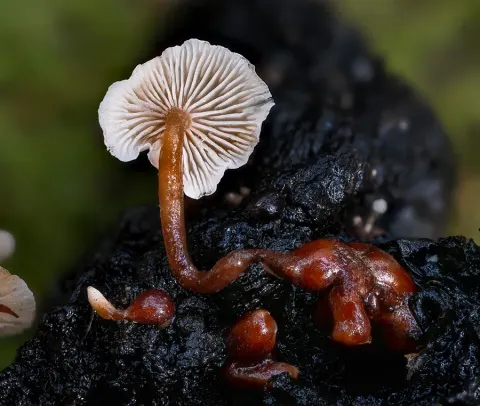
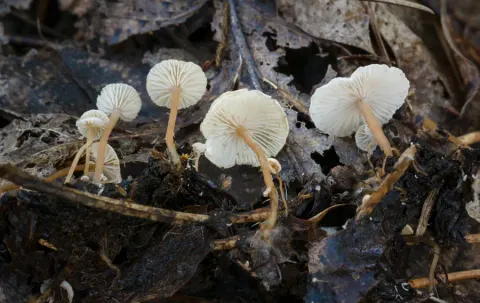
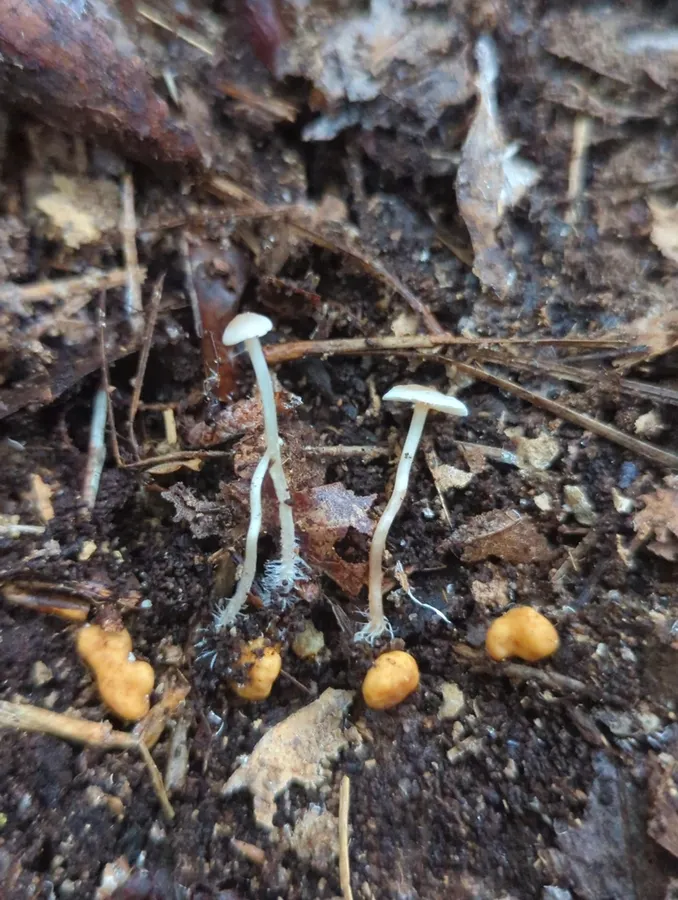
The caps of young mushrooms are roughly spherical, but soon become convex to flattened in maturity, and reach diameters of 2 – 9 mm. The cap margin is rolled or curled inward when young, but straightens out as it matures. The cap color is white to cream. The gills are broadly adnate to slightly decurrent, with a color similar to the cap; their spacing is close to subdistant. The whitish stem is equal in width throughout, usually not straight but with curves, and 2 – 5 cm long by 0.3 – 1.0 mm thick. The upper region of the stem surface can be covered with what appears to be a white powder, and there are thin hairs near the base. The stems originate from a yellowish-brown sclerotium that is up to 6 mm long. The sclerotium ranges in shape from roughly spherical to almond-shaped to irregular, and its surface is often wrinkled and pitted. The mushroom has no distinctive odor or taste, and its edibility is unknown. In deposit, the spore color is white. The spores are smooth, ellipsoidal to tear-shaped, hyaline (translucent), not amyloid, and measure 3.9–5.2 by 2.6–3.3 μm. The basidia (spore-bearing cells in the hymenium) are four-spored and hyaline, with dimensions of 16–20 by 4–5 μm. They have clamps at their bases. There are no cystidia on either the edges (cheilocystidia) or faces (pleurocystidia) of the gills. The arrangement of the hyphae in the hymenophoral tissue varies from regular to interwoven. The cap cuticle is a cutis (a type of tissue where the hyphae are arranged more or less parallel to the surface), formed by hyphae with septa, roughly 4–9 μm in diameter. Clamp connections are present in the hyphae.

Sebagian uraian ditampilkan dalam bahasa sumber; terjemahannya belum tersedia atau belum lolos pemeriksaan.

Rujukan: [1]

Pengukuran mengikuti objek, spesimen atau kultur, dan metode yang disebutkan sumber. Baca uraian asli untuk konteks lengkap.

02 / Kehidupan

Habitat dan peran ekologis

Like all anggota genus Collybia, C. cookei tumbuh di sisa jamur yang sudah busuk dan hitam, seperti spesies Russula, Meripilus giganteus, dan Inonotus hispidus. Fruit bodies kadang tumbuh di kayu yang sudah rusak atau humus yang kaya. The fruit bodies grow scattered, clustered, or in groups. Sebuah studi lapangan yang dilakukan di dekat Brass mill di Sweden revealed menunjukkan bahwa kontaminasi logam berat tidak berdampak sedikit pada penampilan jamur, mungkin karena substratnya dari tubuh buah yang sebagian terurai memiliki konsentrasi logam yang lebih rendah daripada permukaan tanah yang mendasarinya. Collybia cookei ditemukan di Eropa, Asia (Jepang), dan Amerika Utara. European distribution membentang ke utara ke Arktik Circle and Kepulauan Lofoten. Spesies ini tersebar luas di Amerika Utara; pertama kali dilaporkan dari Mexico for di 1998. Jamur ini sebagian berasal dari hutan campuran yang didominasi oleh aspen dan konifer di lingkungan pegunungan dan subalpine. Di Belanda, itu merupakan komponen dari satu dari tiga komunitas jamur saprobik yang terkait dengan tepi jalan (tanah antara tepi jalan dan dinding, pagar atau pagar yang berdekatan) yang ditanam dengan kayu ek biasa (Quercus robur); tepi juga mendukung pertumbuhan jamur Russula ochroleuca, host dari C. cookei.

Sebagian uraian ditampilkan dalam bahasa sumber; terjemahannya belum tersedia atau belum lolos pemeriksaan.

Rujukan: [1]

Habitat atau konteks temuan
hutan
Substrat
Informasi belum tersedia pada sumber rilis ini.
Peran atau konteks
Pengurai
Temukan hubungan serupa
03 / Siklus hidup

Reproduksi

In deposit, the spore color is white. The spores are smooth, ellipsoidal to tear-shaped, hyaline (translucent), not amyloid, and measure 3.9–5.2 by 2.6–3.3 μm. The basidia (spore-bearing cells in the hymenium) are four-spored and hyaline, with dimensions of 16–20 by 4–5 μm. They have clamps at their bases. There are no cystidia on either the edges (cheilocystidia) or faces (pleurocystidia) of the gills. The arrangement of the hyphae in the hymenophoral tissue varies from regular to interwoven. The cap cuticle is a cutis (a type of tissue where the hyphae are arranged more or less parallel to the surface), formed by hyphae with septa, roughly 4–9 μm in diameter. Clamp connections are present in the hyphae.

Sebagian uraian ditampilkan dalam bahasa sumber; terjemahannya belum tersedia atau belum lolos pemeriksaan.

Rujukan: [1]

Sinonim menurut acuan taksonomi rilis: Collybia cirrhata var. cookei; Collybia tuberosa var. cookei; Microcollybia cookei; Sclerotium fungorum
04 / Batas informasi

Catatan identitas dan cakupan

  • Nama diterima mengikuti Catalogue of Life Base2026-09-11; uraian mempertahankan konsep dan nama sumber aslinya.
  • Original geographic, specimen and life-cycle scope retained; source import awaits individual editorial review.
  • Impor dan terjemahan otomatis belum diperiksa editorial per profil. Struktur reproduktif yang disebutkan tidak membuktikan seluruh siklus hidup diketahui.
  • Pengukuran pada uraian mengikuti spesimen, kultur, dan metode sumber; angka tidak diperluas ke semua populasi.

Catatan distribusi dalam narasi mengikuti sumbernya. Dokumentasi spesimen atau foto mengikuti catatan sumber. Bukti wilayah Indonesia dan penilaian konservasi tidak disimpulkan dari gambar.

05 / Dokumentasi

Melihat dengan konteks

Dokumentasi Collybia cookei menurut asosiasi foto pada record takson iNaturalist. Kredit: Alan Rockefeller. Identitas mengikuti sumber; bukan penentuan spesimen independen.

Jenis
Fotografi
Kredit
(c) Alan Rockefeller, some rights reserved (CC BY), uploaded by Alan Rockefeller
Lisensi
CC BY 4.0
Sumber media
Buka entri sumber

Gambar menunjukkan objek menurut identifikasi sumber, bukan verifikasi independen spesimen oleh Fungi. Tidak ada skala baru yang ditambahkan.

06 / Rujukan

Sumber profil

  1. [1] Collybia cookei — Wikipedia (en)Bagian sumber: Frozen revision 1370694474
    Tanggal penghimpunan sumber: 2026-10-12
    Teks sumber: CC BY-SA4.0 · Wikipedia contributors
  2. [2] Catalogue of Life Base2026-09-11 — Collybia cookeiBagian sumber: ColDP NameUsage.tsv ID X54B; accepted species; source 2073
    Tanggal penghimpunan sumber: 2026-10-12
  3. [3] Dokumentasi visual — Collybia cookeiBagian sumber: Individual media record; identification follows the source, not independent determination
    Tanggal penghimpunan sumber: 2026-10-12
    Media sumber: CC BY 4.0 · (c) Alan Rockefeller, some rights reserved (CC BY), uploaded by Alan Rockefeller

Adaptasi teks: CC BY-SA 4.0. Wikipedia contributors — Collybia cookei — Wikipedia (en)

Uraian asli dan riwayat sumber

Riwayat atau halaman sumber

Ringkasan sumber

Collybia cookei, the split-pea shanklet, is a species of fungus in the family Tricholomataceae, and one of three species in the genus Collybia. It is known from Europe, Asia, and North America. The fungus produces fruit bodies that usually grow on the decomposing remains of other mushrooms, like Meripilus giganteus, Inonotus hispidus, or species of Russula; occasionally fruit bodies are found on rich humus or well-decayed wood. The fungus produces small white mushrooms with caps up to 9 mm in diameter, supported by thin stems that originate from a yellowish-brown sclerotium.

Revisi sumber

Morfologi sumber

The caps of young mushrooms are roughly spherical, but soon become convex to flattened in maturity, and reach diameters of 2 – 9 mm. The cap margin is rolled or curled inward when young, but straightens out as it matures. The cap color is white to cream. The gills are broadly adnate to slightly decurrent, with a color similar to the cap; their spacing is close to subdistant. The whitish stem is equal in width throughout, usually not straight but with curves, and 2 – 5 cm long by 0.3 – 1.0 mm thick. The upper region of the stem surface can be covered with what appears to be a white powder, and there are thin hairs near the base. The stems originate from a yellowish-brown sclerotium that is up to 6 mm long. The sclerotium ranges in shape from roughly spherical to almond-shaped to irregular, and its surface is often wrinkled and pitted. The mushroom has no distinctive odor or taste, and its edibility is unknown. In deposit, the spore color is white. The spores are smooth, ellipsoidal to tear-shaped, hyaline (translucent), not amyloid, and measure 3.9–5.2 by 2.6–3.3 μm. The basidia (spore-bearing cells in the hymenium) are four-spored and hyaline, with dimensions of 16–20 by 4–5 μm. They have clamps at their bases. There are no cystidia on either the edges (cheilocystidia) or faces (pleurocystidia) of the gills. The arrangement of the hyphae in the hymenophoral tissue varies from regular to interwoven. The cap cuticle is a cutis (a type of tissue where the hyphae are arranged more or less parallel to the surface), formed by hyphae with septa, roughly 4–9 μm in diameter. Clamp connections are present in the hyphae.

Revisi sumber

Ekologi sumber

Like all members of the genus Collybia, C. cookei grows on the well-rotted, blackened remains of mushrooms, such as species of Russula, Meripilus giganteus, and Inonotus hispidus. Fruit bodies occasionally grow on well-decayed wood or rich humus. The fruit bodies grow scattered, clustered, or in groups. A field study conducted near a Brass mill in Sweden revealed that heavy metal contamination had little effect on the appearance of the mushroom, possibly because its substrate of partially decomposed fruit bodies has a lower metal concentration that the underlying topsoil. Collybia cookei is found in Europe, Asia (Japan), and North America. The European distribution extends north to the Arctic Circle and the Lofoten Islands. The species is widely distributed in North America; it was reported from Mexico for the first time in 1998. The fungus is partial to mixed forest dominated by aspen and conifers in montane and subalpine environments. In The Netherlands, it was a component of one of three communities of saprobic fungi associated with roadside verges (the land between the road edge and the adjacent wall, fence or hedge) planted with common oak (Quercus robur); the verges also supported the growth of the mushroom Russula ochroleuca, a host of C. cookei.

Revisi sumber

Struktur reproduksi sumber

In deposit, the spore color is white. The spores are smooth, ellipsoidal to tear-shaped, hyaline (translucent), not amyloid, and measure 3.9–5.2 by 2.6–3.3 μm. The basidia (spore-bearing cells in the hymenium) are four-spored and hyaline, with dimensions of 16–20 by 4–5 μm. They have clamps at their bases. There are no cystidia on either the edges (cheilocystidia) or faces (pleurocystidia) of the gills. The arrangement of the hyphae in the hymenophoral tissue varies from regular to interwoven. The cap cuticle is a cutis (a type of tissue where the hyphae are arranged more or less parallel to the surface), formed by hyphae with septa, roughly 4–9 μm in diameter. Clamp connections are present in the hyphae.

Revisi sumber

Rujukan halaman ini

Fungi. Collybia cookei. Rilis data fungi-2026-10-12-expansion-2. https://fungi-atlas.mgadib.chatgpt.site/jamur/collybia-cookei/.

Status: impor sumber; pemeriksaan editorial per profil belum selesai. Untuk klaim biologis, gunakan rujukan pada bagian terkait dan periksa konteks sumber aslinya.