Ciri dan struktur
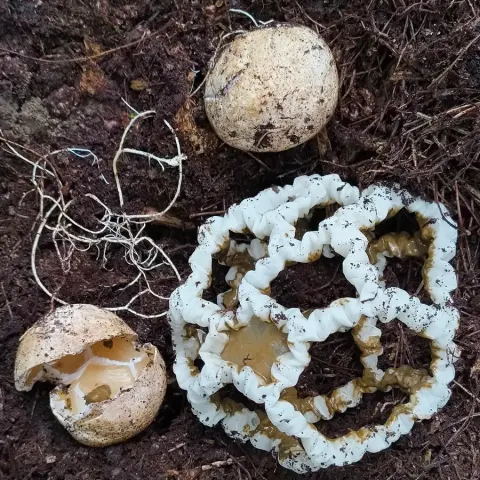
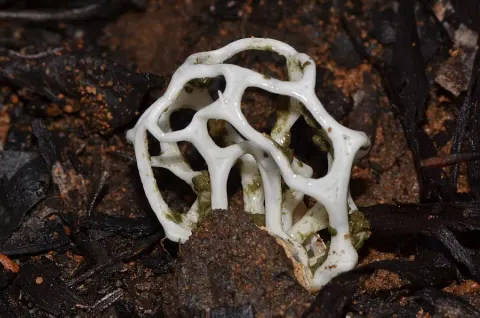
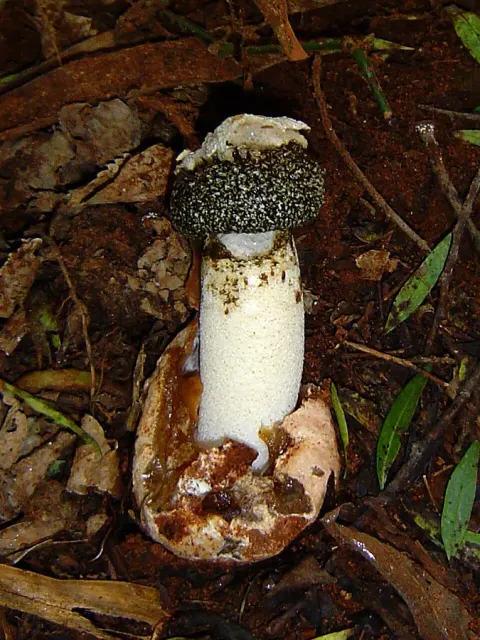
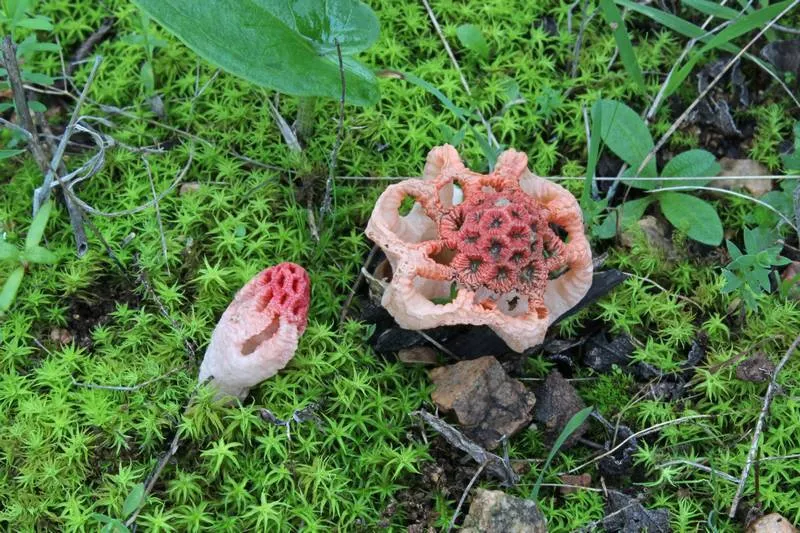
Fruit bodies begin their development in the form of an egg like structure. Measuring about 1 cm in diameter, the roughly spherical egg is white or mottled with brown on the upper part. Attached underneath are one or more thin white rhizomorphs. After emerging from the egg, the fruit body consists of a short, thick stalk from which between four and six vertical, arching columns arise. These columns, colored pink below and gradually deepening in color to red near the top, have a corrugated surface texture. The columns often fork near the top into additional branches that support a lattice-like, or clathrate dome. The meshes of the fertile net are roughly polyhedral and there is an abrupt transition from columns to lattice. The olive-green gleba is held on the bottom of and in between the meshes of the clathrate dome, and the inner side of the upper arms. It has a fetid odor, similar to feces, which attracts flies that visit the mushroom, consume the gleba, and deposit the spores elsewhere to germinate. Spores produced by C. hirudinosus are rod-shaped, hyaline (translucent), and measure 3.5–6.5 by 1–1.75 μm. Structurally, the spongy columns comprise a double layer of tubes, a large inner one and two or three outer ones. The remnants of the egg tissue enclose the base of the structure as a volva.
Habitat dan peran ekologis
Colus hirudinosus is believed to be saprobic, meaning that it obtains nutrients by decomposing dead or decaying organic matter. Fruit bodies grow in manured soil, in sand, but frequently also under Cistus shrubs, which has led some to suggest the fungus may also act as a facultative endophyte. The species is most widespread in Europe, particularly Mediterranean countries (including Corsica, Cyprus, France, Greece, Italy, Portugal, Israel and Spain), but also as far north as Switzerland. In Africa, it has been reported from Algeria and Nigeria, while it has also been found in Asia and Australia. In the Caribbean, it is known only from Jamaica.
- Habitat atau konteks temuan
- Informasi belum tersedia pada sumber rilis ini.
- Substrat
- Informasi belum tersedia pada sumber rilis ini.
- Peran atau konteks
- Pengurai
Reproduksi
Fruit bodies begin their development in the form of an egg like structure. Measuring about 1 cm in diameter, the roughly spherical egg is white or mottled with brown on the upper part. Attached underneath are one or more thin white rhizomorphs. After emerging from the egg, the fruit body consists of a short, thick stalk from which between four and six vertical, arching columns arise. These columns, colored pink below and gradually deepening in color to red near the top, have a corrugated surface texture. The columns often fork near the top into additional branches that support a lattice-like, or clathrate dome. The meshes of the fertile net are roughly polyhedral and there is an abrupt transition from columns to lattice.
Catatan identitas dan cakupan
- Nama diterima mengikuti Catalogue of Life Base2026-09-11; uraian mempertahankan konsep dan nama sumber aslinya.
- Original geographic, specimen and life-cycle scope retained; source import awaits individual editorial review.
- Impor dan terjemahan otomatis belum diperiksa editorial per profil. Struktur reproduktif yang disebutkan tidak membuktikan seluruh siklus hidup diketahui.
- Pengukuran pada uraian mengikuti spesimen, kultur, dan metode sumber; angka tidak diperluas ke semua populasi.
Catatan distribusi dalam narasi mengikuti sumbernya. Dokumentasi spesimen atau foto mengikuti catatan sumber. Bukti wilayah Indonesia dan penilaian konservasi tidak disimpulkan dari gambar.
Melihat dengan konteks
Dokumentasi Colus hirudinosus menurut asosiasi foto pada record takson iNaturalist. Kredit: Davide Puddu. Identitas mengikuti sumber; bukan penentuan spesimen independen.
- Jenis
- Fotografi
- Kredit
- (c) Davide Puddu, some rights reserved (CC BY), uploaded by Davide Puddu
- Lisensi
- CC BY 4.0
- Sumber media
- Buka entri sumber
Dokumentasi tambahan
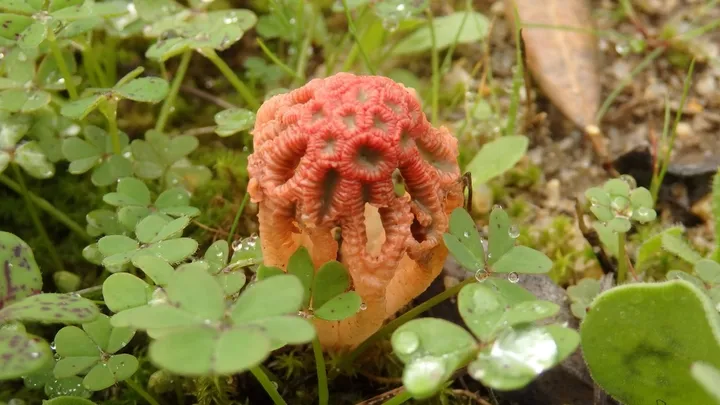
Foto yang diasosiasikan dengan Colus hirudinosus pada iNaturalist. Identifikasi mengikuti sumber; bukan penentuan spesimen independen.
Kredit dan penggunaan
(c) sadino, some rights reserved (CC BY), uploaded by sadino
Ukuran dan format gambar disesuaikan tanpa pemotongan, retus, atau penambahan skala. Lisensi sumber dipertahankan.
Sumber profil
- [1] Colus hirudinosus — Wikipedia (en)
- [2] Catalogue of Life Base2026-09-11 — Colus hirudinosus
- [3] Dokumentasi visual — Colus hirudinosus
- [4] Dokumentasi visual — Colus hirudinosus
Rujukan halaman ini
Fungi. Colus hirudinosus. Rilis data fungi-2026-10-12-expansion-2. https://fungi-atlas.mgadib.chatgpt.site/jamur/colus-hirudinosus/.
Status: impor sumber; pemeriksaan editorial per profil belum selesai. Untuk klaim biologis, gunakan rujukan pada bagian terkait dan periksa konteks sumber aslinya.