Ciri dan struktur
Thallus pale olive gray to brown, weakly glossy to matt, smooth, endophloeodal to partly epiphloeodal, continuous; prothallus line dark gray to brown, sometimes present when in contact with other lichens; photobiont trentepohlioid, the cells rounded to elliptical, 7–12 × 4–8 μm, forming short chains. Ascomata irregularly rounded to elliptical to weakly lobed, rarely distinctly lirellate, with steep flanks, emergent from thallus, 0.1–0.4 × 0.1–0.3 mm, 95–140 µm tall, solitary or forming loose to dense aggregations of 3–15 ascomata, (0.3–)0.5–2.0(–3.5) × 0.3–1.6 mm; disc dark purple black, flat to weakly convex, matt to weakly glossy, white pruinose, a layer of orange–red pruina sometimes present above the white pruina; old ascomata sometimes epruinose; margins level with the disc, typically orange–red pruinose, sometimes with additional patches of white pruina; proper exciple brown, 8–15 µm wide, composed of compressed and vertically oriented paraphysoidal hyphae, the hyphae 1–2 µm thick, branched and netted, often forming short hairs up to 15 µm long at the outer margin; old bark cells often attached to the exciple; epithecium brown, 10–25 µm tall, conglutinated only in the lower parts, composed of branched tips of the paraphysoidal hyphae extending horizontally above the asci; the tips slightly widened to 3(–4) µm, sometimes extending from the epithecium as sparsely branched anticlinal hairs up to 22 µm long; hymenium hyaline, strongly conglutinated, (45–)65–90 µm tall, paraphysoids densely branched and netted, 1–2 µm thick; hypothecium hyaline, conglutinated, 20–35 µm tall, formed of irregular prosoplectenchymatic hyphae 1–2 µm diam.; crystals common in epithecium and proper exciple, of two types: hyaline, leafy crystals, 1–5(–8) µm, and orange, red or purple, granular crystals, 1–2(–4) µm; a weak amorphous, red to purple pigmentation present in exciple, epithecium and patchily distributed in the hymenium.
Habitat dan peran ekologis
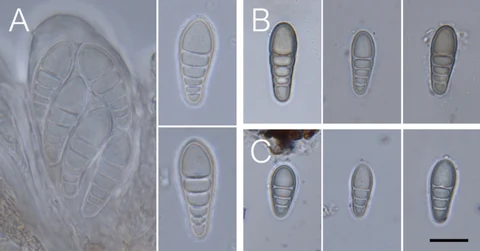
Coniocarpon cinnabarinum differs from the other Coniocarpon species in Norway by distinctly larger ascospores and in ascospore septation: (19–)23–28(–30) × (8–)10–11(–12) µm, (3–)4–5(–8) transversely septate vs (15–)16–18(–20) × (6–)7–8(–9) µm, (2–)3(–4) transversely septate in C. cuspidans vs (15–)17–20(–22) × (6–)7–9(–10) µm, (1–)3–4(–5) transversely septate in C. fallax. Further, the ascomata in C. cinnabarinum are mostly irregularly rounded to elliptical and only rarely lirellate as in C. cuspidans and C. fallax. The ascomatal disc in C. cinnabarinum is typically covered by a thick layer of white pruina which may be overlaid by orange–red pruina, and the ascomatal margin is orange–red pruinose. In C. cuspidans, the ascomata completely lack orange-red pruina, while a thin white pruina may be occasionally present. In C. fallax, the distribution of pruina is similar to C. cinnabarinum, but the white pruina is less pronounced and may even be lacking. Additional differences have been observed in the reaction of proper exciple and epithecium to iodine: I dil /I+ blue in C. cinnabarinum and C. fallax vs I dil /I+ red in C. cuspidans. The quinoid pigments A1, A3 and A4 have been identified in C. cinnabarinum in various amounts.
- Habitat atau konteks temuan
- Informasi belum tersedia pada sumber rilis ini.
- Substrat
- Informasi belum tersedia pada sumber rilis ini.
- Peran atau konteks
- Pembentuk liken
Reproduksi
Thallus pale olive gray to brown, weakly glossy to matt, smooth, endophloeodal to partly epiphloeodal, continuous; prothallus line dark gray to brown, sometimes present when in contact with other lichens; photobiont trentepohlioid, the cells rounded to elliptical, 7–12 × 4–8 μm, forming short chains. Ascomata irregularly rounded to elliptical to weakly lobed, rarely distinctly lirellate, with steep flanks, emergent from thallus, 0.1–0.4 × 0.1–0.3 mm, 95–140 µm tall, solitary or forming loose to dense aggregations of 3–15 ascomata, (0.3–)0.5–2.0(–3.5) × 0.3–1.6 mm; disc dark purple black, flat to weakly convex, matt to weakly glossy, white pruinose, a layer of orange–red pruina sometimes present above the white pruina; old ascomata sometimes epruinose; margins level with the disc, typically orange–red pruinose, sometimes with additional patches of white pruina; proper exciple brown, 8–15 µm wide, composed of compressed and vertically oriented paraphysoidal hyphae, the hyphae 1–2 µm thick, branched and netted, often forming short hairs up to 15 µm long at the outer margin; old bark cells often attached to the exciple; epithecium brown, 10–25 µm tall, conglutinated only in the lower parts, composed of branched tips of the paraphysoidal hyphae extending horizontally above the asci; the tips slightly widened to 3(–4) µm, sometimes extending from the epithecium as sparsely branched anticlinal hairs up to 22 µm long; hymenium hyaline, strongly conglutinated, (45–)65–90 µm tall, paraphysoids densely branched and netted, 1–2 µm thick; hypothecium hyaline, conglutinated, 20–35 µm tall, formed of irregular prosoplectenchymatic hyphae 1–2 µm diam.; crystals common in epithecium and proper exciple, of two types: hyaline, leafy crystals, 1–5(–8) µm, and orange, red or purple, granular crystals, 1–2(–4) µm; a weak amorphous, red to purple pigmentation present in exciple, epithecium and patchily distributed in the hymenium.
Catatan identitas dan cakupan
- Nama diterima mengikuti Catalogue of Life Base2026-09-11; uraian mempertahankan konsep dan nama sumber aslinya.
- Preserve original treatment localities, hosts and substrate scope. Materials examined describe documented specimens, not the full global range.
- Impor dan terjemahan otomatis belum diperiksa editorial per profil. Struktur reproduktif yang disebutkan tidak membuktikan seluruh siklus hidup diketahui.
- Pengukuran pada uraian mengikuti spesimen, kultur, dan metode sumber; angka tidak diperluas ke semua populasi.
Catatan distribusi dalam narasi mengikuti sumbernya. Dokumentasi spesimen atau foto mengikuti catatan sumber. Bukti wilayah Indonesia dan penilaian konservasi tidak disimpulkan dari gambar.
Melihat dengan konteks
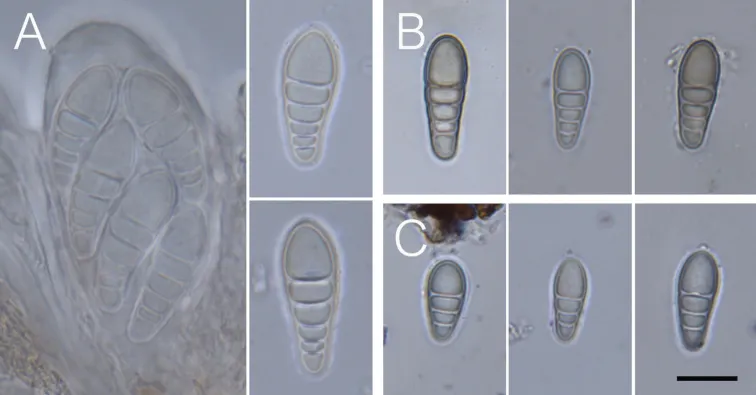
Ascospore morphology. A Coniocarpon cinnabarinum (TRH-L-29007) B Coniocarpon fallax (TRH-L-29008) C Coniocarpon cuspidans (TRH-L-29036). Scale bar: 10 µm.
- Jenis
- Pelat ilmiah
- Kredit
- Andreas Frisch, Victoria Stornes Moen, Martin Grube, Mika Bendiksby
- Lisensi
- CC BY 4.0
- Sumber media
- Buka entri sumber
Dokumentasi tambahan
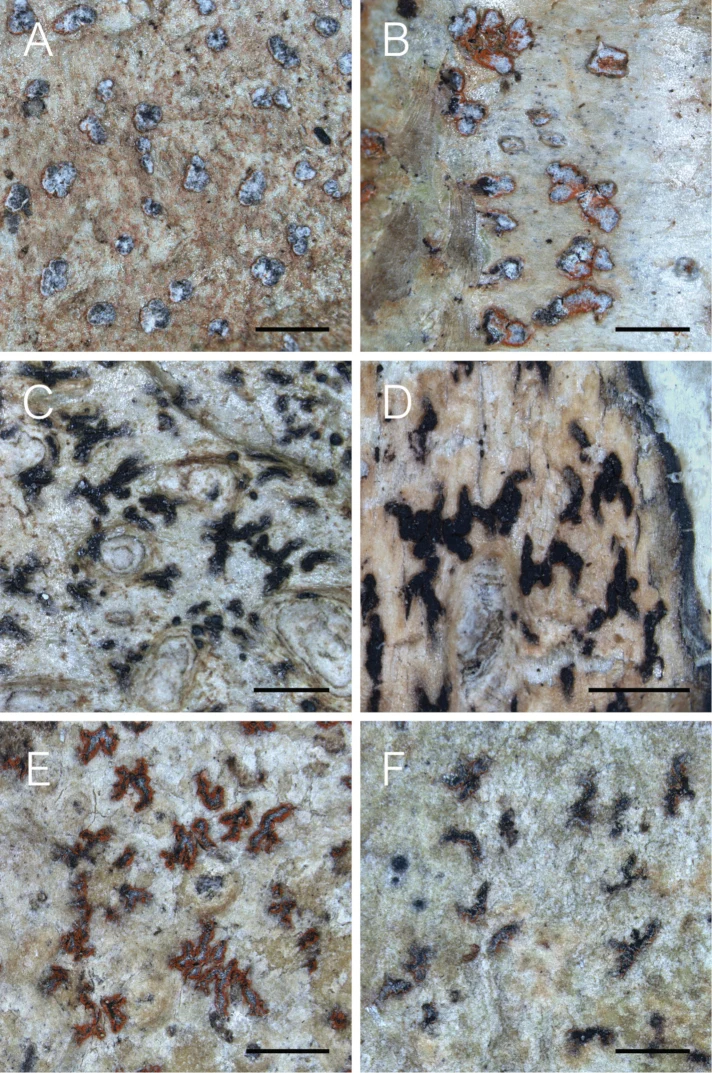
Morphological diversity of Coniocarpon in Norway. A Coniocarpon cinnabarinum (Frisch TRH-L-29000) B Coniocarpon cinnabarinum (Frisch TRH-L-29005) C Coniocarpon cuspidans (TRH-L-29022) D Coniocarpon cuspidans (TRH-L-29023) E Coniocarpon fallax (TRH-L-16793) F Coniocarpon fallax (Frisch TRH-L-29028). Scale bars: 1 mm.
Kredit dan penggunaan
Andreas Frisch, Victoria Stornes Moen, Martin Grube, Mika Bendiksby
Ukuran dan format gambar disesuaikan tanpa pemotongan, retus, atau penambahan skala. Lisensi sumber dipertahankan.
Sumber profil
- [1] Integrative taxonomy confirms three species of Coniocarpon (Arthoniaceae) in Norway — Coniocarpon cinnabarinum
- [2] Catalogue of Life Base2026-09-11 — Coniocarpon cinnabarinum
- [3] Dokumentasi visual — Coniocarpon cinnabarinum
- [4] Dokumentasi visual — Coniocarpon cinnabarinum
Rujukan halaman ini
Fungi. Coniocarpon cinnabarinum. Rilis data fungi-2026-10-12-expansion-2. https://fungi-atlas.mgadib.chatgpt.site/jamur/coniocarpon-cinnabarinum/.
Status: impor sumber; pemeriksaan editorial per profil belum selesai. Untuk klaim biologis, gunakan rujukan pada bagian terkait dan periksa konteks sumber aslinya.