01 / Morfologi

Ciri dan struktur

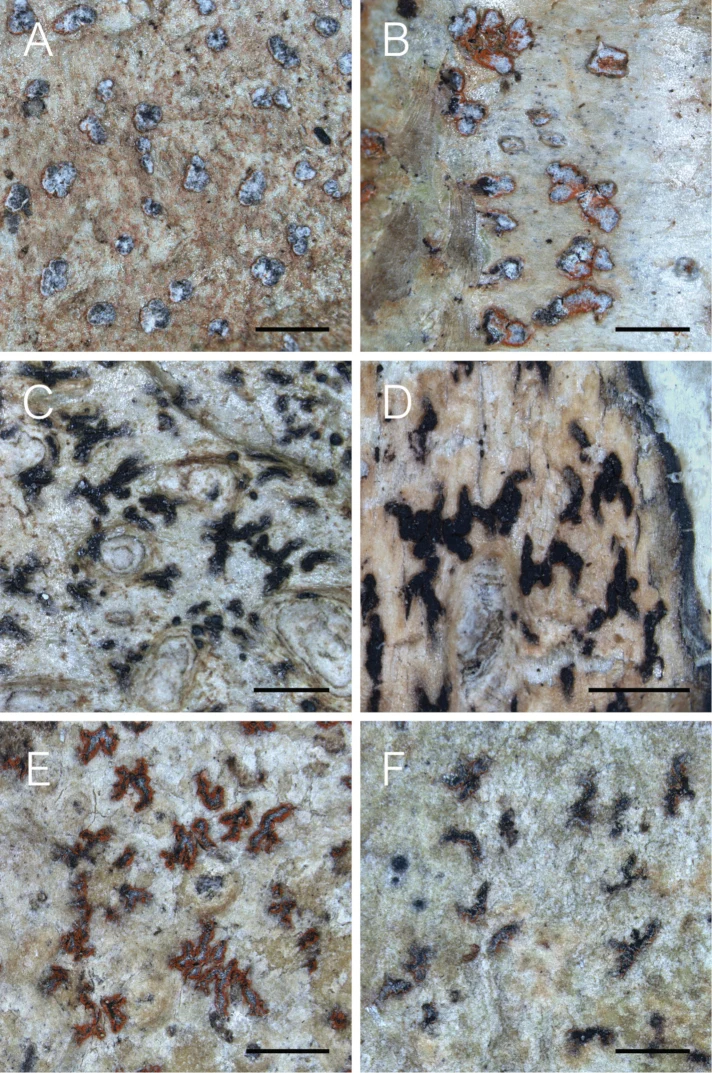
Thallus pale fawn to gray brown, weakly glossy to matt, smooth, endophloeodal to partly epiphloedal, continuous; prothallus line dark grey to brown, sometimes present when in contact with other lichens; photobiont trentepohlioid, the cells rounded to elliptical, 8–13 × 5–10 µm, forming short chains. Ascomata weakly elongate to irregularly lirellate, with steep flanks, emergent from thallus, 0.2–0.4 mm × 0.1–0.2 mm, 65–110 µm tall, typically forming loose to dense aggregations of 3–15 ascomata, weakly elongated to irregularly lirellate to stellate, 0.2–1.5(–2.3) × 0.1–1.8 mm; disc black to dark purple black, flat to weakly convex, weakly glossy to matt, epruinose or with a thin layer of white pruina; margins level with the disc, orange–red pruinose, sometimes with additional patches of white pruina; proper exciple brown, 7–20 µm wide, composed of compressed and vertically oriented paraphysoidal hyphae, the hyphae 1–2 µm thick, branched and netted, often forming short hairs up to 17 µm long at the outer margin; old bark cells sometimes attached to the exciple; epithecium brown, 10–20 µm tall, conglutinated only in the lower parts, composed of branched tips of the paraphysoidal hyphae extending horizontally above the asci; the tips slightly widened to 3(–4) µm, sometimes extending from the epithecium as sparsely branched anticlinal hairs up to 24 µm long; hymenium hyaline, strongly conglutinated, 35–70 µm tall, paraphysoids densely branched and netted, 1–2 µm thick; hypothecium hyaline, conglutinated, 15–30 µm tall, formed of irregular prosoplectenchymatic hyphae 1–2 µm diam.; crystals common in epithecium and proper exciple, of two types: hyaline, leafy crystals, 1–5(–7) µm, and orange, red or purple granular crystals, 1–2(–4) µm; a weak amorphous, red to purple pigmentation present in exciple, epithecium and patchily distributed in the hymenium.

Sebagian uraian ditampilkan dalam bahasa sumber; terjemahannya belum tersedia atau belum lolos pemeriksaan.

Rujukan: [1]

Pengukuran mengikuti objek, spesimen atau kultur, dan metode yang disebutkan sumber. Baca uraian asli untuk konteks lengkap.

02 / Kehidupan

Habitat dan peran ekologis

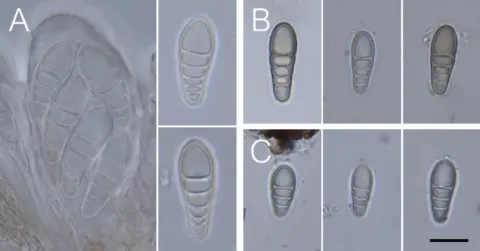
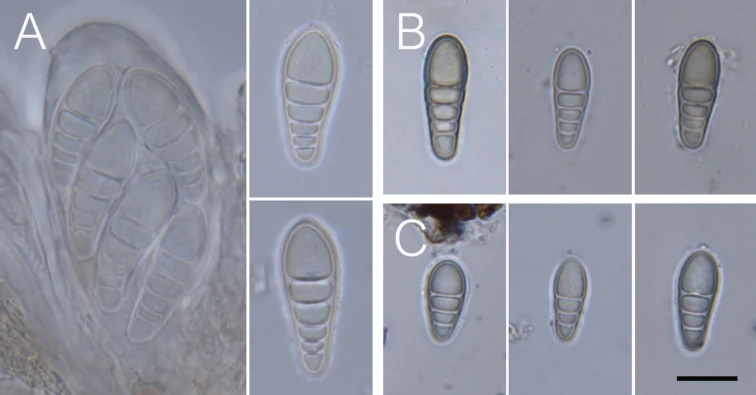
Coniocarpon fallax resembles C. cinnabarinum by ascomata that are covered in an orange–red and white pruina. However, the white pruina is less pronounced in C. fallax and may be absent. The ascomata of C. fallax further are elongate to clearly lirellate and the ascospores are distinctly smaller with less septa: (15–)17–20(–22) × (6–)7–9(–10) µm, (1–)3–4(–5) transversely septate vs (19–)23–28(–30) × (8–)10–11(–12) µm, (3–)4–5(–8) transversely septate in C. cinnabarinum. Mature, apparently well-developed elliptical ascospores with only a single septum were found in one specimen (TRH-L-17089) of C. fallax. Coniocarpon cuspidans has ascospores of similar size which, however, are predominantly 3-septate. The elongate to lirellate ascomata of that species lack an orange–red pruina, and proper exciple and epithecium react I dil /I+ red in iodine.

Sebagian uraian ditampilkan dalam bahasa sumber; terjemahannya belum tersedia atau belum lolos pemeriksaan.

Rujukan: [1]

Habitat atau konteks temuan
Informasi belum tersedia pada sumber rilis ini.
Substrat
Informasi belum tersedia pada sumber rilis ini.
Peran atau konteks
Pembentuk liken
Temukan hubungan serupa
03 / Siklus hidup

Reproduksi

Thallus pale fawn to gray brown, weakly glossy to matt, smooth, endophloeodal to partly epiphloedal, continuous; prothallus line dark grey to brown, sometimes present when in contact with other lichens; photobiont trentepohlioid, the cells rounded to elliptical, 8–13 × 5–10 µm, forming short chains. Ascomata weakly elongate to irregularly lirellate, with steep flanks, emergent from thallus, 0.2–0.4 mm × 0.1–0.2 mm, 65–110 µm tall, typically forming loose to dense aggregations of 3–15 ascomata, weakly elongated to irregularly lirellate to stellate, 0.2–1.5(–2.3) × 0.1–1.8 mm; disc black to dark purple black, flat to weakly convex, weakly glossy to matt, epruinose or with a thin layer of white pruina; margins level with the disc, orange–red pruinose, sometimes with additional patches of white pruina; proper exciple brown, 7–20 µm wide, composed of compressed and vertically oriented paraphysoidal hyphae, the hyphae 1–2 µm thick, branched and netted, often forming short hairs up to 17 µm long at the outer margin; old bark cells sometimes attached to the exciple; epithecium brown, 10–20 µm tall, conglutinated only in the lower parts, composed of branched tips of the paraphysoidal hyphae extending horizontally above the asci; the tips slightly widened to 3(–4) µm, sometimes extending from the epithecium as sparsely branched anticlinal hairs up to 24 µm long; hymenium hyaline, strongly conglutinated, 35–70 µm tall, paraphysoids densely branched and netted, 1–2 µm thick; hypothecium hyaline, conglutinated, 15–30 µm tall, formed of irregular prosoplectenchymatic hyphae 1–2 µm diam.; crystals common in epithecium and proper exciple, of two types: hyaline, leafy crystals, 1–5(–7) µm, and orange, red or purple granular crystals, 1–2(–4) µm; a weak amorphous, red to purple pigmentation present in exciple, epithecium and patchily distributed in the hymenium.

Sebagian uraian ditampilkan dalam bahasa sumber; terjemahannya belum tersedia atau belum lolos pemeriksaan.

Rujukan: [1]

Sinonim menurut acuan taksonomi rilis: Arthonia elegans; Coniocarpon elegans; Coniocarpon gregarium var. elegans; Lichen elegans; Spiloma elegans; Spiloma fallax
04 / Batas informasi

Catatan identitas dan cakupan

  • Nama diterima mengikuti Catalogue of Life Base2026-09-11; uraian mempertahankan konsep dan nama sumber aslinya.
  • Preserve original treatment localities, hosts and substrate scope. Materials examined describe documented specimens, not the full global range.
  • Impor dan terjemahan otomatis belum diperiksa editorial per profil. Struktur reproduktif yang disebutkan tidak membuktikan seluruh siklus hidup diketahui.
  • Pengukuran pada uraian mengikuti spesimen, kultur, dan metode sumber; angka tidak diperluas ke semua populasi.

Catatan distribusi dalam narasi mengikuti sumbernya. Dokumentasi spesimen atau foto mengikuti catatan sumber. Bukti wilayah Indonesia dan penilaian konservasi tidak disimpulkan dari gambar.

05 / Dokumentasi

Melihat dengan konteks

Ascospore morphology. A Coniocarpon cinnabarinum (TRH-L-29007) B Coniocarpon fallax (TRH-L-29008) C Coniocarpon cuspidans (TRH-L-29036). Scale bar: 10 µm.

Jenis
Pelat ilmiah
Kredit
Andreas Frisch, Victoria Stornes Moen, Martin Grube, Mika Bendiksby
Lisensi
CC BY 4.0
Sumber media
Buka entri sumber

Gambar menunjukkan objek menurut identifikasi sumber, bukan verifikasi independen spesimen oleh Fungi. Tidak ada skala baru yang ditambahkan.

Dokumentasi tambahan

06 / Rujukan

Sumber profil

  1. [1] Integrative taxonomy confirms three species of Coniocarpon (Arthoniaceae) in Norway — Coniocarpon fallaxBagian sumber: PMC6992689_section_28
    Tanggal penghimpunan sumber: 2026-10-12
    Teks sumber: CC BY 4.0 · Frisch A, Moen VS, Grube M, Bendiksby M.
  2. [2] Catalogue of Life Base2026-09-11 — Coniocarpon fallaxBagian sumber: ColDP NameUsage.tsv ID XM7J; accepted species; source 2073
    Tanggal penghimpunan sumber: 2026-10-12
  3. [3] Dokumentasi visual — Coniocarpon fallaxBagian sumber: Identitas mengikuti sumber dokumentasi; bukan penentuan spesimen independen.
    Tanggal penghimpunan sumber: 2026-10-17
    Media sumber: CC BY 4.0 · Andreas Frisch, Victoria Stornes Moen, Martin Grube, Mika Bendiksby
  4. [4] Dokumentasi visual — Coniocarpon fallaxBagian sumber: Identitas mengikuti sumber dokumentasi; bukan penentuan spesimen independen.
    Tanggal penghimpunan sumber: 2026-10-17
    Teks sumber: CC BY 4.0 · Andreas Frisch, Victoria Stornes Moen, Martin Grube, Mika Bendiksby

Adaptasi teks: CC BY 4.0. Frisch A, Moen VS, Grube M, Bendiksby M. — Integrative taxonomy confirms three species of Coniocarpon (Arthoniaceae) in Norway — Coniocarpon fallax

Uraian asli dan riwayat sumber

Riwayat atau halaman sumber

Ringkasan sumber

Thallus pale fawn to gray brown, weakly glossy to matt, smooth, endophloeodal to partly epiphloedal, continuous; prothallus line dark grey to brown, sometimes present when in contact with other lichens; photobiont trentepohlioid, the cells rounded to elliptical, 8–13 × 5–10 µm, forming short chains. Ascomata weakly elongate to irregularly lirellate, with steep flanks, emergent from thallus, 0.2–0.4 mm × 0.1–0.2 mm, 65–110 µm tall, typically forming loose to dense aggregations of 3–15 ascomata, weakly elongated to irregularly lirellate to stellate, 0.2–1.5(–2.3) × 0.1–1.8 mm; disc black to dark purple black, flat to weakly convex, weakly glossy to matt, epruinose or with a thin layer of white pruina; margins level with the disc, orange–red pruinose, sometimes with additional patches of white pruina; proper exciple brown, 7–20 µm wide, composed of compressed and vertically oriented paraphysoidal hyphae, the hyphae 1–2 µm thick, branched and netted, often forming short hairs up to 17 µm long at the outer margin; old bark cells sometimes attached to the exciple; epithecium brown, 10–20 µm tall, conglutinated only in the lower parts, composed of branched tips of the paraphysoidal hyphae extending horizontally above the asci; the tips slightly widened to 3(–4) µm, sometimes extending from the epithecium as sparsely branched anticlinal hairs up to 24 µm long; hymenium hyaline, strongly conglutinated, 35–70 µm tall, paraphysoids densely branched and netted, 1–2 µm thick; hypothecium hyaline, conglutinated, 15–30 µm tall, formed of irregular prosoplectenchymatic hyphae 1–2 µm diam.; crystals common in epithecium and proper exciple, of two types: hyaline, leafy crystals, 1–5(–7) µm, and orange, red or purple granular crystals, 1–2(–4) µm; a weak amorphous, red to purple pigmentation present in exciple, epithecium and patchily distributed in the hymenium.

Revisi sumber

Morfologi sumber

Thallus pale fawn to gray brown, weakly glossy to matt, smooth, endophloeodal to partly epiphloedal, continuous; prothallus line dark grey to brown, sometimes present when in contact with other lichens; photobiont trentepohlioid, the cells rounded to elliptical, 8–13 × 5–10 µm, forming short chains. Ascomata weakly elongate to irregularly lirellate, with steep flanks, emergent from thallus, 0.2–0.4 mm × 0.1–0.2 mm, 65–110 µm tall, typically forming loose to dense aggregations of 3–15 ascomata, weakly elongated to irregularly lirellate to stellate, 0.2–1.5(–2.3) × 0.1–1.8 mm; disc black to dark purple black, flat to weakly convex, weakly glossy to matt, epruinose or with a thin layer of white pruina; margins level with the disc, orange–red pruinose, sometimes with additional patches of white pruina; proper exciple brown, 7–20 µm wide, composed of compressed and vertically oriented paraphysoidal hyphae, the hyphae 1–2 µm thick, branched and netted, often forming short hairs up to 17 µm long at the outer margin; old bark cells sometimes attached to the exciple; epithecium brown, 10–20 µm tall, conglutinated only in the lower parts, composed of branched tips of the paraphysoidal hyphae extending horizontally above the asci; the tips slightly widened to 3(–4) µm, sometimes extending from the epithecium as sparsely branched anticlinal hairs up to 24 µm long; hymenium hyaline, strongly conglutinated, 35–70 µm tall, paraphysoids densely branched and netted, 1–2 µm thick; hypothecium hyaline, conglutinated, 15–30 µm tall, formed of irregular prosoplectenchymatic hyphae 1–2 µm diam.; crystals common in epithecium and proper exciple, of two types: hyaline, leafy crystals, 1–5(–7) µm, and orange, red or purple granular crystals, 1–2(–4) µm; a weak amorphous, red to purple pigmentation present in exciple, epithecium and patchily distributed in the hymenium.

Revisi sumber

Ekologi sumber

Coniocarpon fallax resembles C. cinnabarinum by ascomata that are covered in an orange–red and white pruina. However, the white pruina is less pronounced in C. fallax and may be absent. The ascomata of C. fallax further are elongate to clearly lirellate and the ascospores are distinctly smaller with less septa: (15–)17–20(–22) × (6–)7–9(–10) µm, (1–)3–4(–5) transversely septate vs (19–)23–28(–30) × (8–)10–11(–12) µm, (3–)4–5(–8) transversely septate in C. cinnabarinum. Mature, apparently well-developed elliptical ascospores with only a single septum were found in one specimen (TRH-L-17089) of C. fallax. Coniocarpon cuspidans has ascospores of similar size which, however, are predominantly 3-septate. The elongate to lirellate ascomata of that species lack an orange–red pruina, and proper exciple and epithecium react I dil /I+ red in iodine.

Revisi sumber

Struktur reproduksi sumber

Thallus pale fawn to gray brown, weakly glossy to matt, smooth, endophloeodal to partly epiphloedal, continuous; prothallus line dark grey to brown, sometimes present when in contact with other lichens; photobiont trentepohlioid, the cells rounded to elliptical, 8–13 × 5–10 µm, forming short chains. Ascomata weakly elongate to irregularly lirellate, with steep flanks, emergent from thallus, 0.2–0.4 mm × 0.1–0.2 mm, 65–110 µm tall, typically forming loose to dense aggregations of 3–15 ascomata, weakly elongated to irregularly lirellate to stellate, 0.2–1.5(–2.3) × 0.1–1.8 mm; disc black to dark purple black, flat to weakly convex, weakly glossy to matt, epruinose or with a thin layer of white pruina; margins level with the disc, orange–red pruinose, sometimes with additional patches of white pruina; proper exciple brown, 7–20 µm wide, composed of compressed and vertically oriented paraphysoidal hyphae, the hyphae 1–2 µm thick, branched and netted, often forming short hairs up to 17 µm long at the outer margin; old bark cells sometimes attached to the exciple; epithecium brown, 10–20 µm tall, conglutinated only in the lower parts, composed of branched tips of the paraphysoidal hyphae extending horizontally above the asci; the tips slightly widened to 3(–4) µm, sometimes extending from the epithecium as sparsely branched anticlinal hairs up to 24 µm long; hymenium hyaline, strongly conglutinated, 35–70 µm tall, paraphysoids densely branched and netted, 1–2 µm thick; hypothecium hyaline, conglutinated, 15–30 µm tall, formed of irregular prosoplectenchymatic hyphae 1–2 µm diam.; crystals common in epithecium and proper exciple, of two types: hyaline, leafy crystals, 1–5(–7) µm, and orange, red or purple granular crystals, 1–2(–4) µm; a weak amorphous, red to purple pigmentation present in exciple, epithecium and patchily distributed in the hymenium.

Revisi sumber

Rujukan halaman ini

Fungi. Coniocarpon fallax. Rilis data fungi-2026-10-12-expansion-2. https://fungi-atlas.mgadib.chatgpt.site/jamur/coniocarpon-fallax/.

Status: impor sumber; pemeriksaan editorial per profil belum selesai. Untuk klaim biologis, gunakan rujukan pada bagian terkait dan periksa konteks sumber aslinya.