01 / Morfologi

Ciri dan struktur

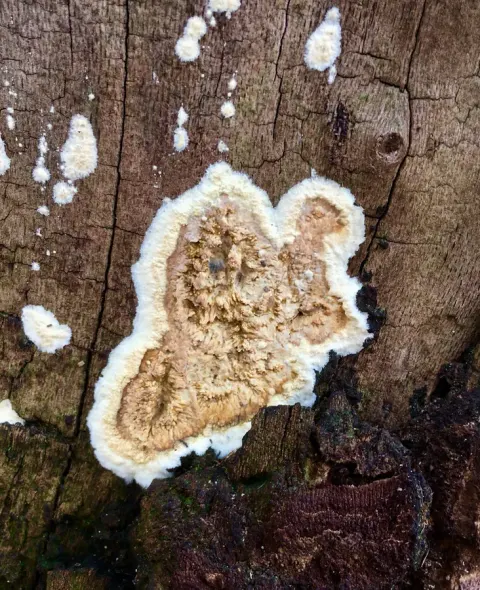
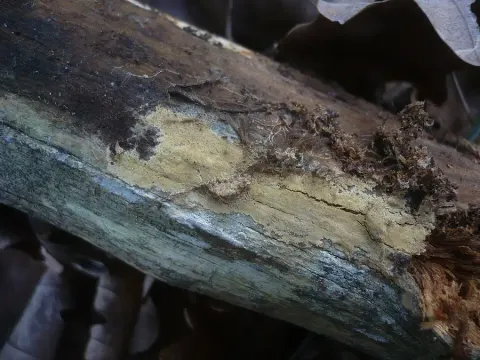
Hymenophore annual, sometimes reviving a second season, loosely attached, effused forming linear areas to 10 x 2 cm; hymenial surface ferruginous, becoming umber, sepia, or olivaceous, velutinate, even, not creviced; margin thinning out, adherent, strongly fibrillose, pallid tan. Context to 500 µm thick, ferruginous, of intertwined hyphae not differentiated into intermediate and basal layers; generative hyphae 4-6 µm diameter, walls 0.5 µm thick, chestnut, branched, inflated to 12 µm inoccasional cells, coated with sparse gelatinous warts. Cordons numerous, scattered in the base, formed from 7-28 partly cemented hyphae. Septocystidia arising in the base of the hymenial layer and projecting to 10 µm, also scattered in the context, cylindrical, septate, 80-180 x 10-16 µm, walls chestnut, 1-3 µm thick, coated with granules of mucilage arranged in irregular warts. Hymenial layer to 120 µm deep, a dense palisade of basidia, paraphyses, septocystidia, and paraphysate hyphae. Basidia subclavate, 30-45 x 6-8 µm, bearing 2-4 spores; sterigmata arcuate, to 6 µm long. Paraphyses subclavate, 18-30 x 5-6 µm. Paraphysate hyphae 4-6 µm diameter, hyaline, slender, septate, projecting to 40 µm. Spores obovate, elliptical, pip-shaped, or naviculate, often flattened on one side, apices rounded or slightly acuminate, bases apiculate, 10-13 x 5-7 µm, walls smooth, ferruginous or chestnut, 0.5 µm thick.

Sebagian uraian ditampilkan dalam bahasa sumber; terjemahannya belum tersedia atau belum lolos pemeriksaan.

Rujukan: [1]

Pengukuran mengikuti objek, spesimen atau kultur, dan metode yang disebutkan sumber. Baca uraian asli untuk konteks lengkap.

02 / Kehidupan

Habitat dan peran ekologis

DISTRIBUTION: Europe, Great Britain, North America, South Africa, New Zealand. HABITAT: Bark of decayed branches and trunks.

Sebagian uraian ditampilkan dalam bahasa sumber; terjemahannya belum tersedia atau belum lolos pemeriksaan.

Rujukan: [1]

Habitat atau konteks temuan
Informasi belum tersedia pada sumber rilis ini.
Substrat
Informasi belum tersedia pada sumber rilis ini.
Peran atau konteks
Belum dikategorikan pada rilis ini.
Temukan hubungan serupa
03 / Siklus hidup

Reproduksi

Hymenophore annual, sometimes reviving a second season, loosely attached, effused forming linear areas to 10 x 2 cm; hymenial surface ferruginous, becoming umber, sepia, or olivaceous, velutinate, even, not creviced; margin thinning out, adherent, strongly fibrillose, pallid tan. Context to 500 µm thick, ferruginous, of intertwined hyphae not differentiated into intermediate and basal layers; generative hyphae 4-6 µm diameter, walls 0.5 µm thick, chestnut, branched, inflated to 12 µm inoccasional cells, coated with sparse gelatinous warts. Cordons numerous, scattered in the base, formed from 7-28 partly cemented hyphae. Septocystidia arising in the base of the hymenial layer and projecting to 10 µm, also scattered in the context, cylindrical, septate, 80-180 x 10-16 µm, walls chestnut, 1-3 µm thick, coated with granules of mucilage arranged in irregular warts.

Sebagian uraian ditampilkan dalam bahasa sumber; terjemahannya belum tersedia atau belum lolos pemeriksaan.

Rujukan: [1]

Sinonim menurut acuan taksonomi rilis: Coniophora arida var. furva; Coniophora atrocinerea; Coniophora brunneola; Coniophora ellisii; Coniophora fulvo-olivacea; Coniophora furva; Coniophora leucothrix; Coniophora olivacea var. atrocinerea; Coniophora sistotremoides; Coniophora umbrina; Coniophorella atrocinerea; Coniophorella olivacea; Coniophorella olivacea subsp. fulvo-olivacea; Coniophorella umbrina; Corticium brunneolum; Corticium ellisii; Corticium leucothrix; Corticium olivaceum; Corticium umbrinum; Hymenochaete ellisii; Hypochnus olivaceus; Odontia sistotremoides; Phylacteria atrocinerea; Rhinotrichum corticioides; Thelephora olivacea; Thelephora sistotremoides; Tomentella fusca var. umbrina
04 / Batas informasi

Catatan identitas dan cakupan

  • Nama diterima mengikuti Catalogue of Life Base2026-09-11; uraian mempertahankan konsep dan nama sumber aslinya.
  • Historical description as cited by BiotaNZ. Preserve explicit New Zealand/locality, host and specimen qualifiers. Distribution is the cited source scope, not a current global range.
  • Impor dan terjemahan otomatis belum diperiksa editorial per profil. Struktur reproduktif yang disebutkan tidak membuktikan seluruh siklus hidup diketahui.
  • Pengukuran pada uraian mengikuti spesimen, kultur, dan metode sumber; angka tidak diperluas ke semua populasi.

Catatan distribusi dalam narasi mengikuti sumbernya. Dokumentasi spesimen atau foto mengikuti catatan sumber. Bukti wilayah Indonesia dan penilaian konservasi tidak disimpulkan dari gambar.

05 / Dokumentasi

Melihat dengan konteks

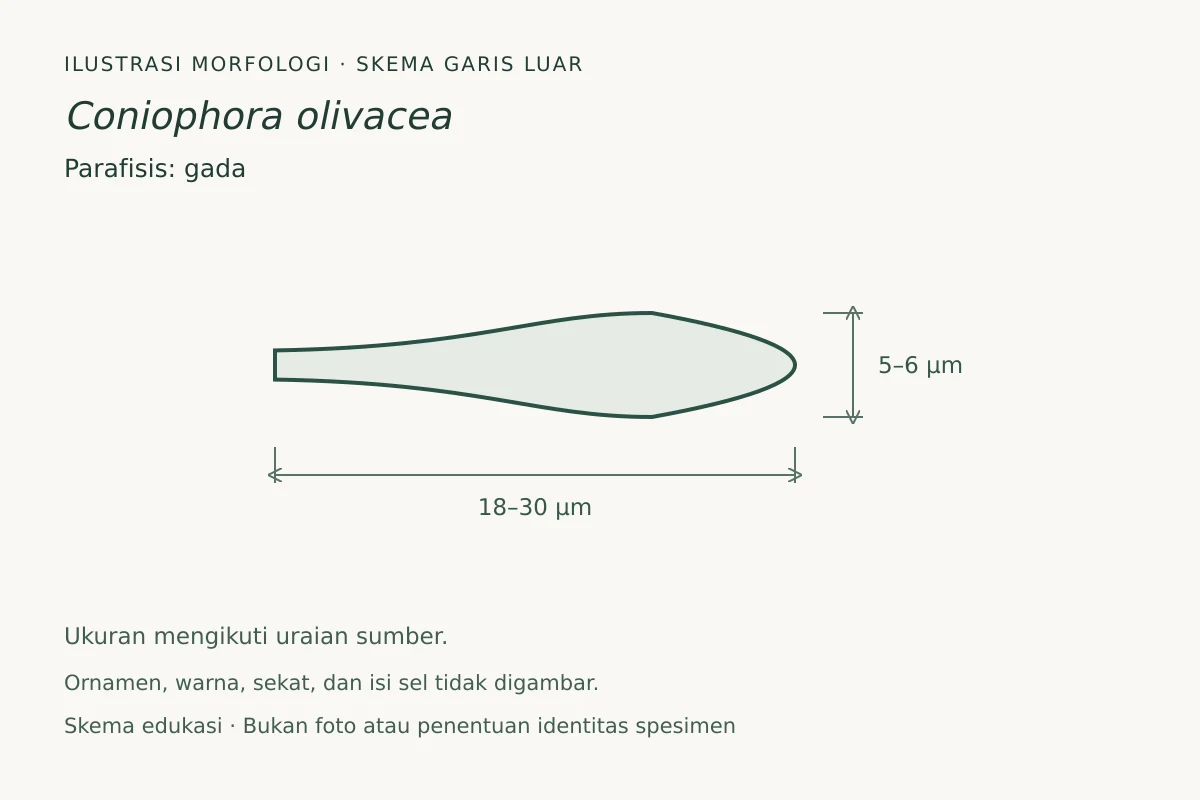
Ilustrasi skematis garis luar parafisis Coniophora olivacea, berdasarkan uraian sumber; ukuran yang dilaporkan 18–30 × 5–6 µm. Proporsi disederhanakan, bukan salinan satu spesimen. Ornamen permukaan, warna, sekat, dan isi sel tidak direkonstruksi. Parafisis hampir berbentuk gada, 18–30 × 5–6 µm. Basidium bersterigma dan spora berapikulus tidak digunakan. Ornamen, warna, sekat, dan isi sel tidak digambar. Skema edukasi, bukan alat identifikasi.

Jenis
Ilustrasi skematis
Kredit
Fungi, ilustrasi orisinal (2026); fakta morfologi berdasarkan Cunningham, G.H. 1963: The Thelephoraceae of Australia and New Zealand. New Zealand Department of Scientific and Industrial Research, Bulletin. 145.
Sumber media
Buka entri sumber

Gambar menunjukkan objek menurut identifikasi sumber, bukan verifikasi independen spesimen oleh Fungi. Tidak ada skala baru yang ditambahkan.

06 / Rujukan

Sumber profil

  1. [1] Cunningham, G.H. 1963: The Thelephoraceae of Australia and New Zealand. New Zealand Department of Scientific and Industrial Research, Bulletin. 145. — Coniophora olivaceaBagian sumber: biota:1cb0defb-36b9-11d5-9548-00d0592d548c:1cb18480-36b9-11d5-9548-00d0592d548c
    Tanggal penghimpunan sumber: 2026-10-12
    Media sumber: CC BY 4.0 · Cunningham, G.H. 1963: The Thelephoraceae of Australia and New Zealand. New Zealand Department of Scientific and Industrial Research, Bulletin. 145.
  2. [2] Catalogue of Life Base2026-09-11 — Coniophora olivaceaBagian sumber: ColDP NameUsage.tsv ID 5ZTCV; accepted species; source 2073
    Tanggal penghimpunan sumber: 2026-10-12

Adaptasi teks: CC BY 4.0. Cunningham, G.H. 1963: The Thelephoraceae of Australia and New Zealand. New Zealand Department of Scientific and Industrial Research, Bulletin. 145. — Cunningham, G.H. 1963: The Thelephoraceae of Australia and New Zealand. New Zealand Department of Scientific and Industrial Research, Bulletin. 145. — Coniophora olivacea

Uraian asli dan riwayat sumber

Riwayat atau halaman sumber

Ringkasan sumber

Hymenophore annual, sometimes reviving a second season, loosely attached, effused forming linear areas to 10 x 2 cm; hymenial surface ferruginous, becoming umber, sepia, or olivaceous, velutinate, even, not creviced; margin thinning out, adherent, strongly fibrillose, pallid tan. Context to 500 µm thick, ferruginous, of intertwined hyphae not differentiated into intermediate and basal layers; generative hyphae 4-6 µm diameter, walls 0.5 µm thick, chestnut, branched, inflated to 12 µm inoccasional cells, coated with sparse gelatinous warts.

Revisi sumber

Morfologi sumber

Hymenophore annual, sometimes reviving a second season, loosely attached, effused forming linear areas to 10 x 2 cm; hymenial surface ferruginous, becoming umber, sepia, or olivaceous, velutinate, even, not creviced; margin thinning out, adherent, strongly fibrillose, pallid tan. Context to 500 µm thick, ferruginous, of intertwined hyphae not differentiated into intermediate and basal layers; generative hyphae 4-6 µm diameter, walls 0.5 µm thick, chestnut, branched, inflated to 12 µm inoccasional cells, coated with sparse gelatinous warts. Cordons numerous, scattered in the base, formed from 7-28 partly cemented hyphae. Septocystidia arising in the base of the hymenial layer and projecting to 10 µm, also scattered in the context, cylindrical, septate, 80-180 x 10-16 µm, walls chestnut, 1-3 µm thick, coated with granules of mucilage arranged in irregular warts. Hymenial layer to 120 µm deep, a dense palisade of basidia, paraphyses, septocystidia, and paraphysate hyphae. Basidia subclavate, 30-45 x 6-8 µm, bearing 2-4 spores; sterigmata arcuate, to 6 µm long. Paraphyses subclavate, 18-30 x 5-6 µm. Paraphysate hyphae 4-6 µm diameter, hyaline, slender, septate, projecting to 40 µm. Spores obovate, elliptical, pip-shaped, or naviculate, often flattened on one side, apices rounded or slightly acuminate, bases apiculate, 10-13 x 5-7 µm, walls smooth, ferruginous or chestnut, 0.5 µm thick.

Revisi sumber

Ekologi sumber

DISTRIBUTION: Europe, Great Britain, North America, South Africa, New Zealand. HABITAT: Bark of decayed branches and trunks.

Revisi sumber

Struktur reproduksi sumber

Hymenophore annual, sometimes reviving a second season, loosely attached, effused forming linear areas to 10 x 2 cm; hymenial surface ferruginous, becoming umber, sepia, or olivaceous, velutinate, even, not creviced; margin thinning out, adherent, strongly fibrillose, pallid tan. Context to 500 µm thick, ferruginous, of intertwined hyphae not differentiated into intermediate and basal layers; generative hyphae 4-6 µm diameter, walls 0.5 µm thick, chestnut, branched, inflated to 12 µm inoccasional cells, coated with sparse gelatinous warts. Cordons numerous, scattered in the base, formed from 7-28 partly cemented hyphae. Septocystidia arising in the base of the hymenial layer and projecting to 10 µm, also scattered in the context, cylindrical, septate, 80-180 x 10-16 µm, walls chestnut, 1-3 µm thick, coated with granules of mucilage arranged in irregular warts.

Revisi sumber

Rujukan halaman ini

Fungi. Coniophora olivacea. Rilis data fungi-2026-10-12-expansion-2. https://fungi-atlas.mgadib.chatgpt.site/jamur/coniophora-olivacea/.

Status: impor sumber; pemeriksaan editorial per profil belum selesai. Untuk klaim biologis, gunakan rujukan pada bagian terkait dan periksa konteks sumber aslinya.