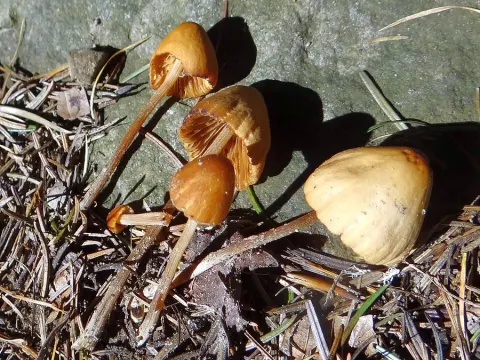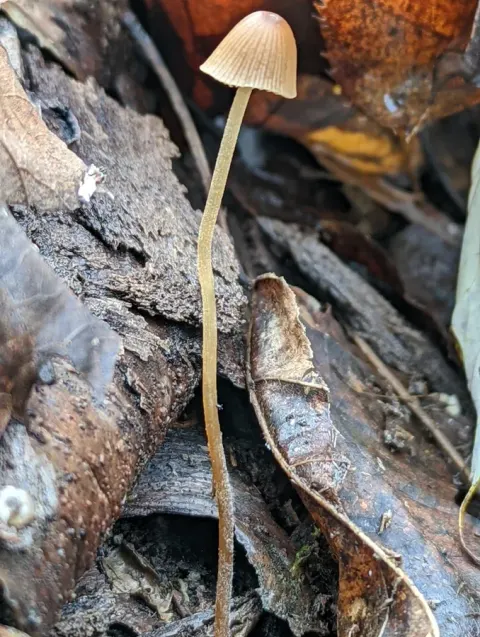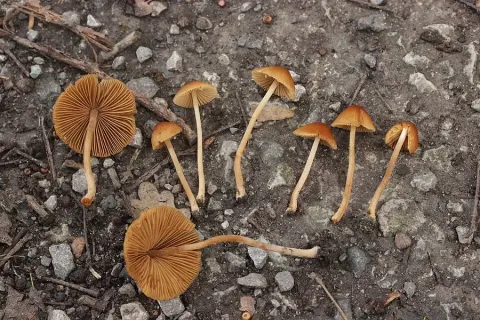
Ciri dan struktur
Basidioma mycenoid. Pileus diameter 1.0–1.5 cm, obtusely conical, edge straight, undulate, center signal brown (RAL8002) to deer brown (RAL8007), fading towards the edge, brown beige (RAL1011) to ivory (RAL1014), pileus hygrophanous, smooth, striate towards the center. Context thin, ivory (RAL1014) to light ivory (RAL1015), no specific odor or taste. Lamellae adnexed to narrowly adnate, ventricose, slightly loosely, unequal in length, beige (RAL1001) to sandy yellow (RAL1002), with smooth margins. Stipe length 3.5–4.0 cm, width 0.5–1.5 mm, cylindrical, brown beige (RAL1011) to sandy yellow (RAL1002), surface pubescent, longitudinally fibrous striate, subbulbous at the base. Basidiospores (40/1/1) 7.5–9.5(–10) × 5.5–6.5 × 5–6 μm, Q=(1.32–)1.34–1.78(–1.80), Qm = 1.49(±0.11), lentiform, frontal view nearly hexagonal or submitriform, side view ellipsoid to oblong, thick-walled, containing oil droplets, germ pore diameter 0.5–1.5 μm. Basidiospores in 5% KOH solution ochre brown (RAL8001) to copper brown (RAL8004). Basidia (14–)15–21(–22) × 8–10 μm, broadly clavate to clavate, 4-spored, with sterigmata length 3–6 μm, basidia contain vacuolar contents. Cheilocystidia (13–)15–21 × 7–10(–11) μm, lecythiform, with capitula 3–6 μm wide. Caulocystidia are ellipsoid to oblong, lageniform, long-necked lageniform, nettle hair-shaped, narrowly conical, fusiform, cylindrical, clavate, narrowly utriform to utriform, measuring (20–)22–55(–57) × (5–)6–16 μm, capilliform cystidia can reach a length of 100 μm, with rare lecythiform cystidia mixed in. Pileipellis hymeniform, consists of spheropedunculate and obpyriform cells, 29–48(–50) × (18–)19–27(–30) μm, with yellow pigment at the base.
Habitat dan peran ekologis
Solitary in mixed forests during autumn. Asia: China, Russia; Europe: Sweden, Finland, Latvia, Hungary, Germany, Austria (Holotype), Belgium, United Kingdom, France, Italy (Hausknecht 2009).
- Habitat atau konteks temuan
- hutan
- Substrat
- Informasi belum tersedia pada sumber rilis ini.
- Peran atau konteks
- Belum dikategorikan pada rilis ini.
Reproduksi
Basidioma mycenoid. Pileus diameter 1.0–1.5 cm, obtusely conical, edge straight, undulate, center signal brown (RAL8002) to deer brown (RAL8007), fading towards the edge, brown beige (RAL1011) to ivory (RAL1014), pileus hygrophanous, smooth, striate towards the center. Context thin, ivory (RAL1014) to light ivory (RAL1015), no specific odor or taste. Lamellae adnexed to narrowly adnate, ventricose, slightly loosely, unequal in length, beige (RAL1001) to sandy yellow (RAL1002), with smooth margins. Stipe length 3.5–4.0 cm, width 0.5–1.5 mm, cylindrical, brown beige (RAL1011) to sandy yellow (RAL1002), surface pubescent, longitudinally fibrous striate, subbulbous at the base. Basidiospores (40/1/1) 7.5–9.5(–10) × 5.5–6.5 × 5–6 μm, Q=(1.32–)1.34–1.78(–1.80), Qm = 1.49(±0.11), lentiform, frontal view nearly hexagonal or submitriform, side view ellipsoid to oblong, thick-walled, containing oil droplets, germ pore diameter 0.5–1.5 μm.
Catatan identitas dan cakupan
- Nama diterima mengikuti Catalogue of Life Base2026-09-11; uraian mempertahankan konsep dan nama sumber aslinya.
- Preserve original treatment localities, hosts and substrate scope. Materials examined describe documented specimens, not the full global range.
- Impor dan terjemahan otomatis belum diperiksa editorial per profil. Struktur reproduktif yang disebutkan tidak membuktikan seluruh siklus hidup diketahui.
- Pengukuran pada uraian mengikuti spesimen, kultur, dan metode sumber; angka tidak diperluas ke semua populasi.
Catatan distribusi dalam narasi mengikuti sumbernya. Dokumentasi spesimen atau foto mengikuti catatan sumber. Bukti wilayah Indonesia dan penilaian konservasi tidak disimpulkan dari gambar.
Melihat dengan konteks
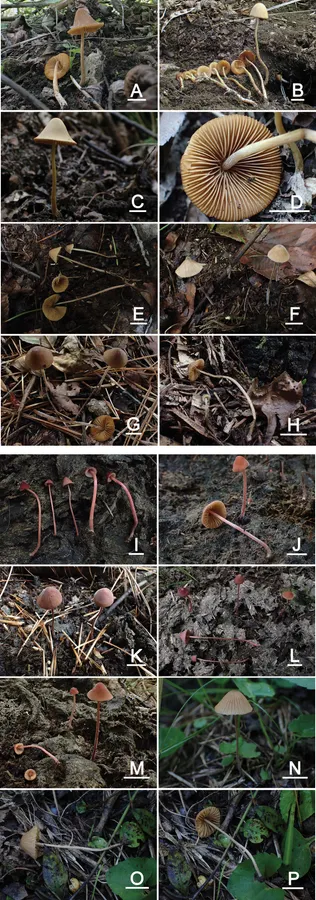
Basidiomata of Conocybe sect. Pilosellae species A C. verna (FJAU65117 T) B C. verna (FJAU65118) C, D C. verna (FJAU65119) E, F C. angulispora (FJAU65120 T) G C. angulispora (FJAU65122) H C. angulispora (FJAU65121) I C. rubrocyanea (FJAU65123 T) J C. rubrocyanea (FJAU71654) K C. rubrocyanea (FJAU71658) L C. rubrocyanea (FJAU71652) M C. rubrocyanea (FJAU71650) N–P C. hexagonospora (FJAU71661), Scale bars: 1 cm, T = holotype.
- Jenis
- Pelat ilmiah
- Kredit
- Han-bing Song, Tolgor Bau
- Lisensi
- CC BY 4.0
- Sumber media
- Buka entri sumber
Dokumentasi tambahan
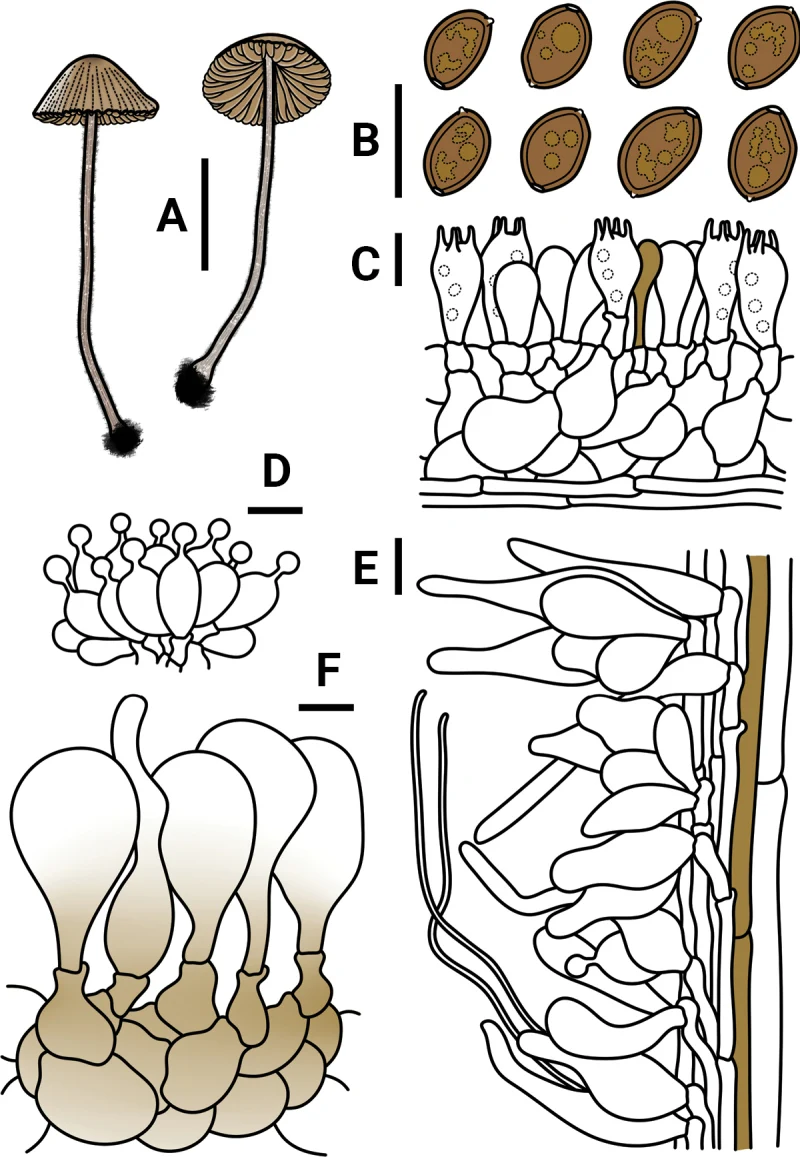
Conocybe hexagonospora (FJAU71661) A basidiomata B basidiospores in KOH C hymenium and subhymenium D cheilocystidia E stipitipellis F pileipellis. Scale bars: 1 cm (A); 10 μm (B–F).
Kredit dan penggunaan
Han-bing Song, Tolgor Bau
Ukuran dan format gambar disesuaikan tanpa pemotongan, retus, atau penambahan skala. Lisensi sumber dipertahankan.
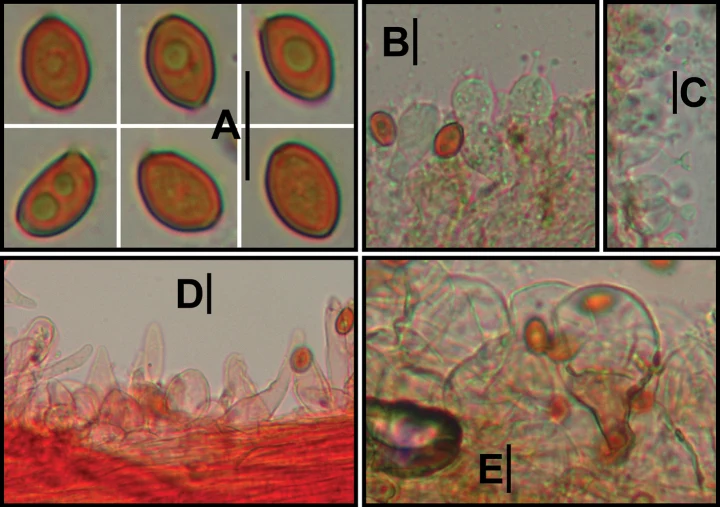
Microscopic structure images of Conocybe hexagonospora (FJAU71661) A basidiospores B basidia C cheilocystidia D stipitipellis E pileipellis. Scale bars: 10 μm (A–E).
Kredit dan penggunaan
Han-bing Song, Tolgor Bau
Ukuran dan format gambar disesuaikan tanpa pemotongan, retus, atau penambahan skala. Lisensi sumber dipertahankan.
Sumber profil
- [1] Three new species and a new record of Conocybe section Pilosellae (Bolbitiaceae, Agaricales) from Jilin Province, China — Conocybe hexagonospora
- [2] Catalogue of Life Base2026-09-11 — Conocybe hexagonospora
- [3] Dokumentasi visual — Conocybe hexagonospora
- [4] Dokumentasi visual — Conocybe hexagonospora
- [5] Dokumentasi visual — Conocybe hexagonospora
Rujukan halaman ini
Fungi. Conocybe hexagonospora. Rilis data fungi-2026-10-12-expansion-2. https://fungi-atlas.mgadib.chatgpt.site/jamur/conocybe-hexagonospora/.
Status: impor sumber; pemeriksaan editorial per profil belum selesai. Untuk klaim biologis, gunakan rujukan pada bagian terkait dan periksa konteks sumber aslinya.