pileus 1.5–6.5 cm lebar, pada awalnya konveksi, kemudian plano-konveksi, cokelat, fibriloza putih marginal; higrophanus, mengering di zona di tengah menjadi cokelat ochraceous pucat. Lamellae medium berjarak, dilampirkan ke marginate, awalnya coklat pucat, kemudian coklat ke coklat gelap, tepi lebih pucat setidaknya ketika muda. stipe 3–8 cm panjang, 0.6–1.1 cm tebal di puncak, 0.8–1.3 cm lebar di dasar, silinder hingga agak clavate, pada awalnya fibrillose sutra putih, menjadi cokelat pucat dengan usia, terutama di dasar. Konteks: dalam pileus cokelat, dalam stipe cokelat pucat, marmer hygrophanaus.
Profil ini diimpor dari uraian spesies pada sumber berlisensi dan sebagian teks diterjemahkan otomatis. Pemeriksaan editorial per profil belum selesai. Bagian yang belum diterjemahkan atau belum lolos pemeriksaan terjemahan tetap ditampilkan dalam bahasa sumber. Angka dan nama ilmiah dipertahankan.
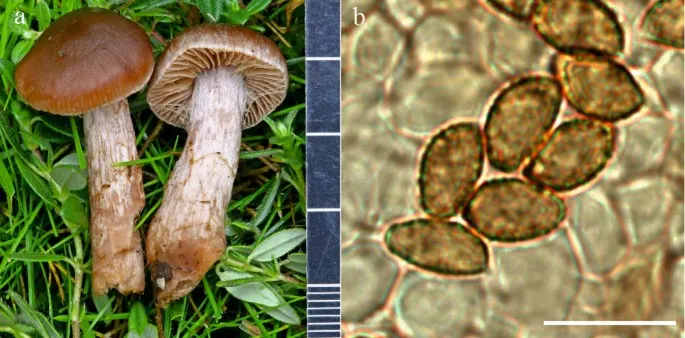
Pileus 1.5–6.5 cm wide, at first convex, later plano-convex, brown, margin whitish fibrillose; hygrophanous, drying up in a zone at the centre to pale ochraceous brown. Lamellae medium spaced, adnexed to emarginate, at first pale brown, later brown to dark brown, edge paler at least when young. Stipe 3–8 cm long, 0.6–1.1 cm thick at apex, 0.8–1.3 cm wide at base, cylindrical to somewhat clavate, at first whitish silky fibrillose, becoming pale brownish with age, especially at the base. Context: in pileus brown, in stipe pale brown, marbled hygrophanous. Universal veil white, rather sparse or more abundant and forming some incomplete girdles on the stipe. Odour in lamellae indistinct. Basidiospores 8–9(–9.5) × 5–5.8 μm, av. = 8.7 × 5.3 µm, Q = 1.4–1.9, Qav. = 1.65, amygdaloid, moderately to strongly verrucose, moderately dextrinoid. Basidia 27–39 × 7–9 µm, clavate, with four sterigmata. Lamellar trama hyphae golden brown, smooth with a few spot-like encrustations. Pileipellis: Epicutis pale, consisting of parallel hyphae, 5.5–8.5 μm wide, smooth with a few spot-like incrustations. Hypoderm pale brown, elements 17–31 × 11–15.5, smooth with a few spot-like encrustations. ITS sequence (GenBank MK010965, holotype) distinct from other members of C. sect. Bovini and deviating from them by more than 13 substitutions and indels.
Sebagian uraian ditampilkan dalam bahasa sumber; terjemahannya belum tersedia atau belum lolos pemeriksaan.
Pengukuran mengikuti objek, spesimen atau kultur, dan metode yang disebutkan sumber. Baca uraian asli untuk konteks lengkap.
02 / Kehidupan
Habitat dan peran ekologis
Ecology and distribution: In deciduous forests (Quercus, Corylus, Fagus) on calcareous ground, also in open, grazed areas, presumably with Helianthemum. From temperate to hemiboreal areas. Known from Central and northern Europe.
Sebagian uraian ditampilkan dalam bahasa sumber; terjemahannya belum tersedia atau belum lolos pemeriksaan.
Pileus 1.5–6.5 cm wide, at first convex, later plano-convex, brown, margin whitish fibrillose; hygrophanous, drying up in a zone at the centre to pale ochraceous brown. Lamellae medium spaced, adnexed to emarginate, at first pale brown, later brown to dark brown, edge paler at least when young. Stipe 3–8 cm long, 0.6–1.1 cm thick at apex, 0.8–1.3 cm wide at base, cylindrical to somewhat clavate, at first whitish silky fibrillose, becoming pale brownish with age, especially at the base. Context: in pileus brown, in stipe pale brown, marbled hygrophanous. Universal veil white, rather sparse or more abundant and forming some incomplete girdles on the stipe. Odour in lamellae indistinct. Basidiospores 8–9(–9.5) × 5–5.8 μm, av. = 8.7 × 5.3 µm, Q = 1.4–1.9, Qav. = 1.65, amygdaloid, moderately to strongly verrucose, moderately dextrinoid.
Sebagian uraian ditampilkan dalam bahasa sumber; terjemahannya belum tersedia atau belum lolos pemeriksaan.
Nama diterima mengikuti Catalogue of Life Base2026-09-11; uraian mempertahankan konsep dan nama sumber aslinya.
Preserve original monograph treatment localities, hosts and specimen/substrate scope. Materials examined document specimens, not the full global range.
Impor dan terjemahan otomatis belum diperiksa editorial per profil. Struktur reproduktif yang disebutkan tidak membuktikan seluruh siklus hidup diketahui.
Pengukuran pada uraian mengikuti spesimen, kultur, dan metode sumber; angka tidak diperluas ke semua populasi.
Catatan distribusi dalam narasi mengikuti sumbernya. Dokumentasi spesimen atau foto mengikuti catatan sumber. Bukti wilayah Indonesia dan penilaian konservasi tidak disimpulkan dari gambar.
05 / Dokumentasi
Melihat dengan konteks
Cortinarius ainsworthii (A.M. Ainsworth 236875, holotype K). a Basidiomata. b Basidiospores. Photograph: a A. Martyn Ainsworth, b Begona Aguirre-Hudson. Scale bars: a = 10 mm, b = 10 µm
Jenis
Pelat ilmiah
Kredit
Penulis dan sumber artikel: Hyde, Kevin D.; Dong, Yang; Phookamsak, Rungtiwa; Jeewon, Rajesh; Bhat, D. Jayarama; Jones, E. B. Gareth; Liu, Ning-Guo; Abeywickrama, Pranami D.; Mapook, Ausana; Wei, Deping; Perera, Rekhani H.; Manawasinghe, Ishara S.; Pem, Dhandevi; Bundhun, Digvijayini; Karunarathna, Anuruddha; Ekanayaka, Anusha H.; Bao, Dan-Feng; Li, Junfu; Samarakoon, Milan C.; Chaiwan, Napalai; Lin, Chuan-Gen; Phutthacharoen, Kunthida; Zhang, Sheng-Nan; Senanayake, Indunil C.; Goonasekara, Ishani D.; Thambugala, Kasun M.; Phukhamsakda, Chayanard; Tennakoon, Danushka S.; Jiang, Hong-Bo; Yang, Jing; Zeng, Ming; Huanraluek, Naruemon; Liu, Jian-Kui (Jack); Wijesinghe, Subodini N.; Tian, Qing; Tibpromma, Saowaluck; Brahmanage, Rashika S.; Boonmee, Saranyaphat; Huang, Shi-Ke; Thiyagaraja, Vinodhini; Lu, Yong-Zhong; Jayawardena, Ruvishika S.; Dong, Wei; Yang, Er-Fu; Singh, Sanjay K.; Singh, Shiv Mohan; Rana, Shiwali; Lad, Sneha S.; Anand, Garima; Devadatha, Bandarupalli; Niranjan, M.; Sarma, V. Venkateswara; Liimatainen, Kare; Aguirre-Hudson, Begoña; Niskanen, Tuula; Overall, Andy; Alvarenga, Renato Lúcio Mendes; Gibertoni, Tatiana Baptista; Pfliegler, Walter P.; Horváth, Enikő; Imre, Alexandra; Alves, Amanda Lucia; da Silva Santos, Ana Carla; Tiago, Patricia Vieira; Bulgakov, Timur S.; Wanasinghe, Dhanushaka N.; Bahkali, Ali H.; Doilom, Mingkwan; Elgorban, Abdallah M.; Maharachchikumbura, Sajeewa S. N.; Rajeshkumar, Kunhiraman C.; Haelewaters, Danny; Mortimer, Peter E.; Zhao, Qi; Lumyong, Saisamorn; Xu, Jianchu; Sheng, Jun
Pileus 1.5–6.5 cm wide, at first convex, later plano-convex, brown, margin whitish fibrillose; hygrophanous, drying up in a zone at the centre to pale ochraceous brown.
Lamellae medium spaced, adnexed to emarginate, at first pale brown, later brown to dark brown, edge paler at least when young.
Stipe 3–8 cm long, 0.6–1.1 cm thick at apex, 0.8–1.3 cm wide at base, cylindrical to somewhat clavate, at first whitish silky fibrillose, becoming pale brownish with age, especially at the base.
Context: in pileus brown, in stipe pale brown, marbled hygrophanous.
Pileus 1.5–6.5 cm wide, at first convex, later plano-convex, brown, margin whitish fibrillose; hygrophanous, drying up in a zone at the centre to pale ochraceous brown. Lamellae medium spaced, adnexed to emarginate, at first pale brown, later brown to dark brown, edge paler at least when young. Stipe 3–8 cm long, 0.6–1.1 cm thick at apex, 0.8–1.3 cm wide at base, cylindrical to somewhat clavate, at first whitish silky fibrillose, becoming pale brownish with age, especially at the base. Context: in pileus brown, in stipe pale brown, marbled hygrophanous. Universal veil white, rather sparse or more abundant and forming some incomplete girdles on the stipe. Odour in lamellae indistinct. Basidiospores 8–9(–9.5) × 5–5.8 μm, av. = 8.7 × 5.3 µm, Q = 1.4–1.9, Qav. = 1.65, amygdaloid, moderately to strongly verrucose, moderately dextrinoid. Basidia 27–39 × 7–9 µm, clavate, with four sterigmata. Lamellar trama hyphae golden brown, smooth with a few spot-like encrustations. Pileipellis: Epicutis pale, consisting of parallel hyphae, 5.5–8.5 μm wide, smooth with a few spot-like incrustations. Hypoderm pale brown, elements 17–31 × 11–15.5, smooth with a few spot-like encrustations. ITS sequence (GenBank MK010965, holotype) distinct from other members of C. sect. Bovini and deviating from them by more than 13 substitutions and indels.
Ecology and distribution: In deciduous forests (Quercus, Corylus, Fagus) on calcareous ground, also in open, grazed areas, presumably with Helianthemum. From temperate to hemiboreal areas. Known from Central and northern Europe.
Pileus 1.5–6.5 cm wide, at first convex, later plano-convex, brown, margin whitish fibrillose; hygrophanous, drying up in a zone at the centre to pale ochraceous brown.
Lamellae medium spaced, adnexed to emarginate, at first pale brown, later brown to dark brown, edge paler at least when young.
Stipe 3–8 cm long, 0.6–1.1 cm thick at apex, 0.8–1.3 cm wide at base, cylindrical to somewhat clavate, at first whitish silky fibrillose, becoming pale brownish with age, especially at the base.
Context: in pileus brown, in stipe pale brown, marbled hygrophanous.
Universal veil white, rather sparse or more abundant and forming some incomplete girdles on the stipe.
Odour in lamellae indistinct.
Basidiospores 8–9(–9.5) × 5–5.8 μm, av. = 8.7 × 5.3 µm, Q = 1.4–1.9, Qav. = 1.65, amygdaloid, moderately to strongly verrucose, moderately dextrinoid.
Status: impor sumber; pemeriksaan editorial per profil belum selesai. Untuk klaim biologis, gunakan rujukan pada bagian terkait dan periksa konteks sumber aslinya.
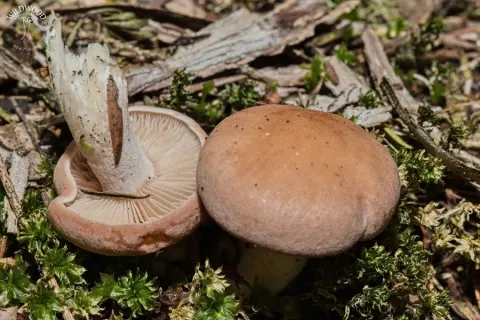
Pileus 25-65 mm diam., convex-pulvinate, umbonate, later becoming expanded and sometimes subdepressed at the centre (at maturity) pink to reddish-brown, radially fibrillose, densely covered with concolorous or yellowish to brownish small…
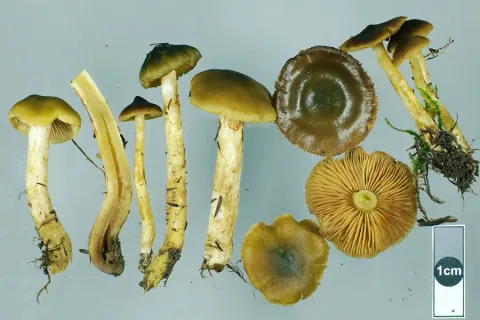
Pileus -60 mm, hemispherical or convex becoming broadly umbonate or obtusely campanulate finally depressed around umbo, margin distinctly inrolled in young specimens; centre black-olive, pale fuliginous-green or grey-green, fading towards…