01 / Morfologi

Ciri dan struktur

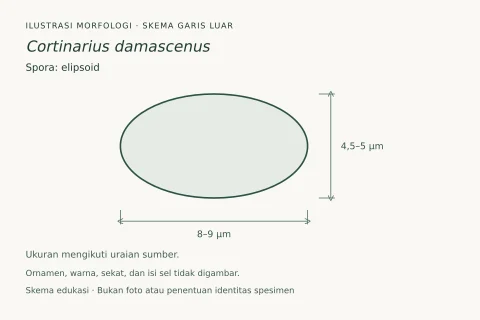
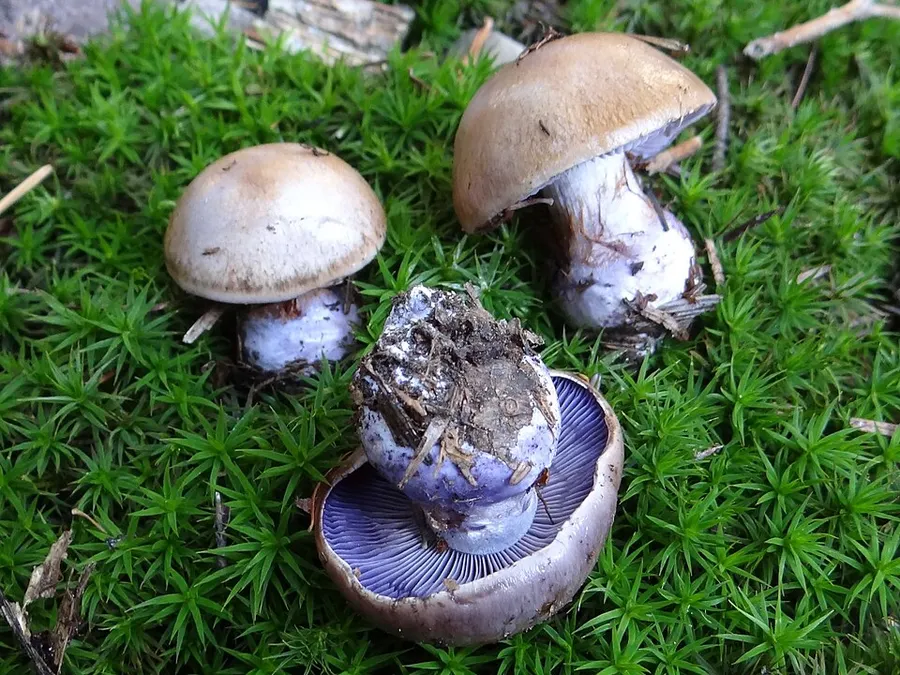
The fruitbodies of this fungus have convex caps, with diameters typically in the range 5 to 12 cm, and various shades of violet, brown or grey. They are slimy when young, and later have brown scales. The pale purple stipe is bulbous, 9 - 15 cm in height and 2 – 3.5 cm in width. The flesh is purple, but turns blood red when bruised or cut. The gills on the cap underside have an adnate attachment to the stipe and purple color; later, the deepens to rusty brown as the spores mature. The smell has been described as pleasant and fruity. The lemon-shaped spores measure 8–11.5 by 5–6.5 μm. C. boreicyanites and C. violaceorubens have smaller and larger spores respectively. C. violaceorubens has a dark purple-brown cap, while that of C. boreicyanites is more bluish.

Sebagian uraian ditampilkan dalam bahasa sumber; terjemahannya belum tersedia atau belum lolos pemeriksaan.

Rujukan: [1]

Pengukuran mengikuti objek, spesimen atau kultur, dan metode yang disebutkan sumber. Baca uraian asli untuk konteks lengkap.

02 / Kehidupan

Habitat dan peran ekologis

Cortinarius cyanites is found in mixed coniferous and deciduous forests in southern Finland, central Sweden southwards into France.

Sebagian uraian ditampilkan dalam bahasa sumber; terjemahannya belum tersedia atau belum lolos pemeriksaan.

Rujukan: [1]

Habitat atau konteks temuan
hutan
Substrat
Informasi belum tersedia pada sumber rilis ini.
Peran atau konteks
Belum dikategorikan pada rilis ini.
Temukan hubungan serupa
03 / Siklus hidup

Reproduksi

Cortinarius cyanites is a basidiomycete fungus of the genus Cortinarius native to Europe. The fruitbodies of this fungus have convex caps, with diameters typically in the range 5 to 12 cm, and various shades of violet, brown or grey. They are slimy when young, and later have brown scales. The pale purple stipe is bulbous, 9 - 15 cm in height and 2 – 3.5 cm in width. The flesh is purple, but turns blood red when bruised or cut. The gills on the cap underside have an adnate attachment to the stipe and purple color; later, the deepens to rusty brown as the spores mature. The smell has been described as pleasant and fruity. The lemon-shaped spores measure 8–11.5 by 5–6.5 μm. C. boreicyanites and C. violaceorubens have smaller and larger spores respectively.

Sebagian uraian ditampilkan dalam bahasa sumber; terjemahannya belum tersedia atau belum lolos pemeriksaan.

Rujukan: [1]

Sinonim menurut acuan taksonomi rilis: Cortinarius alboviolaceus var. cyanites; Cortinarius cyanites f. brevisporus; Cortinarius cyanites var. brevisporus; Cortinarius cyanites var. fusco-ornatus; Gomphos cyanites; Inoloma cyanites; Phlegmacium cyanites; Phlegmacium cyanites var. brevisporum; Sphaerotrachys cyanites
04 / Batas informasi

Catatan identitas dan cakupan

  • Nama diterima mengikuti Catalogue of Life Base2026-09-11; uraian mempertahankan konsep dan nama sumber aslinya.
  • Original geographic, specimen and life-cycle scope retained; source import awaits individual editorial review.
  • Impor dan terjemahan otomatis belum diperiksa editorial per profil. Struktur reproduktif yang disebutkan tidak membuktikan seluruh siklus hidup diketahui.
  • Pengukuran pada uraian mengikuti spesimen, kultur, dan metode sumber; angka tidak diperluas ke semua populasi.

Catatan distribusi dalam narasi mengikuti sumbernya. Dokumentasi spesimen atau foto mengikuti catatan sumber. Bukti wilayah Indonesia dan penilaian konservasi tidak disimpulkan dari gambar.

05 / Dokumentasi

Melihat dengan konteks

Dokumentasi Cortinarius cyanites dari Wikimedia Commons. Cortinarius cyanites . Identifikasi mengikuti record berkas sumber.

Jenis
Fotografi
Kredit
Selso (Jerzy Opioła) .
Sumber media
Buka entri sumber

Gambar menunjukkan objek menurut identifikasi sumber, bukan verifikasi independen spesimen oleh Fungi. Tidak ada skala baru yang ditambahkan.

06 / Rujukan

Sumber profil

  1. [1] Cortinarius cyanites — Wikipedia (en)Bagian sumber: Frozen revision 1364421109
    Tanggal penghimpunan sumber: 2026-10-12
    Teks sumber: CC BY-SA4.0 · Wikipedia contributors
  2. [2] Catalogue of Life Base2026-09-11 — Cortinarius cyanitesBagian sumber: ColDP NameUsage.tsv ID YKM6; accepted species; source 2073
    Tanggal penghimpunan sumber: 2026-10-12
  3. [3] Dokumentasi visual — Cortinarius cyanitesBagian sumber: Individual media record; identification follows the source, not independent determination
    Tanggal penghimpunan sumber: 2026-10-12
    Media sumber: CC BY-SA 3.0 · Selso (Jerzy Opioła) .

Adaptasi teks: CC BY-SA 4.0. Wikipedia contributors — Cortinarius cyanites — Wikipedia (en)

Uraian asli dan riwayat sumber

Riwayat atau halaman sumber

Ringkasan sumber

Cortinarius cyanites is a basidiomycete fungus of the genus Cortinarius native to Europe. Elias Magnus Fries described this species in his 1838 book Epicrisis Systematis Mycologici seu Synopsis Hymenomycetum as Cortinarius cyanites. The species name is derived from the Ancient Greek cyanos "dark blue" Within the large genus Cortinarius, it is classified in the subgenus Phlegmacium and section Cyanites. Genetic analysis showed in 2014 that two previously-described species—C. subcyanites and C. pseudocyanites—lay within the concept of C. cyanites, but conversely revealed three distinct lineages, with two new species—C. boreicyanites and C. violaceorubens—described.

Revisi sumber

Morfologi sumber

The fruitbodies of this fungus have convex caps, with diameters typically in the range 5 to 12 cm, and various shades of violet, brown or grey. They are slimy when young, and later have brown scales. The pale purple stipe is bulbous, 9 - 15 cm in height and 2 – 3.5 cm in width. The flesh is purple, but turns blood red when bruised or cut. The gills on the cap underside have an adnate attachment to the stipe and purple color; later, the deepens to rusty brown as the spores mature. The smell has been described as pleasant and fruity. The lemon-shaped spores measure 8–11.5 by 5–6.5 μm. C. boreicyanites and C. violaceorubens have smaller and larger spores respectively. C. violaceorubens has a dark purple-brown cap, while that of C. boreicyanites is more bluish.

Revisi sumber

Ekologi sumber

Cortinarius cyanites is found in mixed coniferous and deciduous forests in southern Finland, central Sweden southwards into France.

Revisi sumber

Struktur reproduksi sumber

Cortinarius cyanites is a basidiomycete fungus of the genus Cortinarius native to Europe. The fruitbodies of this fungus have convex caps, with diameters typically in the range 5 to 12 cm, and various shades of violet, brown or grey. They are slimy when young, and later have brown scales. The pale purple stipe is bulbous, 9 - 15 cm in height and 2 – 3.5 cm in width. The flesh is purple, but turns blood red when bruised or cut. The gills on the cap underside have an adnate attachment to the stipe and purple color; later, the deepens to rusty brown as the spores mature. The smell has been described as pleasant and fruity. The lemon-shaped spores measure 8–11.5 by 5–6.5 μm. C. boreicyanites and C. violaceorubens have smaller and larger spores respectively.

Revisi sumber

Rujukan halaman ini

Fungi. Cortinarius cyanites. Rilis data fungi-2026-10-12-expansion-2. https://fungi-atlas.mgadib.chatgpt.site/jamur/cortinarius-cyanites/.

Status: impor sumber; pemeriksaan editorial per profil belum selesai. Untuk klaim biologis, gunakan rujukan pada bagian terkait dan periksa konteks sumber aslinya.