01 / Morfologi

Ciri dan struktur

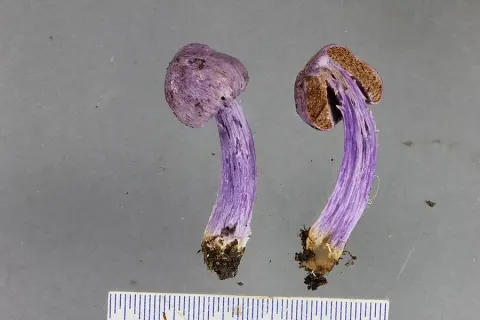
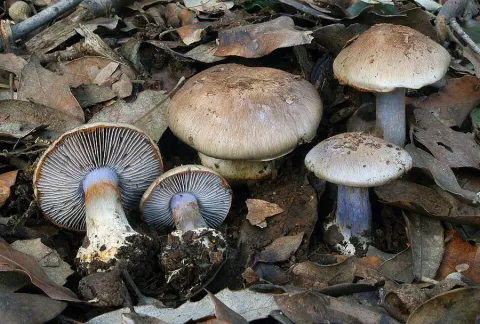
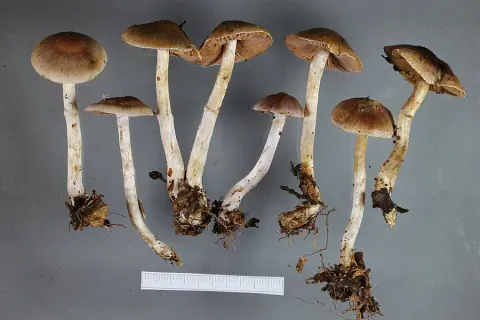
The cap is 4 – 8 cm in diameter, initially pale yellow then darker as it matures, and sandy in the middle. It has a campanulate (like a bell) to convex shape, later becoming flattened, with a very blunt umbo. The cap is fleshy in the center, but becomes thinner towards the margin. Its surface is smooth and sticky, but eventually becomes covered with silky fibers. The gills are crowded together, broad, adnexed, and slightly emarginate (notched) at the stem. They are bluish when young, later turning cinnamon as the spores mature. The stem is 5 – 10 cm long and about 1 cm thick, measuring up to 2 cm thick in the swollen part of the base. It is quite flexible, faintly bluish at the top when young, white when mature with a faint tinge of yellow, smooth, sticky or shiny, and with a cortina at the top forming an annular zone. It is narrower at the apex and usually clavately thickened at the base, stuffed, then hollow. The flesh is white, then slightly yellowish, soft, with mild taste, sometimes slightly bitter when mature, with no distinguishable odor. The mushroom is inedible. The spores are spherical to egg-shaped, drawn into an apiculus at the base, pale rust colored and coarsely verrucose (wart-like), measuring 7–8 by 6.3–6.5 μm. The basidia (spore-bearing cells) are 25–30 by 9–10 μm. The spore deposit is ochraceous rust.

Sebagian uraian ditampilkan dalam bahasa sumber; terjemahannya belum tersedia atau belum lolos pemeriksaan.

Rujukan: [1]

Pengukuran mengikuti objek, spesimen atau kultur, dan metode yang disebutkan sumber. Baca uraian asli untuk konteks lengkap.

02 / Kehidupan

Habitat dan peran ekologis

The fruit bodies of C. delibutus grow scattered or in groups on the ground in mixed and deciduous woods in the autumn, mainly beneath birches and aspens (usually in groups) throughout the temperate zone of the Northern Hemisphere. Di Amerika Utara, jamur ditemukan di utara U S. and Kanada. Fruit bodies adalah sumber makanan untuk tupai Sciurus vulgaris.

Sebagian uraian ditampilkan dalam bahasa sumber; terjemahannya belum tersedia atau belum lolos pemeriksaan.

Rujukan: [1]

Habitat atau konteks temuan
Informasi belum tersedia pada sumber rilis ini.
Substrat
tanah
Peran atau konteks
Belum dikategorikan pada rilis ini.
Temukan hubungan serupa
03 / Siklus hidup

Reproduksi

The cap is 4 – 8 cm in diameter, initially pale yellow then darker as it matures, and sandy in the middle. It has a campanulate (like a bell) to convex shape, later becoming flattened, with a very blunt umbo. The cap is fleshy in the center, but becomes thinner towards the margin. Its surface is smooth and sticky, but eventually becomes covered with silky fibers. The gills are crowded together, broad, adnexed, and slightly emarginate (notched) at the stem. They are bluish when young, later turning cinnamon as the spores mature. The stem is 5 – 10 cm long and about 1 cm thick, measuring up to 2 cm thick in the swollen part of the base. It is quite flexible, faintly bluish at the top when young, white when mature with a faint tinge of yellow, smooth, sticky or shiny, and with a cortina at the top forming an annular zone.

Sebagian uraian ditampilkan dalam bahasa sumber; terjemahannya belum tersedia atau belum lolos pemeriksaan.

Rujukan: [1]

Sinonim menurut acuan taksonomi rilis: Cortinarius delibutus f. achromophyllus; Cortinarius delibutus f. decurrentifolius; Cortinarius delibutus f. dryadicola; Cortinarius delibutus f. gracilentus; Cortinarius delibutus f. megalosporus; Cortinarius delibutus f. ochroleucoides; Cortinarius delibutus f. ochroleucus; Cortinarius delibutus f. parvulus; Cortinarius delibutus f. suratoides; Cortinarius delibutus f. suratus; Cortinarius delibutus var. albescens; Cortinarius delibutus var. elegans; Cortinarius delibutus var. fulvoluteus; Cortinarius delibutus var. naevosus; Cortinarius delibutus var. parvulus; Cortinarius fulvoluteus; Cortinarius naevosus; Cortinarius suratus; Gomphos delibutus; Gomphos naevosus; Gomphos suratus; Myxacium delibutum
04 / Batas informasi

Catatan identitas dan cakupan

  • Nama diterima mengikuti Catalogue of Life Base2026-09-11; uraian mempertahankan konsep dan nama sumber aslinya.
  • Original geographic, specimen and life-cycle scope retained; source import awaits individual editorial review.
  • Impor dan terjemahan otomatis belum diperiksa editorial per profil. Struktur reproduktif yang disebutkan tidak membuktikan seluruh siklus hidup diketahui.
  • Pengukuran pada uraian mengikuti spesimen, kultur, dan metode sumber; angka tidak diperluas ke semua populasi.

Catatan distribusi dalam narasi mengikuti sumbernya. Dokumentasi spesimen atau foto mengikuti catatan sumber. Bukti wilayah Indonesia dan penilaian konservasi tidak disimpulkan dari gambar.

05 / Dokumentasi

Melihat dengan konteks

Dokumentasi visual yang memenuhi pemeriksaan subjek dan hak penggunaan belum tersedia. Foto gejala, label, dan gambar yang meragukan tidak dihitung.

06 / Rujukan

Sumber profil

  1. [1] Cortinarius delibutus — Wikipedia (en)Bagian sumber: Frozen revision 1314268179
    Tanggal penghimpunan sumber: 2026-10-12
    Teks sumber: CC BY-SA4.0 · Wikipedia contributors
  2. [2] Catalogue of Life Base2026-09-11 — Cortinarius delibutusBagian sumber: ColDP NameUsage.tsv ID YKNJ; accepted species; source 2073
    Tanggal penghimpunan sumber: 2026-10-12

Adaptasi teks: CC BY-SA 4.0. Wikipedia contributors — Cortinarius delibutus — Wikipedia (en)

Uraian asli dan riwayat sumber

Riwayat atau halaman sumber

Ringkasan sumber

Cortinarius delibutus, also known as the bluegill webcap or the yellow webcap, is a basidiomycete fungus of the genus Cortinarius. The fruit bodies are medium-sized, with shiny yellow caps on a sticky, yellow-banded club-shaped stem. The mushroom is found in Europe and North America, usually near birch or beech trees.

Revisi sumber

Morfologi sumber

The cap is 4 – 8 cm in diameter, initially pale yellow then darker as it matures, and sandy in the middle. It has a campanulate (like a bell) to convex shape, later becoming flattened, with a very blunt umbo. The cap is fleshy in the center, but becomes thinner towards the margin. Its surface is smooth and sticky, but eventually becomes covered with silky fibers. The gills are crowded together, broad, adnexed, and slightly emarginate (notched) at the stem. They are bluish when young, later turning cinnamon as the spores mature. The stem is 5 – 10 cm long and about 1 cm thick, measuring up to 2 cm thick in the swollen part of the base. It is quite flexible, faintly bluish at the top when young, white when mature with a faint tinge of yellow, smooth, sticky or shiny, and with a cortina at the top forming an annular zone. It is narrower at the apex and usually clavately thickened at the base, stuffed, then hollow. The flesh is white, then slightly yellowish, soft, with mild taste, sometimes slightly bitter when mature, with no distinguishable odor. The mushroom is inedible. The spores are spherical to egg-shaped, drawn into an apiculus at the base, pale rust colored and coarsely verrucose (wart-like), measuring 7–8 by 6.3–6.5 μm. The basidia (spore-bearing cells) are 25–30 by 9–10 μm. The spore deposit is ochraceous rust.

Revisi sumber

Ekologi sumber

The fruit bodies of C. delibutus grow scattered or in groups on the ground in mixed and deciduous woods in the autumn, mainly beneath birches and aspens (usually in groups) throughout the temperate zone of the Northern Hemisphere. In North America, the fungus is found in the northern U.S. and Canada. Fruit bodies are a source of food for the squirrel Sciurus vulgaris.

Revisi sumber

Struktur reproduksi sumber

The cap is 4 – 8 cm in diameter, initially pale yellow then darker as it matures, and sandy in the middle. It has a campanulate (like a bell) to convex shape, later becoming flattened, with a very blunt umbo. The cap is fleshy in the center, but becomes thinner towards the margin. Its surface is smooth and sticky, but eventually becomes covered with silky fibers. The gills are crowded together, broad, adnexed, and slightly emarginate (notched) at the stem. They are bluish when young, later turning cinnamon as the spores mature. The stem is 5 – 10 cm long and about 1 cm thick, measuring up to 2 cm thick in the swollen part of the base. It is quite flexible, faintly bluish at the top when young, white when mature with a faint tinge of yellow, smooth, sticky or shiny, and with a cortina at the top forming an annular zone.

Revisi sumber

Rujukan halaman ini

Fungi. Cortinarius delibutus. Rilis data fungi-2026-10-12-expansion-2. https://fungi-atlas.mgadib.chatgpt.site/jamur/cortinarius-delibutus/.

Status: impor sumber; pemeriksaan editorial per profil belum selesai. Untuk klaim biologis, gunakan rujukan pada bagian terkait dan periksa konteks sumber aslinya.