01 / Morfologi

Ciri dan struktur

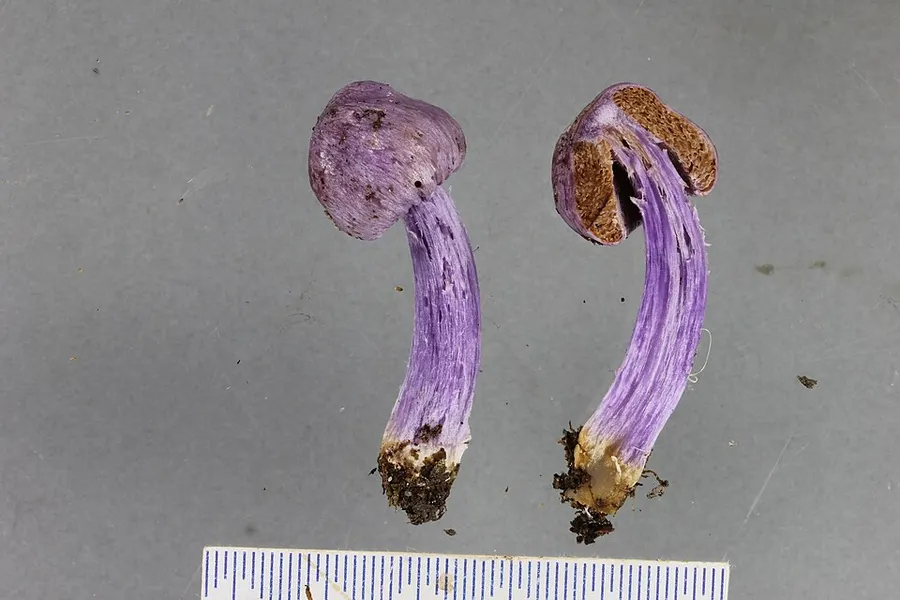
The species produces secotioid fruit bodies. The pileus ranges from 15 to 25 mm in diameter. It has a rounded shape with an incurved margin. The surface of the pileus has a smooth texture with small cracks or grooves, giving the surface a mottled appearance, slightly slimy, lavender in colour becoming slightly reddish with age. The gleba is yellow-brown to sienna in colour, with irregular locules (compartments) up to 3 mm long, attached at the top of the stipe and becoming free. The stipe is 15 to 45 mm long and 6 to 10 mm wide, centrally attached, pale violet to purple, extending into the pileus as a pale violet columella. The fruit bodies have a delicate silvery veil and no cortina. Tissues of the fruit body show no reaction to a 5% solution of potassium hydroxide. The basidiospores average 13.8 μm long and 7.6 μm wide, are rusty to tawny in colour, ellipsoid to almond-shaped, strongly warted. The spores don't change colour in contact with Melzer's reagent. Cortinarius diaphorus is distinguished from the other purple secotioid Cortinarius species in New Zealand by the combination of lavender colour of the pileus, pale mottling when young and reddening with age, and the strongly warted spores.

Sebagian uraian ditampilkan dalam bahasa sumber; terjemahannya belum tersedia atau belum lolos pemeriksaan.

Rujukan: [1]

Pengukuran mengikuti objek, spesimen atau kultur, dan metode yang disebutkan sumber. Baca uraian asli untuk konteks lengkap.

02 / Kehidupan

Habitat dan peran ekologis

Cortinarius diaphorus occurs in the South Island of New Zealand. It is an ectomycorrhizal fungus, found in forests dominated by Nothofagus species including red beech (N. fusca), silver beech (N. menziesii), and hard beech (N. truncata).

Sebagian uraian ditampilkan dalam bahasa sumber; terjemahannya belum tersedia atau belum lolos pemeriksaan.

Rujukan: [1]

Habitat atau konteks temuan
hutan
Substrat
Informasi belum tersedia pada sumber rilis ini.
Peran atau konteks
Mitra tumbuhan
Temukan hubungan serupa
03 / Siklus hidup

Reproduksi

The species produces secotioid fruit bodies. The pileus ranges from 15 to 25 mm in diameter. It has a rounded shape with an incurved margin. The surface of the pileus has a smooth texture with small cracks or grooves, giving the surface a mottled appearance, slightly slimy, lavender in colour becoming slightly reddish with age. The gleba is yellow-brown to sienna in colour, with irregular locules (compartments) up to 3 mm long, attached at the top of the stipe and becoming free. The stipe is 15 to 45 mm long and 6 to 10 mm wide, centrally attached, pale violet to purple, extending into the pileus as a pale violet columella. The fruit bodies have a delicate silvery veil and no cortina. Tissues of the fruit body show no reaction to a 5% solution of potassium hydroxide.

Sebagian uraian ditampilkan dalam bahasa sumber; terjemahannya belum tersedia atau belum lolos pemeriksaan.

Rujukan: [1]

04 / Batas informasi

Catatan identitas dan cakupan

  • Nama diterima mengikuti Catalogue of Life Base2026-09-11; uraian mempertahankan konsep dan nama sumber aslinya.
  • Original geographic, specimen and life-cycle scope retained; source import awaits individual editorial review.
  • Impor dan terjemahan otomatis belum diperiksa editorial per profil. Struktur reproduktif yang disebutkan tidak membuktikan seluruh siklus hidup diketahui.
  • Pengukuran pada uraian mengikuti spesimen, kultur, dan metode sumber; angka tidak diperluas ke semua populasi.

Catatan distribusi dalam narasi mengikuti sumbernya. Dokumentasi spesimen atau foto mengikuti catatan sumber. Bukti wilayah Indonesia dan penilaian konservasi tidak disimpulkan dari gambar.

05 / Dokumentasi

Melihat dengan konteks

Dokumentasi Cortinarius diaphorus dari Wikimedia Commons. Photo of Cortinarius diaphorus uploaded from iNaturalist . Identifikasi mengikuti record berkas sumber.

Jenis
Fotografi
Kredit
(c) David Orlovich, some rights reserved (CC BY)
Lisensi
CC BY 4.0
Sumber media
Buka entri sumber

Gambar menunjukkan objek menurut identifikasi sumber, bukan verifikasi independen spesimen oleh Fungi. Tidak ada skala baru yang ditambahkan.

06 / Rujukan

Sumber profil

  1. [1] Cortinarius diaphorus — Wikipedia (en)Bagian sumber: Frozen revision 1364421115
    Tanggal penghimpunan sumber: 2026-10-12
    Teks sumber: CC BY-SA4.0 · Wikipedia contributors
  2. [2] Catalogue of Life Base2026-09-11 — Cortinarius diaphorusBagian sumber: ColDP NameUsage.tsv ID 9Z4X5; accepted species; source 2073
    Tanggal penghimpunan sumber: 2026-10-12
  3. [3] Dokumentasi visual — Cortinarius diaphorusBagian sumber: Individual media record; identification follows the source, not independent determination
    Tanggal penghimpunan sumber: 2026-10-12
    Media sumber: CC BY 4.0 · (c) David Orlovich, some rights reserved (CC BY)

Adaptasi teks: CC BY-SA 4.0. Wikipedia contributors — Cortinarius diaphorus — Wikipedia (en)

Uraian asli dan riwayat sumber

Riwayat atau halaman sumber

Ringkasan sumber

The species produces secotioid fruit bodies. The pileus ranges from 15 to 25 mm in diameter. It has a rounded shape with an incurved margin. The surface of the pileus has a smooth texture with small cracks or grooves, giving the surface a mottled appearance, slightly slimy, lavender in colour becoming slightly reddish with age. The gleba is yellow-brown to sienna in colour, with irregular locules (compartments) up to 3 mm long, attached at the top of the stipe and becoming free. The stipe is 15 to 45 mm long and 6 to 10 mm wide, centrally attached, pale violet to purple, extending into the pileus as a pale violet columella.

Revisi sumber

Morfologi sumber

The species produces secotioid fruit bodies. The pileus ranges from 15 to 25 mm in diameter. It has a rounded shape with an incurved margin. The surface of the pileus has a smooth texture with small cracks or grooves, giving the surface a mottled appearance, slightly slimy, lavender in colour becoming slightly reddish with age. The gleba is yellow-brown to sienna in colour, with irregular locules (compartments) up to 3 mm long, attached at the top of the stipe and becoming free. The stipe is 15 to 45 mm long and 6 to 10 mm wide, centrally attached, pale violet to purple, extending into the pileus as a pale violet columella. The fruit bodies have a delicate silvery veil and no cortina. Tissues of the fruit body show no reaction to a 5% solution of potassium hydroxide. The basidiospores average 13.8 μm long and 7.6 μm wide, are rusty to tawny in colour, ellipsoid to almond-shaped, strongly warted. The spores don't change colour in contact with Melzer's reagent. Cortinarius diaphorus is distinguished from the other purple secotioid Cortinarius species in New Zealand by the combination of lavender colour of the pileus, pale mottling when young and reddening with age, and the strongly warted spores.

Revisi sumber

Ekologi sumber

Cortinarius diaphorus occurs in the South Island of New Zealand. It is an ectomycorrhizal fungus, found in forests dominated by Nothofagus species including red beech (N. fusca), silver beech (N. menziesii), and hard beech (N. truncata).

Revisi sumber

Struktur reproduksi sumber

The species produces secotioid fruit bodies. The pileus ranges from 15 to 25 mm in diameter. It has a rounded shape with an incurved margin. The surface of the pileus has a smooth texture with small cracks or grooves, giving the surface a mottled appearance, slightly slimy, lavender in colour becoming slightly reddish with age. The gleba is yellow-brown to sienna in colour, with irregular locules (compartments) up to 3 mm long, attached at the top of the stipe and becoming free. The stipe is 15 to 45 mm long and 6 to 10 mm wide, centrally attached, pale violet to purple, extending into the pileus as a pale violet columella. The fruit bodies have a delicate silvery veil and no cortina. Tissues of the fruit body show no reaction to a 5% solution of potassium hydroxide.

Revisi sumber

Rujukan halaman ini

Fungi. Cortinarius diaphorus. Rilis data fungi-2026-10-12-expansion-2. https://fungi-atlas.mgadib.chatgpt.site/jamur/cortinarius-diaphorus/.

Status: impor sumber; pemeriksaan editorial per profil belum selesai. Untuk klaim biologis, gunakan rujukan pada bagian terkait dan periksa konteks sumber aslinya.