01 / Morfologi

Ciri dan struktur

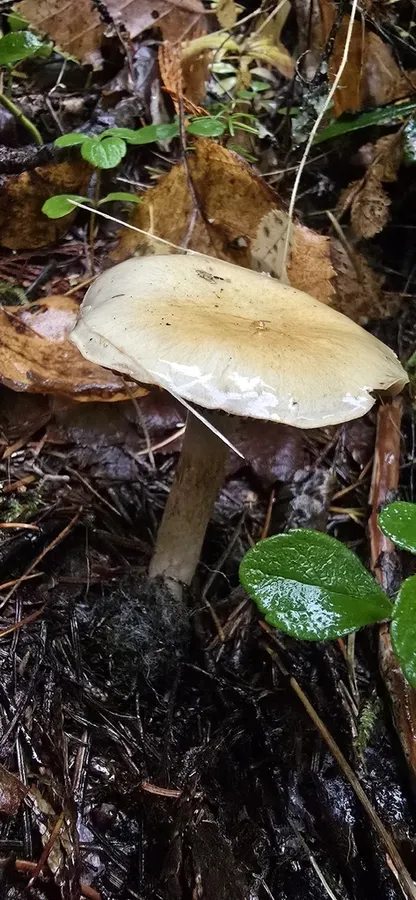
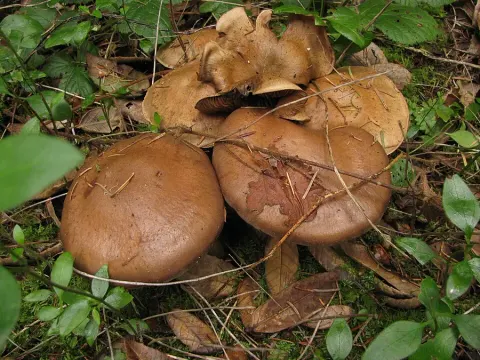
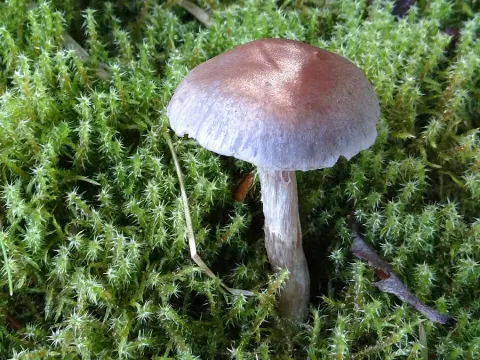
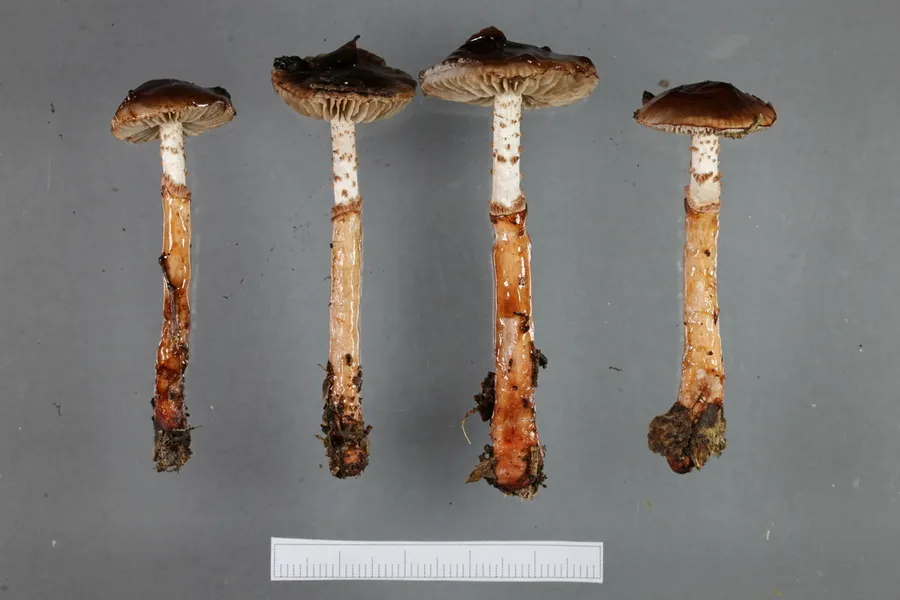
The pileus measures 20–35 mm in diameter, and is glutinous and weakly hygrophanous. it has a pale grey to pale grey-brown color, with a distinctive red center, The surface is smooth. The margin is weakly striate when younger, becoming more grooved as it matures. The gills are pale grey. The stipe is the shape of a cylinder, often featuring a small, round bulb, and is glutinous; it starts off grey-white, covered in reddish gluten when young, it then develops distinctive red spots and numerous thick red stair-like girdles on the stipe, which darken to red-brown after collection, ending in a small collar that is studded with red-brown scales. It has an abundant veil which is hyaline with a reddish tint, and the cortina is underdeveloped. The flesh is dirty grey to greyish tan, with an unmistakably strong odor, reminiscent of naphthalene (mothballs), sometimes with a more gas-like quality. It is considered tasteless. Chemical reactions are trivial, with no significant change observed upon application of NaOH. Microscopically, the spores are broadly amygdaloid (almond shaped, but rounded), measuring 11.7–15 × 7–8.5 μm, and are moderately to fairly coarsely verrucose (bumpy/warty)

Sebagian uraian ditampilkan dalam bahasa sumber; terjemahannya belum tersedia atau belum lolos pemeriksaan.

Rujukan: [1]

Pengukuran mengikuti objek, spesimen atau kultur, dan metode yang disebutkan sumber. Baca uraian asli untuk konteks lengkap.

02 / Kehidupan

Habitat dan peran ekologis

Cortinarius indolicus is considered occasional in New Zealands Nothofagus forests where it grows on soil, associated with N. fusca and N. menziesii.

Sebagian uraian ditampilkan dalam bahasa sumber; terjemahannya belum tersedia atau belum lolos pemeriksaan.

Rujukan: [1]

Habitat atau konteks temuan
hutan
Substrat
tanah
Peran atau konteks
Belum dikategorikan pada rilis ini.
Temukan hubungan serupa
03 / Siklus hidup

Reproduksi

The pileus measures 20–35 mm in diameter, and is glutinous and weakly hygrophanous. it has a pale grey to pale grey-brown color, with a distinctive red center, The surface is smooth. The margin is weakly striate when younger, becoming more grooved as it matures. The gills are pale grey. The stipe is the shape of a cylinder, often featuring a small, round bulb, and is glutinous; it starts off grey-white, covered in reddish gluten when young, it then develops distinctive red spots and numerous thick red stair-like girdles on the stipe, which darken to red-brown after collection, ending in a small collar that is studded with red-brown scales. It has an abundant veil which is hyaline with a reddish tint, and the cortina is underdeveloped.

Sebagian uraian ditampilkan dalam bahasa sumber; terjemahannya belum tersedia atau belum lolos pemeriksaan.

Rujukan: [1]

04 / Batas informasi

Catatan identitas dan cakupan

  • Nama diterima mengikuti Catalogue of Life Base2026-09-11; uraian mempertahankan konsep dan nama sumber aslinya.
  • Original geographic, specimen and life-cycle scope retained; source import awaits individual editorial review.
  • Impor dan terjemahan otomatis belum diperiksa editorial per profil. Struktur reproduktif yang disebutkan tidak membuktikan seluruh siklus hidup diketahui.
  • Pengukuran pada uraian mengikuti spesimen, kultur, dan metode sumber; angka tidak diperluas ke semua populasi.

Catatan distribusi dalam narasi mengikuti sumbernya. Dokumentasi spesimen atau foto mengikuti catatan sumber. Bukti wilayah Indonesia dan penilaian konservasi tidak disimpulkan dari gambar.

05 / Dokumentasi

Melihat dengan konteks

Dokumentasi Cortinarius indolicus menurut asosiasi foto pada record takson iNaturalist. Kredit: David Orlovich. Identitas mengikuti sumber; bukan penentuan spesimen independen.

Jenis
Fotografi
Kredit
(c) David Orlovich, some rights reserved (CC BY), uploaded by David Orlovich
Lisensi
CC BY 4.0
Sumber media
Buka entri sumber

Gambar menunjukkan objek menurut identifikasi sumber, bukan verifikasi independen spesimen oleh Fungi. Tidak ada skala baru yang ditambahkan.

06 / Rujukan

Sumber profil

  1. [1] Cortinarius indolicus — Wikipedia (en)Bagian sumber: Frozen revision 1352083550
    Tanggal penghimpunan sumber: 2026-10-12
    Teks sumber: CC BY-SA4.0 · Wikipedia contributors
  2. [2] Catalogue of Life Base2026-09-11 — Cortinarius indolicusBagian sumber: ColDP NameUsage.tsv ID 6B67W; accepted species; source 2073
    Tanggal penghimpunan sumber: 2026-10-12
  3. [3] Dokumentasi visual — Cortinarius indolicusBagian sumber: Individual media record; identification follows the source, not independent determination
    Tanggal penghimpunan sumber: 2026-10-12
    Media sumber: CC BY 4.0 · (c) David Orlovich, some rights reserved (CC BY), uploaded by David Orlovich

Adaptasi teks: CC BY-SA 4.0. Wikipedia contributors — Cortinarius indolicus — Wikipedia (en)

Uraian asli dan riwayat sumber

Riwayat atau halaman sumber

Ringkasan sumber

The pileus measures 20–35 mm in diameter, and is glutinous and weakly hygrophanous. it has a pale grey to pale grey-brown color, with a distinctive red center, The surface is smooth. The margin is weakly striate when younger, becoming more grooved as it matures. The gills are pale grey. The stipe is the shape of a cylinder, often featuring a small, round bulb, and is glutinous; it starts off grey-white, covered in reddish gluten when young, it then develops distinctive red spots and numerous thick red stair-like girdles on the stipe, which darken to red-brown after collection, ending in a small collar that is studded with red-brown scales.

Revisi sumber

Morfologi sumber

The pileus measures 20–35 mm in diameter, and is glutinous and weakly hygrophanous. it has a pale grey to pale grey-brown color, with a distinctive red center, The surface is smooth. The margin is weakly striate when younger, becoming more grooved as it matures. The gills are pale grey. The stipe is the shape of a cylinder, often featuring a small, round bulb, and is glutinous; it starts off grey-white, covered in reddish gluten when young, it then develops distinctive red spots and numerous thick red stair-like girdles on the stipe, which darken to red-brown after collection, ending in a small collar that is studded with red-brown scales. It has an abundant veil which is hyaline with a reddish tint, and the cortina is underdeveloped. The flesh is dirty grey to greyish tan, with an unmistakably strong odor, reminiscent of naphthalene (mothballs), sometimes with a more gas-like quality. It is considered tasteless. Chemical reactions are trivial, with no significant change observed upon application of NaOH. Microscopically, the spores are broadly amygdaloid (almond shaped, but rounded), measuring 11.7–15 × 7–8.5 μm, and are moderately to fairly coarsely verrucose (bumpy/warty)

Revisi sumber

Ekologi sumber

Cortinarius indolicus is considered occasional in New Zealands Nothofagus forests where it grows on soil, associated with N. fusca and N. menziesii.

Revisi sumber

Struktur reproduksi sumber

The pileus measures 20–35 mm in diameter, and is glutinous and weakly hygrophanous. it has a pale grey to pale grey-brown color, with a distinctive red center, The surface is smooth. The margin is weakly striate when younger, becoming more grooved as it matures. The gills are pale grey. The stipe is the shape of a cylinder, often featuring a small, round bulb, and is glutinous; it starts off grey-white, covered in reddish gluten when young, it then develops distinctive red spots and numerous thick red stair-like girdles on the stipe, which darken to red-brown after collection, ending in a small collar that is studded with red-brown scales. It has an abundant veil which is hyaline with a reddish tint, and the cortina is underdeveloped.

Revisi sumber

Rujukan halaman ini

Fungi. Cortinarius indolicus. Rilis data fungi-2026-10-12-expansion-2. https://fungi-atlas.mgadib.chatgpt.site/jamur/cortinarius-indolicus/.

Status: impor sumber; pemeriksaan editorial per profil belum selesai. Untuk klaim biologis, gunakan rujukan pada bagian terkait dan periksa konteks sumber aslinya.