Ciri dan struktur
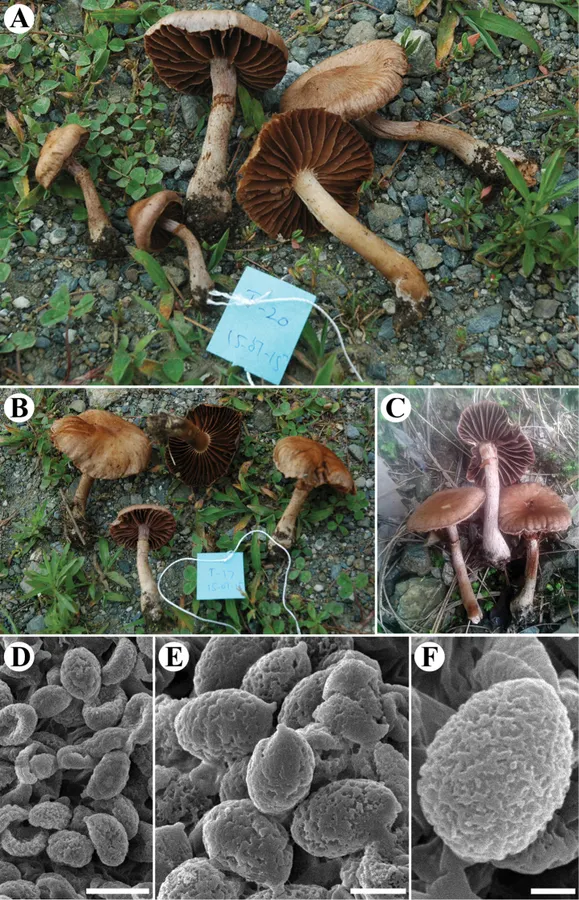
Cortinarius pseudotorvus is an oak-associated species that differs from C. torvus by the smaller and slender basidiomata, and by the slightly more felty surface of pilei; it has broadly ellipsoid to sub-amygdaliform basidiospores (10.9 × 7.1 µm in average). Basidiomata small sized and slender. Pileus campanulate when young, becoming subumbonate and sometimes flat to plano-convex in mature stages, 15–30 mm in diameter, with margins deflexed, undulate, sometimes moderately to strongly striate; cuticle light brown (8.3YR 6.7/2.5), smooth to finely or even coarsely fibrillose (felty), with dark brown (4.7YR 2.6/5.5) fibrils radiating from the center. Lamellae adnate, broad, distant and relatively thick, with an evenly smooth margin, dark brown with age (4.1 YR 1.8/3.1); lamellulae present, regular. Stipe cylindrical, up to 56 mm long, 4–9 mm at apex and 1.1–1.3 cm thick at base, which is slightly bulbous, solid; surface brown (7.8YR 4.4/4.7) becoming whitish (3Y 7.2/1.5) in upper half and the base, finely fibrillose, the 3⁄4 of stipe covered with universal veil remnants when young, and partial veil present, whitish in young specimens and brownish when mature, forming in general a persistent annulus. Context of pileus and stipe of the same color as the cuticle. Smell indistinct and taste not recorded. Basidiospores broadly ellipsoid to sub-amygdaliform, [90/6/3] (9.2–) 9.9–11.6 (–12.5) × (6.1–) 6.7–7.7 (–8.1) µm, avl × avw= 10.9 × 7.1 µm, light yellowish brown to dark brown in 5% KOH, reddish brown in Melzer’s reagent, densely ornamented. Basidia clavate, 25–35 × 7–8 µm, 4-spored, clamped at the base, hyaline in 5% KOH, darker when stained in Congo red.
Habitat dan peran ekologis
Gregarious; growing in either pure oak forests (Quercus oblongata) or mixed forests with oaks and pines (Pinus wallichiana) at an altitude greater than 2000 m a.s.l. The soil pH was around 8.4.
- Habitat atau konteks temuan
- hutan
- Substrat
- Informasi belum tersedia pada sumber rilis ini.
- Peran atau konteks
- Belum dikategorikan pada rilis ini.
Reproduksi
Cortinarius pseudotorvus is an oak-associated species that differs from C. torvus by the smaller and slender basidiomata, and by the slightly more felty surface of pilei; it has broadly ellipsoid to sub-amygdaliform basidiospores (10.9 × 7.1 µm in average). Basidiomata small sized and slender. Pileus campanulate when young, becoming subumbonate and sometimes flat to plano-convex in mature stages, 15–30 mm in diameter, with margins deflexed, undulate, sometimes moderately to strongly striate; cuticle light brown (8.3YR 6.7/2.5), smooth to finely or even coarsely fibrillose (felty), with dark brown (4.7YR 2.6/5.5) fibrils radiating from the center. Lamellae adnate, broad, distant and relatively thick, with an evenly smooth margin, dark brown with age (4.1 YR 1.8/3.1); lamellulae present, regular.
Catatan identitas dan cakupan
- Nama diterima mengikuti Catalogue of Life Base2026-09-11; uraian mempertahankan konsep dan nama sumber aslinya.
- Preserve original treatment localities, hosts and substrate scope. Materials examined describe documented specimens, not the full global range.
- Impor dan terjemahan otomatis belum diperiksa editorial per profil. Struktur reproduktif yang disebutkan tidak membuktikan seluruh siklus hidup diketahui.
- Pengukuran pada uraian mengikuti spesimen, kultur, dan metode sumber; angka tidak diperluas ke semua populasi.
Catatan distribusi dalam narasi mengikuti sumbernya. Dokumentasi spesimen atau foto mengikuti catatan sumber. Bukti wilayah Indonesia dan penilaian konservasi tidak disimpulkan dari gambar.
Melihat dengan konteks
The new species Cortinarius pseudotorvus, AST20 (LAH35257, holotype). A–C Basidiomata A, B AST20 (holotype) C MJ-15103 (LAH36368) D–F Basidiospores of AST20 (holotype) observed with the SEM technique. Photo: A. Naseer (A, B), J. Khan (C). Scale bars: 10 µm (D), 5 µm (E), 2 µm (F).
- Jenis
- Pelat ilmiah
- Kredit
- Arooj Naseer, Isaac Garrido-Benavent, Junaid Khan, Josep Ballarà, Rafael Mahiques, Abdul Nasir Khalid, Hassan Sher
- Lisensi
- CC BY 4.0
- Sumber media
- Buka entri sumber
Sumber profil
- [1] Cortinarius pakistanicus and C. pseudotorvus: two new species in oak forests in the Pakistan Himalayas — Cortinarius pseudotorvus
- [2] Catalogue of Life Base2026-09-11 — Cortinarius pseudotorvus
- [3] Dokumentasi visual — Cortinarius pseudotorvus
Rujukan halaman ini
Fungi. Cortinarius pseudotorvus. Rilis data fungi-2026-10-12-expansion-2. https://fungi-atlas.mgadib.chatgpt.site/jamur/cortinarius-pseudotorvus/.
Status: impor sumber; pemeriksaan editorial per profil belum selesai. Untuk klaim biologis, gunakan rujukan pada bagian terkait dan periksa konteks sumber aslinya.