01 / Morfologi

Ciri dan struktur

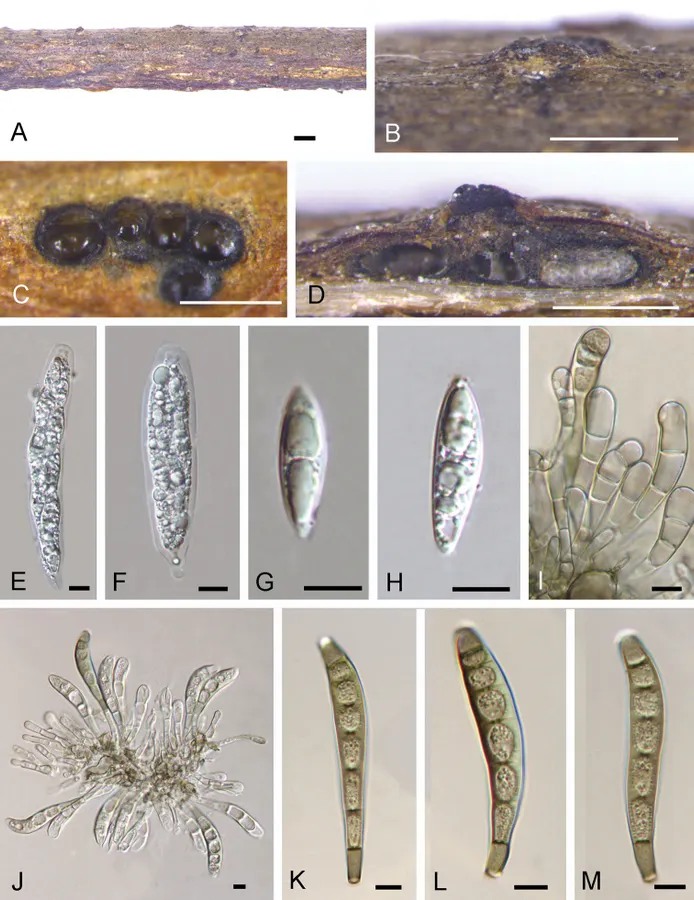
Coryneum songshanense can be distinguished from the morphologically similar C. sinense by its narrower conidia. Associated with canker on twigs of Quercus dentata. Sexual morph: Pseudostromata 0.3–1 mm diam., typically distinct, circular, without perithecial bumps, containing up to 6 perithecia embedded in a well-developed entostroma. Ectostromatic disc distinct, circular, black, 0.3–0.5 mm diam. Central column and entostroma grey. Ostioles inconspicuous and often invisible at the surface of the ectostromatic disc. Perithecia (150–)200–450(–550) μm diam. (n = 20), globular, somewhat flattened at the base with black short neck. Asci 75–145 × 17–23 μm, 8-spored, unitunicate, clavate, shortly pedicellate, apically rounded, with an inconspicuous apical ring. Ascospores (24.1–)25.5–35.4(–38.2) × (7.5–)7.9–9.8(–10.6) μm, l/w = (3.0–)3.3–3.8(–4.2) (n = 50), 2-seriate, fusiform, ends pointed, uniseptate or aseptate, not constricted at the septa, hyaline, guttulate, smooth-walled. Asexual morph: Conidiomata acervular, 0.2–0.6 mm wide, 0.2–0.5 mm high, solitary, erumpent through the outer periderm layers of the host, scattered, surface tissues above slightly domed. Conidiophores 15–35 μm long, 4–7 μm wide, unbranched, cylindrical, septate, hyaline at the apex, pale brown at the base. Conidiogenous cells holoblastic, integrated, indeterminate, cylindrical, expanding towards the apices, pale brown, smooth, with 0–1 percurrent extensions. Conidia (51–)56–67(–76) × (9–)10–11(–11.5) μm, l/w = (5.2–)5.5–6.9(–8.1) (n = 50), variable in shape, curved, broadly fusiform to fusiform, cylindrical or clavate, dark brown, smooth-walled, 5–7-distoseptate, apical cell with a hyaline tip, truncate and black at the base.

Sebagian uraian ditampilkan dalam bahasa sumber; terjemahannya belum tersedia atau belum lolos pemeriksaan.

Rujukan: [1]

Pengukuran mengikuti objek, spesimen atau kultur, dan metode yang disebutkan sumber. Baca uraian asli untuk konteks lengkap.

02 / Kehidupan

Habitat dan peran ekologis

CHINA. Beijing City: Songshan Mountain, on dead twigs of Quercus dentata, 15 June 2018, N. Jiang & C.M. Tian (holotype: BJFC -S1722; ex-type culture from ascospore: CFCC 52997). On PDA at 25 °C, colonies growing slowly and unevenly, reaching 70 mm diam. within 30 d, gradually becoming brownish dark grey in colour with scant cottony aerial mycelium, asexual morphs developed after 40 d. CHINA. Beijing City: Songshan Mountain, on dead twigs of Quercus dentata, 15 June 2018, N. Jiang & C.M. Tian (isotype: BJFC -S1723; living culture from conidium: CFCC 52998).

Sebagian uraian ditampilkan dalam bahasa sumber; terjemahannya belum tersedia atau belum lolos pemeriksaan.

Rujukan: [1]

Habitat atau konteks temuan
kultur yang didokumentasikan
Substrat
Informasi belum tersedia pada sumber rilis ini.
Peran atau konteks
Belum dikategorikan pada rilis ini.
Temukan hubungan serupa
03 / Siklus hidup

Reproduksi

Coryneum songshanense can be distinguished from the morphologically similar C. sinense by its narrower conidia. Associated with canker on twigs of Quercus dentata. Sexual morph: Pseudostromata 0.3–1 mm diam., typically distinct, circular, without perithecial bumps, containing up to 6 perithecia embedded in a well-developed entostroma. Ectostromatic disc distinct, circular, black, 0.3–0.5 mm diam. Central column and entostroma grey. Ostioles inconspicuous and often invisible at the surface of the ectostromatic disc. Perithecia (150–)200–450(–550) μm diam. (n = 20), globular, somewhat flattened at the base with black short neck. Asci 75–145 × 17–23 μm, 8-spored, unitunicate, clavate, shortly pedicellate, apically rounded, with an inconspicuous apical ring.

Sebagian uraian ditampilkan dalam bahasa sumber; terjemahannya belum tersedia atau belum lolos pemeriksaan.

Rujukan: [1]

04 / Batas informasi

Catatan identitas dan cakupan

  • Nama diterima mengikuti Catalogue of Life Base2026-09-11; uraian mempertahankan konsep dan nama sumber aslinya.
  • Preserve original treatment localities, hosts and substrate scope. Materials examined describe documented specimens, not the full global range.
  • Impor dan terjemahan otomatis belum diperiksa editorial per profil. Struktur reproduktif yang disebutkan tidak membuktikan seluruh siklus hidup diketahui.
  • Pengukuran pada uraian mengikuti spesimen, kultur, dan metode sumber; angka tidak diperluas ke semua populasi.

Catatan distribusi dalam narasi mengikuti sumbernya. Dokumentasi spesimen atau foto mengikuti catatan sumber. Bukti wilayah Indonesia dan penilaian konservasi tidak disimpulkan dari gambar.

05 / Dokumentasi

Melihat dengan konteks

Coryneum songshanense from Quercus dentata (BJFC -S1722, holotype) A, B Fruiting bodies on natural substrate in surface view C pseudostroma in transverse section, showing perithecia and gray entostroma D longitudinal sections through pseudostromata E, F immature asci G, H immaure Ascospores I, J conidiophores K–M conidia. Scale bars: 1 mm (A, B); 0.5 mm (C, D); 10 μm (E–M).

Jenis
Pelat ilmiah
Kredit
Ning Jiang, Hermann Voglmayr, Cheng-Ming Tian
Lisensi
CC BY 4.0
Sumber media
Buka entri sumber

Gambar menunjukkan objek menurut identifikasi sumber, bukan verifikasi independen spesimen oleh Fungi. Tidak ada skala baru yang ditambahkan.

06 / Rujukan

Sumber profil

  1. [1] Morphology and phylogeny reveal two novel Coryneum species from China — Coryneum songshanenseBagian sumber: PMC6637033_section_17
    Tanggal penghimpunan sumber: 2026-10-12
    Teks sumber: CC BY 4.0 · Jiang N, Voglmayr H, Tian CM.
  2. [2] Catalogue of Life Base2026-09-11 — Coryneum songshanenseBagian sumber: ColDP NameUsage.tsv ID YR9V; accepted species; source 2073
    Tanggal penghimpunan sumber: 2026-10-12
  3. [3] Dokumentasi visual — Coryneum songshanenseBagian sumber: Individual media record; identification follows the source, not independent determination
    Tanggal penghimpunan sumber: 2026-10-12
    Media sumber: CC BY 4.0 · Ning Jiang, Hermann Voglmayr, Cheng-Ming Tian

Adaptasi teks: CC BY 4.0. Jiang N, Voglmayr H, Tian CM. — Morphology and phylogeny reveal two novel Coryneum species from China — Coryneum songshanense

Uraian asli dan riwayat sumber

Riwayat atau halaman sumber

Ringkasan sumber

Coryneum songshanense can be distinguished from the morphologically similar C. sinense by its narrower conidia. Associated with canker on twigs of Quercus dentata. Sexual morph: Pseudostromata 0.3–1 mm diam., typically distinct, circular, without perithecial bumps, containing up to 6 perithecia embedded in a well-developed entostroma. Ectostromatic disc distinct, circular, black, 0.3–0.5 mm diam. Central column and entostroma grey. Ostioles inconspicuous and often invisible at the surface of the ectostromatic disc.

Revisi sumber

Morfologi sumber

Coryneum songshanense can be distinguished from the morphologically similar C. sinense by its narrower conidia. Associated with canker on twigs of Quercus dentata. Sexual morph: Pseudostromata 0.3–1 mm diam., typically distinct, circular, without perithecial bumps, containing up to 6 perithecia embedded in a well-developed entostroma. Ectostromatic disc distinct, circular, black, 0.3–0.5 mm diam. Central column and entostroma grey. Ostioles inconspicuous and often invisible at the surface of the ectostromatic disc. Perithecia (150–)200–450(–550) μm diam. (n = 20), globular, somewhat flattened at the base with black short neck. Asci 75–145 × 17–23 μm, 8-spored, unitunicate, clavate, shortly pedicellate, apically rounded, with an inconspicuous apical ring. Ascospores (24.1–)25.5–35.4(–38.2) × (7.5–)7.9–9.8(–10.6) μm, l/w = (3.0–)3.3–3.8(–4.2) (n = 50), 2-seriate, fusiform, ends pointed, uniseptate or aseptate, not constricted at the septa, hyaline, guttulate, smooth-walled. Asexual morph: Conidiomata acervular, 0.2–0.6 mm wide, 0.2–0.5 mm high, solitary, erumpent through the outer periderm layers of the host, scattered, surface tissues above slightly domed. Conidiophores 15–35 μm long, 4–7 μm wide, unbranched, cylindrical, septate, hyaline at the apex, pale brown at the base. Conidiogenous cells holoblastic, integrated, indeterminate, cylindrical, expanding towards the apices, pale brown, smooth, with 0–1 percurrent extensions. Conidia (51–)56–67(–76) × (9–)10–11(–11.5) μm, l/w = (5.2–)5.5–6.9(–8.1) (n = 50), variable in shape, curved, broadly fusiform to fusiform, cylindrical or clavate, dark brown, smooth-walled, 5–7-distoseptate, apical cell with a hyaline tip, truncate and black at the base.

Revisi sumber

Ekologi sumber

CHINA. Beijing City: Songshan Mountain, on dead twigs of Quercus dentata, 15 June 2018, N. Jiang & C.M. Tian (holotype: BJFC -S1722; ex-type culture from ascospore: CFCC 52997). On PDA at 25 °C, colonies growing slowly and unevenly, reaching 70 mm diam. within 30 d, gradually becoming brownish dark grey in colour with scant cottony aerial mycelium, asexual morphs developed after 40 d. CHINA. Beijing City: Songshan Mountain, on dead twigs of Quercus dentata, 15 June 2018, N. Jiang & C.M. Tian (isotype: BJFC -S1723; living culture from conidium: CFCC 52998).

Revisi sumber

Struktur reproduksi sumber

Coryneum songshanense can be distinguished from the morphologically similar C. sinense by its narrower conidia. Associated with canker on twigs of Quercus dentata. Sexual morph: Pseudostromata 0.3–1 mm diam., typically distinct, circular, without perithecial bumps, containing up to 6 perithecia embedded in a well-developed entostroma. Ectostromatic disc distinct, circular, black, 0.3–0.5 mm diam. Central column and entostroma grey. Ostioles inconspicuous and often invisible at the surface of the ectostromatic disc. Perithecia (150–)200–450(–550) μm diam. (n = 20), globular, somewhat flattened at the base with black short neck. Asci 75–145 × 17–23 μm, 8-spored, unitunicate, clavate, shortly pedicellate, apically rounded, with an inconspicuous apical ring.

Revisi sumber

Rujukan halaman ini

Fungi. Coryneum songshanense. Rilis data fungi-2026-10-12-expansion-2. https://fungi-atlas.mgadib.chatgpt.site/jamur/coryneum-songshanense/.

Status: impor sumber; pemeriksaan editorial per profil belum selesai. Untuk klaim biologis, gunakan rujukan pada bagian terkait dan periksa konteks sumber aslinya.