Ciri dan struktur
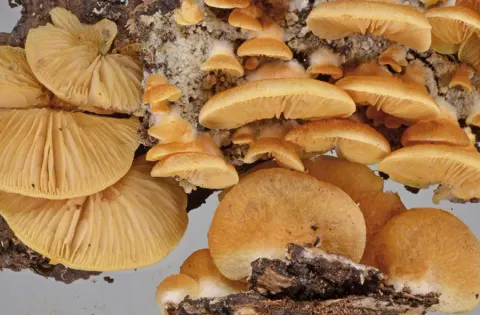
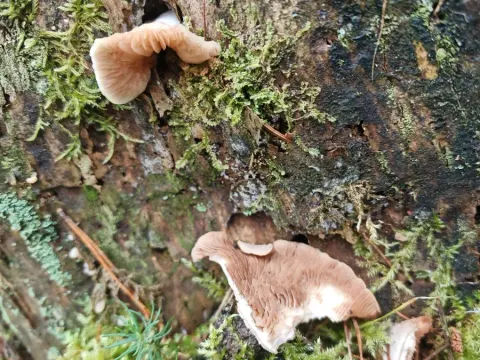
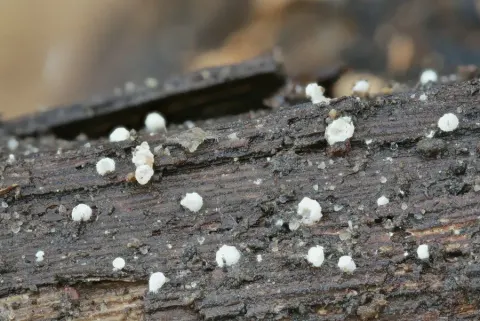
Diagnosis: Basidiomata pileate, sessile, gregarious. Pileus rounded flabelliform, convex to applanate, 7–50 mm wide, 6–30 mm in diameter, hygrophanous; margin not or only when very moist translucently striate; surface grayish-yellow when young, brown when mature, smooth, when young pruinose, soon glabrous, sometimes with brown scales. Lamellae yellowish-white to grayish-yellow when young, brown when mature. Basidiospores are globose to subglobose, in average 5.8 × 5.7 μm, Qav. = 1.01, warted. Cheilocystidia mostly narrowly clavate, in average 43.3 × 9.8 μm. Pileipellis a cutis, the terminal cells mostly narrowly clavate. Clamp connections present in all parts. On the wood of decaying stumps of Pinus sylvestris. Description: Basidiomata pileate, sessile (even without a rudimentary stipe on the youngest basidiomata; laterally or dorsally attached to the substrate); growing in tight groups of more than five to nearly a hundred basidiomata (usually on one place on the stump), imbricate; or growing in more sparse groups of fewer than five basidiomata, sometimes single (often scattered in several places on the stump). Pileus mostly rounded flabelliform, sometimes flabelliform; convex, plano-convex to applanate; flat or umbonate, sometimes depressed near the point of attachment; 7–50 mm wide, 6–30 mm in diameter; hygrophanous; margin usually involute, becoming inflexed to reflexed, somewhat exceeding the lamellae; entire, in some (mostly in larger) basidiomata crenulated, crenate or undulate, not or only when very moist translucently striate; surface of young basidiomata grayish-yellow (4B4–champagne or 4B5–corn), with a distinctly lighter margin (4A4–light yellow), just a short time pruinose, soon glabrous, smooth, when drying with no or slightly lighter colour changes (4A4, 4B4, 4B5), mature and fresh basidiomata more brownish (5D5–clay, 5D6–oak brown, 5E6–mustard brown) to dark brown when very old (7F8), of the same colour or lighter when dried (4B4, 4B5); sometimes with fine sun brown (6D5) scales on the clay (5D5) background in older basidiomata; whitish mycelial tomentum at the point of attachment present on both sides of the pileus, strongly contrasting with the colour of pileus and lamellae, extending up to one-fifth to one-quarter of the pileus diameter.
Habitat dan peran ekologis
Ecology: Our collections of C. pini were from 80 to 100 years old stumps of Pinus sylvestris in the 3rd to 5th decay stages. The stumps of felled trees were 30 to 50 cm thick and the basidiomata were formed at their base, on strongly decayed wood, and almost in contact with soil. Some stumps were overgrown with mosses (Hypnum cupressiforme, Aulacomnium androgynum) and some were also colonized by other basidiomycetes (Mycena sp., Artomyces sp.), ascomycetes (Ascocoryne sp.), or myxomycetes. The stumps were located in well-lit places, namely along the forest road, at the forest edge, or where the clearing was created by the felling of trees. The findings were from the months of August to October. We have found C. pini at three localities in the Záhorská nížina Lowland (north-western Slovakia), in forests with cultivated Scots pine (Pinus sylvestris), and at an elevation of 190 to 220 m a.s.l. The forests were between 80 and 100(110) years old and were reaching felling age.
- Habitat atau konteks temuan
- hutan
- Substrat
- Informasi belum tersedia pada sumber rilis ini.
- Peran atau konteks
- Belum dikategorikan pada rilis ini.
Reproduksi
Diagnosis: Basidiomata pileate, sessile, gregarious. Pileus rounded flabelliform, convex to applanate, 7–50 mm wide, 6–30 mm in diameter, hygrophanous; margin not or only when very moist translucently striate; surface grayish-yellow when young, brown when mature, smooth, when young pruinose, soon glabrous, sometimes with brown scales. Lamellae yellowish-white to grayish-yellow when young, brown when mature. Basidiospores are globose to subglobose, in average 5.8 × 5.7 μm, Qav. = 1.01, warted. Cheilocystidia mostly narrowly clavate, in average 43.3 × 9.8 μm. Pileipellis a cutis, the terminal cells mostly narrowly clavate. Clamp connections present in all parts. On the wood of decaying stumps of Pinus sylvestris.
Catatan identitas dan cakupan
- Nama diterima mengikuti Catalogue of Life Base2026-09-11; uraian mempertahankan konsep dan nama sumber aslinya.
- Preserve original treatment localities, hosts and substrate scope. Materials examined describe documented specimens, not the full global range.
- Impor dan terjemahan otomatis belum diperiksa editorial per profil. Struktur reproduktif yang disebutkan tidak membuktikan seluruh siklus hidup diketahui.
- Pengukuran pada uraian mengikuti spesimen, kultur, dan metode sumber; angka tidak diperluas ke semua populasi.
Catatan distribusi dalam narasi mengikuti sumbernya. Dokumentasi spesimen atau foto mengikuti catatan sumber. Bukti wilayah Indonesia dan penilaian konservasi tidak disimpulkan dari gambar.
Melihat dengan konteks
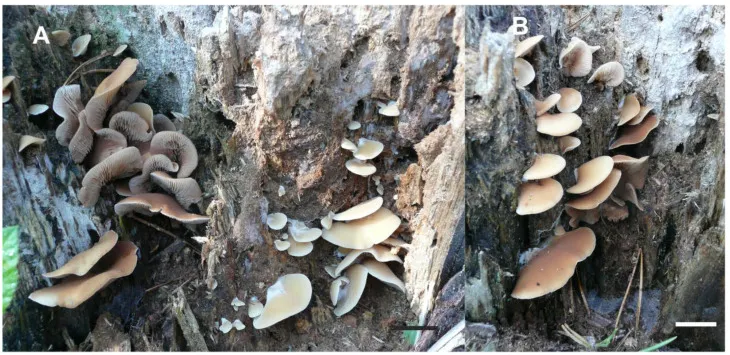
Sessile basidiomata of Crepidotus pini (SLO 2579). (A) Young basidiomata with greyish-yellow pileus surface (right) and mature basidiomata with brown lamellae (left), (B) mature basidiomata with more brownish pileus surface, (Scale bar = 1 cm).
- Jenis
- Pelat ilmiah
- Kredit
- © 2022 by the authors.
- Lisensi
- CC BY 4.0
- Sumber media
- Buka entri sumber
Sumber profil
- [1] Phylogeny of Crepidotus applanatus Look-Alikes Reveals a Convergent Morphology Evolution and a New Species C. pini — Crepidotus pini
- [2] Catalogue of Life Base2026-09-11 — Crepidotus pini
- [3] Dokumentasi visual — Crepidotus pini
Rujukan halaman ini
Fungi. Crepidotus pini. Rilis data fungi-2026-10-12-expansion-2. https://fungi-atlas.mgadib.chatgpt.site/jamur/crepidotus-pini/.
Status: impor sumber; pemeriksaan editorial per profil belum selesai. Untuk klaim biologis, gunakan rujukan pada bagian terkait dan periksa konteks sumber aslinya.