01 / Morfologi

Ciri dan struktur

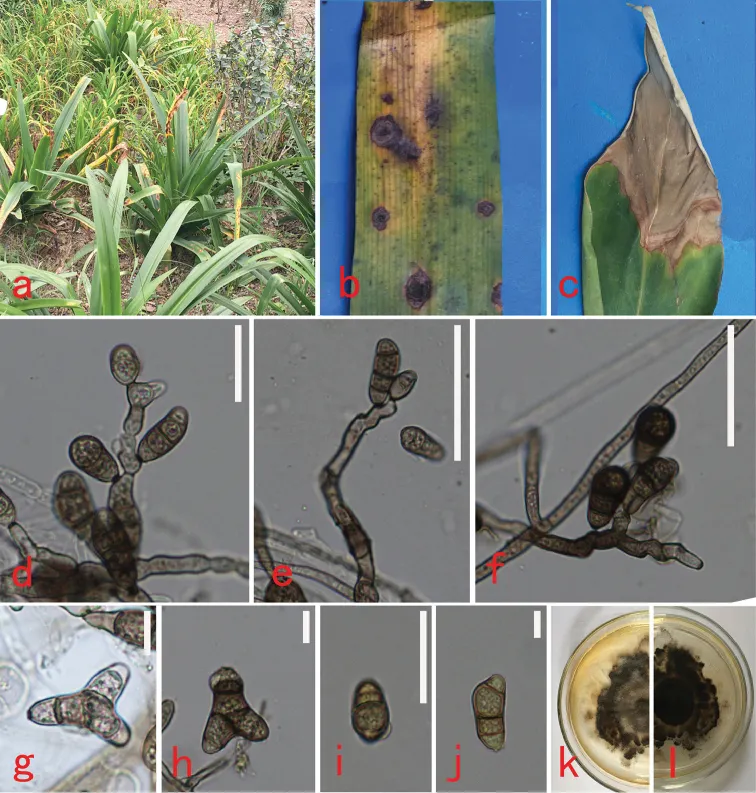
Characterised by producing four celled, smaller conidia (4.5–11.5 × 2–6 µm), usually curved at the third cell from the base. Symptoms on Hippeastrum striatum: Fructification mostly epiphyllous, disease spot 3–12 mm, subspherical to oblong ovate, brown to dark brown, effuse (Figure 2a, b). Symptoms on Canna indica: Fructification of the fungus was mostly epiphyllous, the large blighted, irregular spots near leaf apex to the whole leaves, greyish-brown (Figure 2c). Colonies on PDA, vegetative hyphae septate, branched, subhyaline to brown, smooth to asperulate, 1.5–3 µm, anastomosing. Sexual morph: Undetermined. Asexual morph: Hyphomycetous. Conidiophores 10.5–77.5 × 1–3.5 µm (av. = 22.2 × 2.1 µm, n = 30), arising singly, simple or branched, flexuous, septate, geniculate at spore bearing part, pale brown, dark brown, paler towards apex. Percurrent proliferation only observed occasionally. Conidiogenous loci somewhat thickened and darkened, spores up to 0.8–1 µm diam, smooth. Mature conidia always four celled, 4.5–11.5 × 2–6 µm (av. = 8.2 × 3.8 µm, n = 50), smooth-walled, usually curved at the third cell from the base, sometimes straight, navicular, bifurcate, obpyriform, tapering towards rounded ends, pale brown to dark reddish brown. Hilum usually conspicuous or sometimes slightly protuberant.

Sebagian uraian ditampilkan dalam bahasa sumber; terjemahannya belum tersedia atau belum lolos pemeriksaan.

Rujukan: [1]

Pengukuran mengikuti objek, spesimen atau kultur, dan metode yang disebutkan sumber. Baca uraian asli untuk konteks lengkap.

02 / Kehidupan

Habitat dan peran ekologis

Symptoms on Hippeastrum striatum: Fructification mostly epiphyllous, disease spot 3–12 mm, subspherical to oblong ovate, brown to dark brown, effuse (Figure 2a, b). Symptoms on Canna indica: Fructification of the fungus was mostly epiphyllous, the large blighted, irregular spots near leaf apex to the whole leaves, greyish-brown (Figure 2c). Colonies on PDA, vegetative hyphae septate, branched, subhyaline to brown, smooth to asperulate, 1.5–3 µm, anastomosing. Sexual morph: Undetermined. Asexual morph: Hyphomycetous. Conidiophores 10.5–77.5 × 1–3.5 µm (av. = 22.2 × 2.1 µm, n = 30), arising singly, simple or branched, flexuous, septate, geniculate at spore bearing part, pale brown, dark brown, paler towards apex. Percurrent proliferation only observed occasionally. Conidiogenous loci somewhat thickened and darkened, spores up to 0.8–1 µm diam, smooth. Mature conidia always four celled, 4.5–11.5 × 2–6 µm (av. = 8.2 × 3.8 µm, n = 50), smooth-walled, usually curved at the third cell from the base, sometimes straight, navicular, bifurcate, obpyriform, tapering towards rounded ends, pale brown to dark reddish brown. Hilum usually conspicuous or sometimes slightly protuberant. Isolated from leaf diseases of H. striatum and Canna indica in China

Sebagian uraian ditampilkan dalam bahasa sumber; terjemahannya belum tersedia atau belum lolos pemeriksaan.

Rujukan: [1]

Habitat atau konteks temuan
kultur yang didokumentasikan
Substrat
Informasi belum tersedia pada sumber rilis ini.
Peran atau konteks
Belum dikategorikan pada rilis ini.
Temukan hubungan serupa
03 / Siklus hidup

Reproduksi

Characterised by producing four celled, smaller conidia (4.5–11.5 × 2–6 µm), usually curved at the third cell from the base. Symptoms on Hippeastrum striatum: Fructification mostly epiphyllous, disease spot 3–12 mm, subspherical to oblong ovate, brown to dark brown, effuse (Figure 2a, b). Symptoms on Canna indica: Fructification of the fungus was mostly epiphyllous, the large blighted, irregular spots near leaf apex to the whole leaves, greyish-brown (Figure 2c). Colonies on PDA, vegetative hyphae septate, branched, subhyaline to brown, smooth to asperulate, 1.5–3 µm, anastomosing. Sexual morph: Undetermined. Asexual morph: Hyphomycetous. Conidiophores 10.5–77.5 × 1–3.5 µm (av. = 22.2 × 2.1 µm, n = 30), arising singly, simple or branched, flexuous, septate, geniculate at spore bearing part, pale brown, dark brown, paler towards apex.

Sebagian uraian ditampilkan dalam bahasa sumber; terjemahannya belum tersedia atau belum lolos pemeriksaan.

Rujukan: [1]

04 / Batas informasi

Catatan identitas dan cakupan

  • Nama diterima mengikuti Catalogue of Life Base2026-09-11; uraian mempertahankan konsep dan nama sumber aslinya.
  • Preserve original treatment localities, hosts and substrate scope. Materials examined describe documented specimens, not the full global range.
  • Impor dan terjemahan otomatis belum diperiksa editorial per profil. Struktur reproduktif yang disebutkan tidak membuktikan seluruh siklus hidup diketahui.
  • Pengukuran pada uraian mengikuti spesimen, kultur, dan metode sumber; angka tidak diperluas ke semua populasi.

Catatan distribusi dalam narasi mengikuti sumbernya. Dokumentasi spesimen atau foto mengikuti catatan sumber. Bukti wilayah Indonesia dan penilaian konservasi tidak disimpulkan dari gambar.

05 / Dokumentasi

Melihat dengan konteks

Curvularia microspora (HGUP 6272). a–c Leaf diseases symptoms on Hippeastrum rutilum and Canna indica. d–f Conidiophores, conidiogenous loci and conidia g–j Immature and mature conidia k–l Upper (k) and lower (l) surface of colony. Scar bars: d, i (10 μm), e–f = 20μm, g–h, j = (5 μm).

Jenis
Pelat ilmiah
Kredit
Yin Liang, Shuang-Fei Ran, Jayarama Bhat, Kevin D. Hyde, Yong Wang, De-Gang Zhao
Lisensi
CC BY 4.0
Sumber media
Buka entri sumber

Gambar menunjukkan objek menurut identifikasi sumber, bukan verifikasi independen spesimen oleh Fungi. Tidak ada skala baru yang ditambahkan.

06 / Rujukan

Sumber profil

  1. [1] Curvularia microspora sp. nov. associated with leaf diseases of Hippeastrum striatum in China — Curvularia microsporaBagian sumber: PMC5804299_section_9
    Tanggal penghimpunan sumber: 2026-10-12
    Teks sumber: CC BY 4.0 · Liang, Yin & Ran, Shuang-Fei & Bhat, Jayarama & Hyde, Kevin D.
  2. [2] Catalogue of Life Base2026-09-11 — Curvularia microsporaBagian sumber: ColDP NameUsage.tsv ID 32LH5; accepted species; source 2073
    Tanggal penghimpunan sumber: 2026-10-12
  3. [3] Dokumentasi visual — Curvularia microsporaBagian sumber: Individual media record; identification follows the source, not independent determination
    Tanggal penghimpunan sumber: 2026-10-12
    Media sumber: CC BY 4.0 · Yin Liang, Shuang-Fei Ran, Jayarama Bhat, Kevin D. Hyde, Yong Wang, De-Gang Zhao

Adaptasi teks: CC BY 4.0. Liang, Yin & Ran, Shuang-Fei & Bhat, Jayarama & Hyde, Kevin D. — Curvularia microspora sp. nov. associated with leaf diseases of Hippeastrum striatum in China — Curvularia microspora

Uraian asli dan riwayat sumber

Riwayat atau halaman sumber

Ringkasan sumber

Characterised by producing four celled, smaller conidia (4.5–11.5 × 2–6 µm), usually curved at the third cell from the base. Symptoms on Hippeastrum striatum: Fructification mostly epiphyllous, disease spot 3–12 mm, subspherical to oblong ovate, brown to dark brown, effuse (Figure 2a, b). Symptoms on Canna indica: Fructification of the fungus was mostly epiphyllous, the large blighted, irregular spots near leaf apex to the whole leaves, greyish-brown (Figure 2c). Colonies on PDA, vegetative hyphae septate, branched, subhyaline to brown, smooth to asperulate, 1.5–3 µm, anastomosing.

Revisi sumber

Morfologi sumber

Characterised by producing four celled, smaller conidia (4.5–11.5 × 2–6 µm), usually curved at the third cell from the base. Symptoms on Hippeastrum striatum: Fructification mostly epiphyllous, disease spot 3–12 mm, subspherical to oblong ovate, brown to dark brown, effuse (Figure 2a, b). Symptoms on Canna indica: Fructification of the fungus was mostly epiphyllous, the large blighted, irregular spots near leaf apex to the whole leaves, greyish-brown (Figure 2c). Colonies on PDA, vegetative hyphae septate, branched, subhyaline to brown, smooth to asperulate, 1.5–3 µm, anastomosing. Sexual morph: Undetermined. Asexual morph: Hyphomycetous. Conidiophores 10.5–77.5 × 1–3.5 µm (av. = 22.2 × 2.1 µm, n = 30), arising singly, simple or branched, flexuous, septate, geniculate at spore bearing part, pale brown, dark brown, paler towards apex. Percurrent proliferation only observed occasionally. Conidiogenous loci somewhat thickened and darkened, spores up to 0.8–1 µm diam, smooth. Mature conidia always four celled, 4.5–11.5 × 2–6 µm (av. = 8.2 × 3.8 µm, n = 50), smooth-walled, usually curved at the third cell from the base, sometimes straight, navicular, bifurcate, obpyriform, tapering towards rounded ends, pale brown to dark reddish brown. Hilum usually conspicuous or sometimes slightly protuberant.

Revisi sumber

Ekologi sumber

Symptoms on Hippeastrum striatum: Fructification mostly epiphyllous, disease spot 3–12 mm, subspherical to oblong ovate, brown to dark brown, effuse (Figure 2a, b). Symptoms on Canna indica: Fructification of the fungus was mostly epiphyllous, the large blighted, irregular spots near leaf apex to the whole leaves, greyish-brown (Figure 2c). Colonies on PDA, vegetative hyphae septate, branched, subhyaline to brown, smooth to asperulate, 1.5–3 µm, anastomosing. Sexual morph: Undetermined. Asexual morph: Hyphomycetous. Conidiophores 10.5–77.5 × 1–3.5 µm (av. = 22.2 × 2.1 µm, n = 30), arising singly, simple or branched, flexuous, septate, geniculate at spore bearing part, pale brown, dark brown, paler towards apex. Percurrent proliferation only observed occasionally. Conidiogenous loci somewhat thickened and darkened, spores up to 0.8–1 µm diam, smooth. Mature conidia always four celled, 4.5–11.5 × 2–6 µm (av. = 8.2 × 3.8 µm, n = 50), smooth-walled, usually curved at the third cell from the base, sometimes straight, navicular, bifurcate, obpyriform, tapering towards rounded ends, pale brown to dark reddish brown. Hilum usually conspicuous or sometimes slightly protuberant. Isolated from leaf diseases of H. striatum and Canna indica in China

Revisi sumber

Struktur reproduksi sumber

Characterised by producing four celled, smaller conidia (4.5–11.5 × 2–6 µm), usually curved at the third cell from the base. Symptoms on Hippeastrum striatum: Fructification mostly epiphyllous, disease spot 3–12 mm, subspherical to oblong ovate, brown to dark brown, effuse (Figure 2a, b). Symptoms on Canna indica: Fructification of the fungus was mostly epiphyllous, the large blighted, irregular spots near leaf apex to the whole leaves, greyish-brown (Figure 2c). Colonies on PDA, vegetative hyphae septate, branched, subhyaline to brown, smooth to asperulate, 1.5–3 µm, anastomosing. Sexual morph: Undetermined. Asexual morph: Hyphomycetous. Conidiophores 10.5–77.5 × 1–3.5 µm (av. = 22.2 × 2.1 µm, n = 30), arising singly, simple or branched, flexuous, septate, geniculate at spore bearing part, pale brown, dark brown, paler towards apex.

Revisi sumber

Rujukan halaman ini

Fungi. Curvularia microspora. Rilis data fungi-2026-10-12-expansion-2. https://fungi-atlas.mgadib.chatgpt.site/jamur/curvularia-microspora/.

Status: impor sumber; pemeriksaan editorial per profil belum selesai. Untuk klaim biologis, gunakan rujukan pada bagian terkait dan periksa konteks sumber aslinya.