01 / Morfologi

Ciri dan struktur

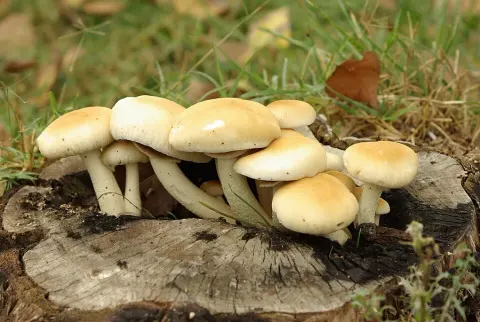
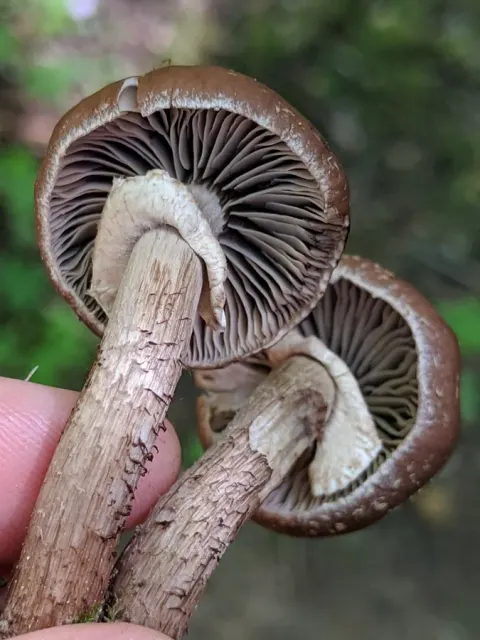
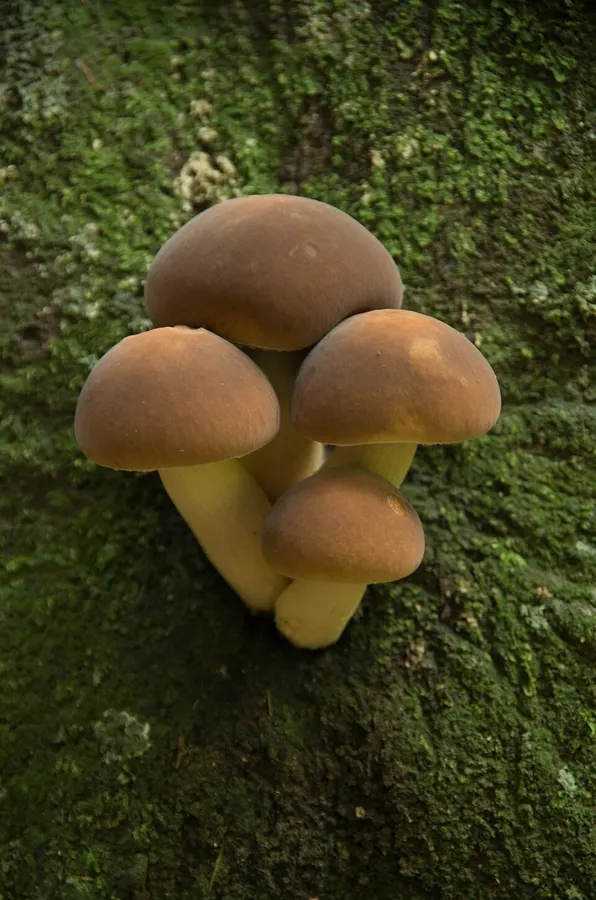
Pileus 65-200 mm, convex to plano-convex finally plane, at first dark yellow brown to greyish brown ("snuff brown" "fulvous") then fading during expansion to buff with cinnamon tinge at disc, at length wholly whitish, smooth with a texture of close velvet becoming like chamois then naked on weathering, occasionally dimpled in age, often becoming cracked into areolae; margin entire, not striate, dotted with loose crumb-like particles whilst still inrolled. Stipe 110-150(-200) x 12-20 mm, cylindric to somewhat thicker downwards, annulate, white to pale buff with longitudinal lines of concolorous to brownish tiny squamules, surface occasionally cracking into recurved scales downwards; ring apical, membranous, pale buff, slow to detach from pileus-margin, collapsing into a full "flared skirt", ridged and striped above by longitudinal dark brown lines from spores and sprinkled below with crumb-like fragments similar to those on the young pileus margin, soft and collapsing in humid weather. Gills adnate with slight tooth, fairly crowded from many lamellulae, buff darkening to snuff-brown or umber, margin white, finely floccose-denticulate. Flesh white in pileus and stipe-apex, firm, a grey watery zone sometimes present above gills, browning towards stipe-base, tough-fibrous in stipe-cortex, more tenuous inside. Taste mild, pleasant; smell nutty, like yeast. Basidiospores umber to date-brown in mass, (8.5-) 9.5 -12 x (5.5-) 6-6.5 µm, ellipsoid, slightly thick-walled, ochraceous brown in water, darker in aqueous alkali solutions, guttulate, non-amyloid, not strongly cyanophilic; germ-pore present, small.

Sebagian uraian ditampilkan dalam bahasa sumber; terjemahannya belum tersedia atau belum lolos pemeriksaan.

Rujukan: [1]

Pengukuran mengikuti objek, spesimen atau kultur, dan metode yang disebutkan sumber. Baca uraian asli untuk konteks lengkap.

02 / Kehidupan

Habitat dan peran ekologis

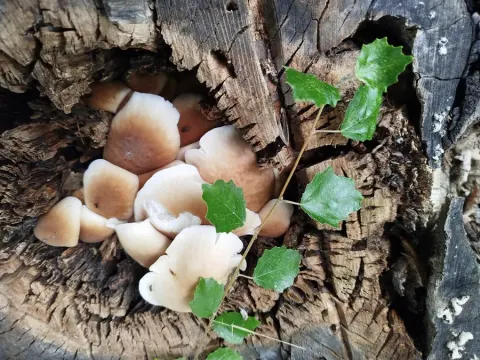
Habitats gigantic clusters or singly, on introduced and native dicotyledonous trees especially tawa (Beilschmiedia tawa Benth. & Hook. f.) and kohekohe (Dysoxylum spectabile Hook. f.); common, widespread and almost certainly indigenous in New Zealand. It has not as yet been recorded on any gymnospermous host. It is found both on living hosts and those recently dead and sometimes fairly high above the ground. Basidiomata appear typically from wounds, being associated with a very slow heart rot, although it is probably only a secondary invader; but see Stevenson, 1982.

Sebagian uraian ditampilkan dalam bahasa sumber; terjemahannya belum tersedia atau belum lolos pemeriksaan.

Rujukan: [1]

Habitat atau konteks temuan
Informasi belum tersedia pada sumber rilis ini.
Substrat
Informasi belum tersedia pada sumber rilis ini.
Peran atau konteks
Belum dikategorikan pada rilis ini.
Temukan hubungan serupa
03 / Siklus hidup

Reproduksi

Pileus 65-200 mm, convex to plano-convex finally plane, at first dark yellow brown to greyish brown ("snuff brown" "fulvous") then fading during expansion to buff with cinnamon tinge at disc, at length wholly whitish, smooth with a texture of close velvet becoming like chamois then naked on weathering, occasionally dimpled in age, often becoming cracked into areolae; margin entire, not striate, dotted with loose crumb-like particles whilst still inrolled. Stipe 110-150(-200) x 12-20 mm, cylindric to somewhat thicker downwards, annulate, white to pale buff with longitudinal lines of concolorous to brownish tiny squamules, surface occasionally cracking into recurved scales downwards; ring apical, membranous, pale buff, slow to detach from pileus-margin, collapsing into a full "flared skirt", ridged and striped above by longitudinal dark brown lines from spores and sprinkled below with crumb-like fragments similar to those on the young pileus margin, soft and collapsing in humid weather.

Sebagian uraian ditampilkan dalam bahasa sumber; terjemahannya belum tersedia atau belum lolos pemeriksaan.

Rujukan: [1]

Sinonim menurut acuan taksonomi rilis: Agrocybe parasitica
04 / Batas informasi

Catatan identitas dan cakupan

  • Nama diterima mengikuti Catalogue of Life Base2026-09-11; uraian mempertahankan konsep dan nama sumber aslinya.
  • Historical description as cited by BiotaNZ. Preserve explicit New Zealand/locality, host and specimen qualifiers. Distribution is the cited source scope, not a current global range.
  • Impor dan terjemahan otomatis belum diperiksa editorial per profil. Struktur reproduktif yang disebutkan tidak membuktikan seluruh siklus hidup diketahui.
  • Pengukuran pada uraian mengikuti spesimen, kultur, dan metode sumber; angka tidak diperluas ke semua populasi.

Catatan distribusi dalam narasi mengikuti sumbernya. Dokumentasi spesimen atau foto mengikuti catatan sumber. Bukti wilayah Indonesia dan penilaian konservasi tidak disimpulkan dari gambar.

05 / Dokumentasi

Melihat dengan konteks

Dokumentasi Cyclocybe parasitica dari Wikimedia Commons. Cluster of young Cyclocybe parasitica fruiting bodies Identifikasi mengikuti record berkas sumber.

Jenis
Fotografi
Kredit
mrutherford
Lisensi
CC BY 4.0
Sumber media
Buka entri sumber

Gambar menunjukkan objek menurut identifikasi sumber, bukan verifikasi independen spesimen oleh Fungi. Tidak ada skala baru yang ditambahkan.

06 / Rujukan

Sumber profil

  1. [1] Watling, R.; Taylor, G.M. 1987: Observations on the Bolbitiaceae: 27. Preliminary account of the Bolbitiaceae of New Zealand. Bibliotheca Mycologica. 117. — Agrocybe parasiticaBagian sumber: biota:1cb0fec0-36b9-11d5-9548-00d0592d548c:1cb17cd8-36b9-11d5-9548-00d0592d548c
    Tanggal penghimpunan sumber: 2026-10-12
    Teks sumber: CC BY 4.0 · Watling, R.; Taylor, G.M. 1987: Observations on the Bolbitiaceae: 27. Preliminary account of the Bolbitiaceae of New Zealand. Bibliotheca Mycologica. 117.
  2. [2] Catalogue of Life Base2026-09-11 — Cyclocybe parasiticaBagian sumber: ColDP NameUsage.tsv ID 6C467; accepted species; source 2073
    Tanggal penghimpunan sumber: 2026-10-12
  3. [3] Dokumentasi visual — Cyclocybe parasiticaBagian sumber: Individual media record; identification follows the source, not independent determination
    Tanggal penghimpunan sumber: 2026-10-12
    Media sumber: CC BY 4.0 · mrutherford

Adaptasi teks: CC BY 4.0. Watling, R.; Taylor, G.M. 1987: Observations on the Bolbitiaceae: 27. Preliminary account of the Bolbitiaceae of New Zealand. Bibliotheca Mycologica. 117. — Watling, R.; Taylor, G.M. 1987: Observations on the Bolbitiaceae: 27. Preliminary account of the Bolbitiaceae of New Zealand. Bibliotheca Mycologica. 117. — Agrocybe parasitica

Uraian asli dan riwayat sumber

Riwayat atau halaman sumber

Ringkasan sumber

Pileus 65-200 mm, convex to plano-convex finally plane, at first dark yellow brown to greyish brown ("snuff brown" "fulvous") then fading during expansion to buff with cinnamon tinge at disc, at length wholly whitish, smooth with a texture of close velvet becoming like chamois then naked on weathering, occasionally dimpled in age, often becoming cracked into areolae; margin entire, not striate, dotted with loose crumb-like particles whilst still inrolled. Stipe 110-150(-200) x 12-20 mm, cylindric to somewhat thicker downwards, annulate, white to pale buff with longitudinal lines of concolorous to brownish tiny squamules, surface occasionally cracking into recurved scales downwards; ring apical, membranous, pale buff, slow to detach from pileus-margin, collapsing into a full "flared skirt", ridged and striped above by longitudinal dark brown lines from spores and sprinkled below with crumb-like fragments similar to those on the young pileus margin, soft and collapsing in humid weather.

Revisi sumber

Morfologi sumber

Pileus 65-200 mm, convex to plano-convex finally plane, at first dark yellow brown to greyish brown ("snuff brown" "fulvous") then fading during expansion to buff with cinnamon tinge at disc, at length wholly whitish, smooth with a texture of close velvet becoming like chamois then naked on weathering, occasionally dimpled in age, often becoming cracked into areolae; margin entire, not striate, dotted with loose crumb-like particles whilst still inrolled. Stipe 110-150(-200) x 12-20 mm, cylindric to somewhat thicker downwards, annulate, white to pale buff with longitudinal lines of concolorous to brownish tiny squamules, surface occasionally cracking into recurved scales downwards; ring apical, membranous, pale buff, slow to detach from pileus-margin, collapsing into a full "flared skirt", ridged and striped above by longitudinal dark brown lines from spores and sprinkled below with crumb-like fragments similar to those on the young pileus margin, soft and collapsing in humid weather. Gills adnate with slight tooth, fairly crowded from many lamellulae, buff darkening to snuff-brown or umber, margin white, finely floccose-denticulate. Flesh white in pileus and stipe-apex, firm, a grey watery zone sometimes present above gills, browning towards stipe-base, tough-fibrous in stipe-cortex, more tenuous inside. Taste mild, pleasant; smell nutty, like yeast. Basidiospores umber to date-brown in mass, (8.5-) 9.5 -12 x (5.5-) 6-6.5 µm, ellipsoid, slightly thick-walled, ochraceous brown in water, darker in aqueous alkali solutions, guttulate, non-amyloid, not strongly cyanophilic; germ-pore present, small.

Revisi sumber

Ekologi sumber

Habitats gigantic clusters or singly, on introduced and native dicotyledonous trees especially tawa (Beilschmiedia tawa Benth. & Hook. f.) and kohekohe (Dysoxylum spectabile Hook. f.); common, widespread and almost certainly indigenous in New Zealand. It has not as yet been recorded on any gymnospermous host. It is found both on living hosts and those recently dead and sometimes fairly high above the ground. Basidiomata appear typically from wounds, being associated with a very slow heart rot, although it is probably only a secondary invader; but see Stevenson, 1982.

Revisi sumber

Struktur reproduksi sumber

Pileus 65-200 mm, convex to plano-convex finally plane, at first dark yellow brown to greyish brown ("snuff brown" "fulvous") then fading during expansion to buff with cinnamon tinge at disc, at length wholly whitish, smooth with a texture of close velvet becoming like chamois then naked on weathering, occasionally dimpled in age, often becoming cracked into areolae; margin entire, not striate, dotted with loose crumb-like particles whilst still inrolled. Stipe 110-150(-200) x 12-20 mm, cylindric to somewhat thicker downwards, annulate, white to pale buff with longitudinal lines of concolorous to brownish tiny squamules, surface occasionally cracking into recurved scales downwards; ring apical, membranous, pale buff, slow to detach from pileus-margin, collapsing into a full "flared skirt", ridged and striped above by longitudinal dark brown lines from spores and sprinkled below with crumb-like fragments similar to those on the young pileus margin, soft and collapsing in humid weather.

Revisi sumber

Rujukan halaman ini

Fungi. Cyclocybe parasitica. Rilis data fungi-2026-10-12-expansion-2. https://fungi-atlas.mgadib.chatgpt.site/jamur/cyclocybe-parasitica/.

Status: impor sumber; pemeriksaan editorial per profil belum selesai. Untuk klaim biologis, gunakan rujukan pada bagian terkait dan periksa konteks sumber aslinya.