Ciri dan struktur
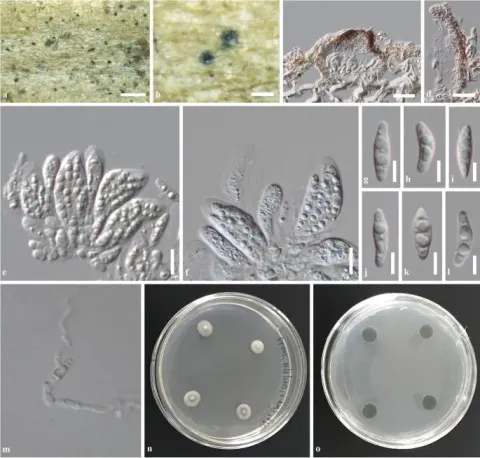
Culture characteristics: Colonies on PDA 15–20 mm in diameter after two weeks at 27 °C, brown to black, effuse, circular, dense and rough at the surface, well-defined, undulate edge with sinking, slightly striated; dark brown at the reverse, without pigments produced in PDA. Vegetative hyphae 2–4 μm wide, hyaline, branched, septate.
Habitat dan peran ekologis
Culture characteristics: Colonies on PDA 15–20 mm in diameter after two weeks at 27 °C, brown to black, effuse, circular, dense and rough at the surface, well-defined, undulate edge with sinking, slightly striated; dark brown at the reverse, without pigments produced in PDA. Vegetative hyphae 2–4 μm wide, hyaline, branched, septate.
- Habitat atau konteks temuan
- Informasi belum tersedia pada sumber rilis ini.
- Substrat
- Informasi belum tersedia pada sumber rilis ini.
- Peran atau konteks
- Belum dikategorikan pada rilis ini.
Reproduksi
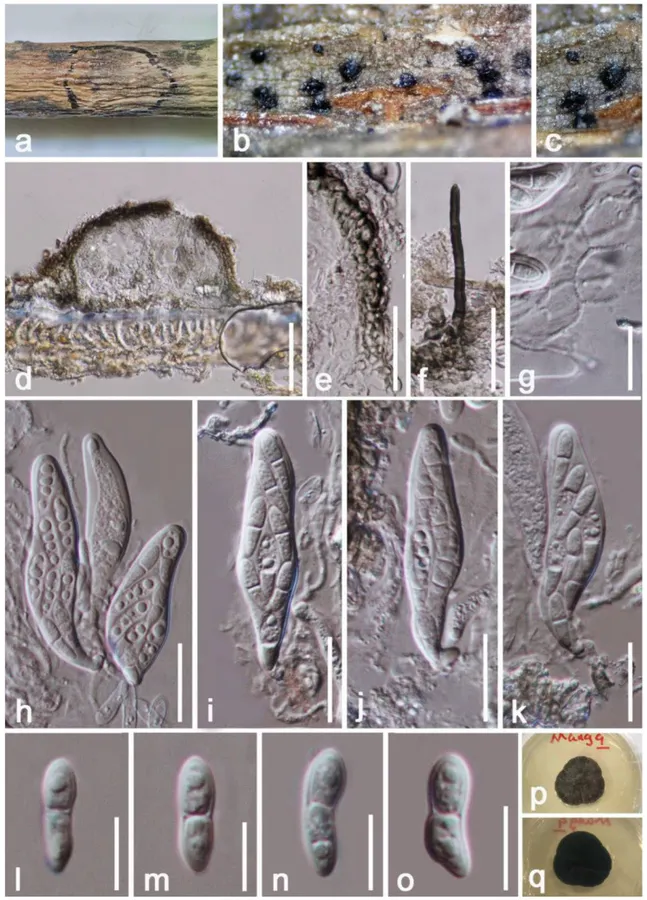
Notes: Our isolates clustered within Cyphellophora, while they share similar characteristics with C. jingdongensi (IFRD 9049) which was reported by Yang et al. [ 69 ] from China, but our strains differ by having distinct setae at the outermost of peridium, and ellipsoid to irregular, 1-septate, thick-walled, rough, and smaller (12–16 × 3–5 µm vs. 16–24 × 5–7 μm) ascospores. The BLASTn values and percent-sequence of ITS, SSU, LSU and rpb1 showed that our strain is closely related to the taxa in Table 1, and phylogenetic results indicated that they are separated. Phylogenetic results indicated that our isolates are well separated from C. attinorum (CBS 131958), C. sessilis (CBS 238.93, CBS 243.85) and C. jingdongensi (IFRD 9049) clades with high statistical supports (92% in ML, 0.99 in BI) (Figure 7).
Catatan identitas dan cakupan
- Nama diterima mengikuti Catalogue of Life Base2026-09-11; uraian mempertahankan konsep dan nama sumber aslinya.
- Preserve original treatment localities, hosts and substrate scope. Materials examined describe documented specimens, not the full global range.
- Impor dan terjemahan otomatis belum diperiksa editorial per profil. Struktur reproduktif yang disebutkan tidak membuktikan seluruh siklus hidup diketahui.
- Pengukuran pada uraian mengikuti spesimen, kultur, dan metode sumber; angka tidak diperluas ke semua populasi.
Catatan distribusi dalam narasi mengikuti sumbernya. Dokumentasi spesimen atau foto mengikuti catatan sumber. Bukti wilayah Indonesia dan penilaian konservasi tidak disimpulkan dari gambar.
Melihat dengan konteks
Cyphellophora hongheensis (HKAS 122661, holotype). (a) Ascomata on decaying wood of mango; (b – c) Close-up of ascomata on substrate; (d) Horizontal section of ascomata; (e) Peridium; (f) Seta; (g) Pseudoparaphyses; (h – k) Asci; (l – o) Ascospores; (p) Obverse view of colony on PDA; (q) Reverse view of colony on PDA. Scale bars: (d) = 50 μm; (f) = 30 μm; (e) = 25 μm; (h – k) = 20 μm; (g) =15 μm; (l – o) = 10 μm.
- Jenis
- Pelat ilmiah
- Kredit
- © 2022 by the authors.
- Lisensi
- CC BY 4.0
- Sumber media
- Buka entri sumber
Sumber profil
- [1] Taxonomy and Phylogeny of Fungi Associated with Mangifera indica from Yunnan, China — Cyphellophora hongheensis
- [2] Catalogue of Life Base2026-09-11 — Cyphellophora hongheensis
- [3] Dokumentasi visual — Cyphellophora hongheensis
Rujukan halaman ini
Fungi. Cyphellophora hongheensis. Rilis data fungi-2026-10-12-expansion-2. https://fungi-atlas.mgadib.chatgpt.site/jamur/cyphellophora-hongheensis/.
Status: impor sumber; pemeriksaan editorial per profil belum selesai. Untuk klaim biologis, gunakan rujukan pada bagian terkait dan periksa konteks sumber aslinya.