Ciri dan struktur
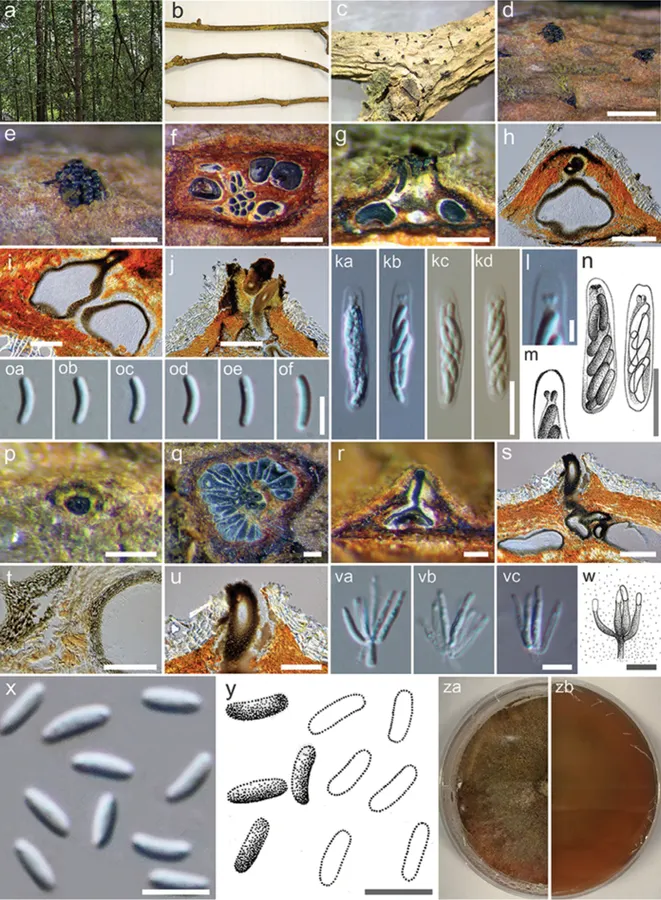
MFLU 17-0709 Associated with twigs and branches of Xylocarpus moluccensis. Sexual morph: Stromata immersed in bark. Ascostromata 400–1000 × 70–250 µm diameter, semi-immersed in host tissue, scattered, erumpent, uni- or multi-loculate, with ostiolar neck. Ostiole 70–150 µm diameter, numerous, dark brown to black, at the same level as the disc, occasionally area below disc a lighter entostroma. Peridium comprising several layers of cell of textura angularis, with innermost layer thick, brown, outer layer dark brown. Hamathecium comprising long cylindrical, cellular, anastomosed paraphyses. Asci (21–)23–25 × 4.1–4.7(–5) μm (x ‒ = 22 × 4.3 μm, n = 15), 6–8-spored, unitunicate, clavate to elongate obovoid, with a J-, refractive apical ring. Ascospores (5.6–)6–6.8 × 1.3–1.5(–2) μm (x ‒ = 6.6 × 1.5 μm, n = 20), biseriate, elongate-allantoid, unicellular, hyaline, smooth-walled. Asexual morph: Conidiomata 400–1200 × 180–380 µm diameter, semi-immersed in host tissue, solitary, erumpent, scattered, discoid, circular to ovoid, with multi-loculate, pycnidial, embedded in stromatic tissue, with ostiole. Ostioles 230–300 µm long, with an ostiolar neck. Peridium comprising few layers of cells of textura angularis, with innermost layer thin, pale brown, outer layer brown to dark brown. Conidiophores unbranched or occasionally branched at the bases, formed from the innermost layer of pycnidial wall, with conidiogenous cells. Conidiogenous cells (3.3–)6–9.1 × 1–1.3(–1.7) μm (x ‒ = 6 × 1.3 μm, n = 15), blastic, enteroblastic, flask-shaped, phialidic, hyaline and smooth-walled. Conidia (3.3–)3.8–4 × 1–1.3(–1.5) µm (x ‒ = 3.8 × 1.3 µm, n = 30), unicellular, subcylindrical, hyaline, smooth-walled.
Habitat dan peran ekologis
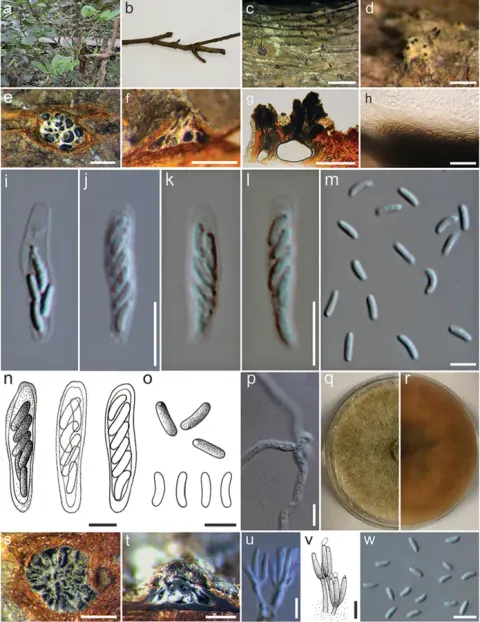
Cytospora thailandica was collected from branches of Xylocarpus moluccensis. The new species resembles some other Cytospora species, but is characterised by uni- or multi-loculate ascomata/conidiomata with unicellular, subcylindrical and hyaline spores in both morphs. Cytospora species associated with Xylocarpus granatum is also reported in this study as C. xylocarpi (MFLUCC 17-0251, Fig. 5). Cytospora xylocarpi is similar to C. thailandica in its conidiomata being multi-loculate and in the length of conidia in the asexual morph (C. xylocarpi: conidia 3 × 1.1 µm versus 3.8 × 1.3 µm in C. thailandica). However, C. thailandica differs from C. xylocarpi in having shorter ostiolar necks and larger asci and ascospores (Table 2). Phylogenetic analysis of our combined gene also reveals C. thailandica is closely related to C. lumnitzericola (Fig. 1), but there are nucleotide differences as mentioned in notes of C. lumnitzericola. The individual ITS1+ITS2 phylogenetic tree also indicates that C. thailandica is distinct with good support (Fig. 2).
- Habitat atau konteks temuan
- Informasi belum tersedia pada sumber rilis ini.
- Substrat
- Informasi belum tersedia pada sumber rilis ini.
- Peran atau konteks
- Belum dikategorikan pada rilis ini.
Reproduksi
MFLU 17-0709 Associated with twigs and branches of Xylocarpus moluccensis. Sexual morph: Stromata immersed in bark. Ascostromata 400–1000 × 70–250 µm diameter, semi-immersed in host tissue, scattered, erumpent, uni- or multi-loculate, with ostiolar neck. Ostiole 70–150 µm diameter, numerous, dark brown to black, at the same level as the disc, occasionally area below disc a lighter entostroma. Peridium comprising several layers of cell of textura angularis, with innermost layer thick, brown, outer layer dark brown. Hamathecium comprising long cylindrical, cellular, anastomosed paraphyses. Asci (21–)23–25 × 4.1–4.7(–5) μm (x ‒ = 22 × 4.3 μm, n = 15), 6–8-spored, unitunicate, clavate to elongate obovoid, with a J-, refractive apical ring.
Catatan identitas dan cakupan
- Nama diterima mengikuti Catalogue of Life Base2026-09-11; uraian mempertahankan konsep dan nama sumber aslinya.
- Preserve original treatment localities, hosts and substrate scope. Materials examined describe documented specimens, not the full global range.
- Impor dan terjemahan otomatis belum diperiksa editorial per profil. Struktur reproduktif yang disebutkan tidak membuktikan seluruh siklus hidup diketahui.
- Pengukuran pada uraian mengikuti spesimen, kultur, dan metode sumber; angka tidak diperluas ke semua populasi.
Catatan distribusi dalam narasi mengikuti sumbernya. Dokumentasi spesimen atau foto mengikuti catatan sumber. Bukti wilayah Indonesia dan penilaian konservasi tidak disimpulkan dari gambar.
Melihat dengan konteks
Cytospora thailandica (MFLU 17-0709, holotype). a Xylocarpus moluccensis b Branch of Xylocarpus moluccensis c Ascostromata on host substrate d, e Surface of ascomata f Transverse sections through ascostroma to show distribution of locules g–h Longitudinal sections through ascostroma to show distribution of locules i Peridium j Ostiolar neck ka – kd, n Asci l, m Apical ring oa–of Ascospores p Surface of conidioma q Transverse sections through conidioma to show distribution of locules r, s Longitudinal sections through conidioma to show distribution of locules t Peridium u Ostiolar neck va–vc, w Conidiogenous cells with attached conidia x, y Conidia za, zb Colonies on MEA (za-from above, zb-from below). Scale bars: d = 1000 µm, e–g = 400 µm, h, j, p–s = 200 µm, i, u = 100 µm, ka–kd, n = 10 µm, l, m = 2 µm, oa–of, va–vc, w = 5 µm, t = 50 µm, x, y = 4 µm.
- Jenis
- Pelat ilmiah
- Kredit
- Chada Norphanphoun, Olivier Raspé, Rajesh Jeewon, Ting-Chi Wen, Kevin D. Hyde
- Lisensi
- CC BY 4.0
- Sumber media
- Buka entri sumber
Sumber profil
- [1] Morphological and phylogenetic characterisation of novel Cytospora species associated with mangroves — Cytospora thailandica
- [2] Catalogue of Life Base2026-09-11 — Cytospora thailandica
- [3] Dokumentasi visual — Cytospora thailandica
Rujukan halaman ini
Fungi. Cytospora thailandica. Rilis data fungi-2026-10-12-expansion-2. https://fungi-atlas.mgadib.chatgpt.site/jamur/cytospora-thailandica/.
Status: impor sumber; pemeriksaan editorial per profil belum selesai. Untuk klaim biologis, gunakan rujukan pada bagian terkait dan periksa konteks sumber aslinya.