01 / Morfologi

Ciri dan struktur

Rosellinia bunodes is the causal agent of black root rot of many herbaceous and woody perennials in both tropical and sub-tropical regions of the world. Closely related species – namely R. pepo and R. nectarix – cause symptomatically similar diseases, but distinguishing between species can be quite difficult without the help of molecular (DNA) analysis, since survival structures are rarely observed in both the field and laboratory. Species in the genus Rosellinia can be microscopically identified by the characteristic pear-shaped (piriform) swelling near the septa of adjacent hyphal cells. Taxonomically, Rosellinia spp. are classified as Sordariomycetes within Ascomycota. Rosellinia bunodes is a facultative soil saprophyte capable of infecting a wide range of hosts, including native forest species and important agricultural crops like tea, citrus, coffee, yam, fig, rubber, cassava, banana, avocado, pepper, potato, cocoa, ginger, daffodils, yerba mate and poplar. New reports of susceptible hosts are also still occasionally reported. Outbreaks of black root rot in agricultural systems and the wild often occur in circular patches. Despite the pathogen's wide host range, disease signs and symptoms typically present in the same manner regardless of host species. Symptoms and disease progression have been likened to those caused by Phytophthora spp. and Armillaria spp. Importantly, R. bunodes is capable of infecting hosts at any age or developmental stage, from young seedlings to mature trees, and shows rapid root colonization abilities on susceptible hosts. The earliest symptoms are visible just seven days after inoculation in vitro as brown lesions on roots that progressively darken to black.

Sebagian uraian ditampilkan dalam bahasa sumber; terjemahannya belum tersedia atau belum lolos pemeriksaan.

Rujukan: [1]

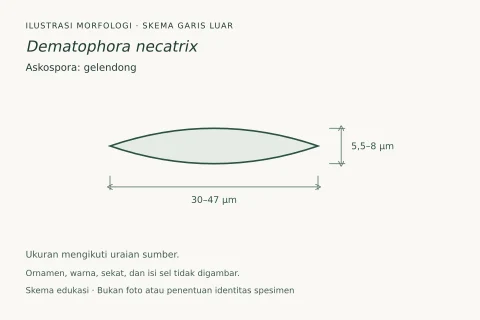
Pengukuran mengikuti objek, spesimen atau kultur, dan metode yang disebutkan sumber. Baca uraian asli untuk konteks lengkap.

02 / Kehidupan

Habitat dan peran ekologis

Rosellinia bunodes adalah saprofit tanah fakultatif yang mampu menginfeksi berbagai spesies tuan rumah, termasuk spesies hutan asli dan tanaman pertanian penting seperti teh, jeruk, kopi, yam, buah ara, karet, mani, pisang, alpukat, lada, kentang, kakao, jahe, narcis, yerba mate dan poplar. New reports dari host yang rentan juga masih terkadang dilaporkan. Outbreaks of Karat akar hitam dalam sistem pertanian dan liar sering terjadi di tempat-tempat bulat. Despite the rentang inang, tanda-tanda penyakit dan gejala patogen yang luas biasanya hadir dengan cara yang sama terlepas dari spesies inang. Symptoms and perkembangan penyakit telah dibandingkan dengan yang disebabkan oleh Phytophthora spp. dan Armillaria spp. Yang penting, R. bunodes mampu menginfeksi inang pada usia atau tahap perkembangan manapun, dari benih muda hingga pohon matang, dan menunjukkan kemampuan koloniisasi akar yang cepat pada inang yang rentan. Gejala awal terlihat hanya tujuh hari setelah vaksinasi in vitro sebagai lesi cokelat pada akar yang secara bertahap menjadi hitam. Dark discoloration dari pembungkus vaskular terlihat tidak lama kemudian. Once inside jaringan vaskular, R. bunodes mengkompromikan aliran xylem dan transportasi nutrisi ke bagian udara inang yang mengakibatkan kloroda, kedinginan, kering mati kembali, daun jatuh, dan akhirnya kematian inang.

Rujukan: [1]

Habitat atau konteks temuan
hutan
Substrat
Informasi belum tersedia pada sumber rilis ini.
Peran atau konteks
Belum dikategorikan pada rilis ini.
Temukan hubungan serupa
03 / Siklus hidup

Reproduksi

Early signs of R. bunodes colonization include white, cottony growth on roots that also progressively darken with age. As mycelia grow, they form dense mats over roots and at the base of tree trunks that thicken into irregular knots and aggregate into rhizomorphs. Over time mycelia darken to form black, branching strands firmly attached to host roots; occasionally black dots are visible before this color change, indicating production of asexual and sexual survival structures. Darkened, mature hyphae can also develop and function as microsclerotia, however germination of microsclerotia has never been achieved in a laboratory setting nor observed in nature. Teleomorphic stages of Rosellinia spp. are only occasionally observed in the wild and have never been observed in laboratory cultures.

Sebagian uraian ditampilkan dalam bahasa sumber; terjemahannya belum tersedia atau belum lolos pemeriksaan.

Rujukan: [1]

Sinonim menurut acuan taksonomi rilis: Hypoxylon bunodes; Rosellinia bunodes; Rosellinia echinata; Rosellinia zingiberis; Sphaeria bunodes
04 / Batas informasi

Catatan identitas dan cakupan

  • Nama diterima mengikuti Catalogue of Life Base2026-09-11; uraian mempertahankan konsep dan nama sumber aslinya.
  • Original geographic, specimen and life-cycle scope retained; source import awaits individual editorial review.
  • Impor dan terjemahan otomatis belum diperiksa editorial per profil. Struktur reproduktif yang disebutkan tidak membuktikan seluruh siklus hidup diketahui.
  • Pengukuran pada uraian mengikuti spesimen, kultur, dan metode sumber; angka tidak diperluas ke semua populasi.

Catatan distribusi dalam narasi mengikuti sumbernya. Dokumentasi spesimen atau foto mengikuti catatan sumber. Bukti wilayah Indonesia dan penilaian konservasi tidak disimpulkan dari gambar.

05 / Dokumentasi

Melihat dengan konteks

Dokumentasi visual yang memenuhi pemeriksaan subjek dan hak penggunaan belum tersedia. Foto gejala, label, dan gambar yang meragukan tidak dihitung.

06 / Rujukan

Sumber profil

  1. [1] Rosellinia bunodes — Wikipedia (en)Bagian sumber: Frozen revision 1311405039
    Tanggal penghimpunan sumber: 2026-10-12
    Teks sumber: CC BY-SA4.0 · Wikipedia contributors
  2. [2] Catalogue of Life Base2026-09-11 — Dematophora bunodesBagian sumber: ColDP NameUsage.tsv ID 9Z5HY; accepted species; source 2073
    Tanggal penghimpunan sumber: 2026-10-12

Adaptasi teks: CC BY-SA 4.0. Wikipedia contributors — Rosellinia bunodes — Wikipedia (en)

Uraian asli dan riwayat sumber

Riwayat atau halaman sumber

Ringkasan sumber

Rosellinia bunodes is a plant pathogen infecting several hosts including avocados, bananas, cacao and tea. Rosellinia bunodes is the causal agent of black root rot of many herbaceous and woody perennials in both tropical and sub-tropical regions of the world. Closely related species – namely R. pepo and R. nectarix – cause symptomatically similar diseases, but distinguishing between species can be quite difficult without the help of molecular (DNA) analysis, since survival structures are rarely observed in both the field and laboratory.

Revisi sumber

Morfologi sumber

Rosellinia bunodes is the causal agent of black root rot of many herbaceous and woody perennials in both tropical and sub-tropical regions of the world. Closely related species – namely R. pepo and R. nectarix – cause symptomatically similar diseases, but distinguishing between species can be quite difficult without the help of molecular (DNA) analysis, since survival structures are rarely observed in both the field and laboratory. Species in the genus Rosellinia can be microscopically identified by the characteristic pear-shaped (piriform) swelling near the septa of adjacent hyphal cells. Taxonomically, Rosellinia spp. are classified as Sordariomycetes within Ascomycota. Rosellinia bunodes is a facultative soil saprophyte capable of infecting a wide range of hosts, including native forest species and important agricultural crops like tea, citrus, coffee, yam, fig, rubber, cassava, banana, avocado, pepper, potato, cocoa, ginger, daffodils, yerba mate and poplar. New reports of susceptible hosts are also still occasionally reported. Outbreaks of black root rot in agricultural systems and the wild often occur in circular patches. Despite the pathogen's wide host range, disease signs and symptoms typically present in the same manner regardless of host species. Symptoms and disease progression have been likened to those caused by Phytophthora spp. and Armillaria spp. Importantly, R. bunodes is capable of infecting hosts at any age or developmental stage, from young seedlings to mature trees, and shows rapid root colonization abilities on susceptible hosts. The earliest symptoms are visible just seven days after inoculation in vitro as brown lesions on roots that progressively darken to black.

Revisi sumber

Ekologi sumber

Rosellinia bunodes is a facultative soil saprophyte capable of infecting a wide range of hosts, including native forest species and important agricultural crops like tea, citrus, coffee, yam, fig, rubber, cassava, banana, avocado, pepper, potato, cocoa, ginger, daffodils, yerba mate and poplar. New reports of susceptible hosts are also still occasionally reported. Outbreaks of black root rot in agricultural systems and the wild often occur in circular patches. Despite the pathogen's wide host range, disease signs and symptoms typically present in the same manner regardless of host species. Symptoms and disease progression have been likened to those caused by Phytophthora spp. and Armillaria spp. Importantly, R. bunodes is capable of infecting hosts at any age or developmental stage, from young seedlings to mature trees, and shows rapid root colonization abilities on susceptible hosts. The earliest symptoms are visible just seven days after inoculation in vitro as brown lesions on roots that progressively darken to black. Dark discoloration of vascular bundles is visible shortly thereafter. Once inside the vascular tissue, R. bunodes compromises xylem flow and transport of nutrients to aerial parts of the host resulting in chlorosis, wilting, dry die-back, leaf drop, and eventually host death.

Revisi sumber

Struktur reproduksi sumber

Early signs of R. bunodes colonization include white, cottony growth on roots that also progressively darken with age. As mycelia grow, they form dense mats over roots and at the base of tree trunks that thicken into irregular knots and aggregate into rhizomorphs. Over time mycelia darken to form black, branching strands firmly attached to host roots; occasionally black dots are visible before this color change, indicating production of asexual and sexual survival structures. Darkened, mature hyphae can also develop and function as microsclerotia, however germination of microsclerotia has never been achieved in a laboratory setting nor observed in nature. Teleomorphic stages of Rosellinia spp. are only occasionally observed in the wild and have never been observed in laboratory cultures.

Revisi sumber

Rujukan halaman ini

Fungi. Dematophora bunodes. Rilis data fungi-2026-10-12-expansion-2. https://fungi-atlas.mgadib.chatgpt.site/jamur/dematophora-bunodes/.

Status: impor sumber; pemeriksaan editorial per profil belum selesai. Untuk klaim biologis, gunakan rujukan pada bagian terkait dan periksa konteks sumber aslinya.