01 / Morfologi

Ciri dan struktur

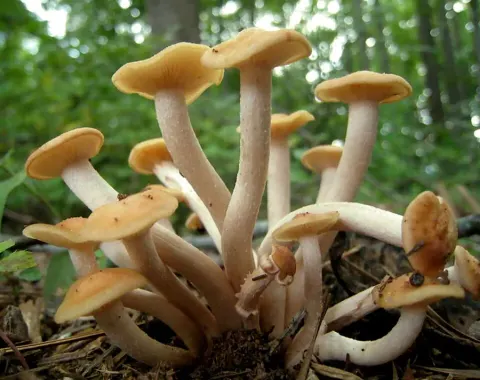
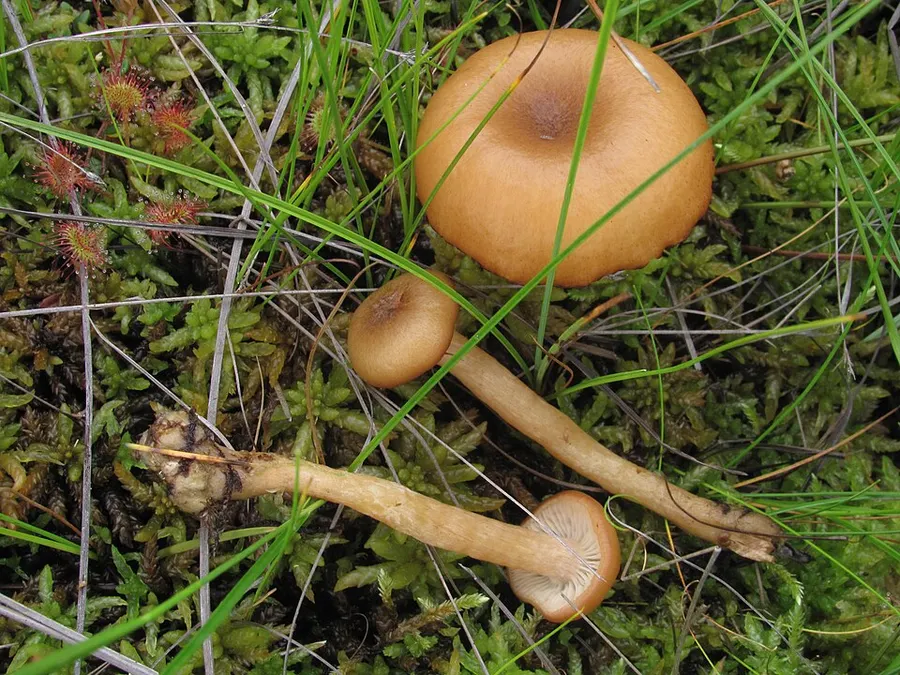
The cap can grow to 10 cm in diameter, and is convex at first becoming flattened with age, sometimes developing a depressed centre. The cap has a slightly curved margin and is often striate with the gills visible through its thin structure. The centre is dark brown and scaly. The rest of the cap is yellowish-brown to brown, paler when it is dry and darker when it is moist. The gills are rather narrow and decurrent, whitish at first, becoming cream, buff or pinkish. The stem is up to 10 cm tall, cylindrical and slightly swollen at the base. It is the same colour as the cap. There are no mycelial cords at the base of the stem. The spore print is white.

Sebagian uraian ditampilkan dalam bahasa sumber; terjemahannya belum tersedia atau belum lolos pemeriksaan.

Rujukan: [1]

Pengukuran mengikuti objek, spesimen atau kultur, dan metode yang disebutkan sumber. Baca uraian asli untuk konteks lengkap.

02 / Kehidupan

Habitat dan peran ekologis

The marsh honey fungus has a boreal and montane Eurasian distribution. In Europe, it has been recorded in Austria, Switzerland, the Czech Republic, Denmark, Sweden, Finland, France, Germany, Poland, the British Isles, the Netherlands, Russia and Slovakia. In Asia, it has been recorded in China, Japan and Turkey. Its typical habitat is in waterlogged habitats, in raised bogs, peat mires and alkaline fens, among Sphagnum mosses, sedges, cottongrass and reeds. It is uncommon or rare across the whole of its range. It grows on the Garron Plateau in County Antrim in Northern Ireland, this being one of the only four known sites in the British Isles.

Sebagian uraian ditampilkan dalam bahasa sumber; terjemahannya belum tersedia atau belum lolos pemeriksaan.

Rujukan: [1]

Habitat atau konteks temuan
Informasi belum tersedia pada sumber rilis ini.
Substrat
Informasi belum tersedia pada sumber rilis ini.
Peran atau konteks
Belum dikategorikan pada rilis ini.
Temukan hubungan serupa
03 / Siklus hidup

Reproduksi

The cap can grow to 10 cm in diameter, and is convex at first becoming flattened with age, sometimes developing a depressed centre. The cap has a slightly curved margin and is often striate with the gills visible through its thin structure. The centre is dark brown and scaly. The rest of the cap is yellowish-brown to brown, paler when it is dry and darker when it is moist. The gills are rather narrow and decurrent, whitish at first, becoming cream, buff or pinkish. The stem is up to 10 cm tall, cylindrical and slightly swollen at the base. It is the same colour as the cap. There are no mycelial cords at the base of the stem. The spore print is white.

Sebagian uraian ditampilkan dalam bahasa sumber; terjemahannya belum tersedia atau belum lolos pemeriksaan.

Rujukan: [1]

Sinonim menurut acuan taksonomi rilis: Agaricus ectypus; Armillaria ectypa; Armillariella ectypa; Camarophyllus ectypus; Clitocybe ectypa; Collybia ectypa; Omphalia ectypa; Tricholoma ectypum
04 / Batas informasi

Catatan identitas dan cakupan

  • Nama diterima mengikuti Catalogue of Life Base2026-09-11; uraian mempertahankan konsep dan nama sumber aslinya.
  • Original geographic, specimen and life-cycle scope retained; source import awaits individual editorial review.
  • Impor dan terjemahan otomatis belum diperiksa editorial per profil. Struktur reproduktif yang disebutkan tidak membuktikan seluruh siklus hidup diketahui.
  • Pengukuran pada uraian mengikuti spesimen, kultur, dan metode sumber; angka tidak diperluas ke semua populasi.

Catatan distribusi dalam narasi mengikuti sumbernya. Dokumentasi spesimen atau foto mengikuti catatan sumber. Bukti wilayah Indonesia dan penilaian konservasi tidak disimpulkan dari gambar.

05 / Dokumentasi

Melihat dengan konteks

Dokumentasi Armillaria ectypa dari Wikimedia Commons. Vesi-külmaseen Läänemaa Suursoos Identifikasi mengikuti record berkas sumber.

Jenis
Fotografi
Kredit
Pärismaalane
Sumber media
Buka entri sumber

Gambar menunjukkan objek menurut identifikasi sumber, bukan verifikasi independen spesimen oleh Fungi. Tidak ada skala baru yang ditambahkan.

06 / Rujukan

Sumber profil

  1. [1] Armillaria ectypa — Wikipedia (en)Bagian sumber: Frozen revision 1195184247
    Tanggal penghimpunan sumber: 2026-10-12
    Teks sumber: CC BY-SA4.0 · Wikipedia contributors
  2. [2] Catalogue of Life Base2026-09-11 — Desarmillaria ectypaBagian sumber: ColDP NameUsage.tsv ID 34YZL; accepted species; source 2073
    Tanggal penghimpunan sumber: 2026-10-12
  3. [3] Dokumentasi visual — Armillaria ectypaBagian sumber: Individual media record; identification follows the source, not independent determination
    Tanggal penghimpunan sumber: 2026-10-12
    Media sumber: CC BY-SA 4.0 · Pärismaalane

Adaptasi teks: CC BY-SA 4.0. Wikipedia contributors — Armillaria ectypa — Wikipedia (en)

Uraian asli dan riwayat sumber

Riwayat atau halaman sumber

Ringkasan sumber

The cap can grow to 10 cm in diameter, and is convex at first becoming flattened with age, sometimes developing a depressed centre. The cap has a slightly curved margin and is often striate with the gills visible through its thin structure. The centre is dark brown and scaly. The rest of the cap is yellowish-brown to brown, paler when it is dry and darker when it is moist. The gills are rather narrow and decurrent, whitish at first, becoming cream, buff or pinkish. The stem is up to 10 cm tall, cylindrical and slightly swollen at the base.

Revisi sumber

Morfologi sumber

The cap can grow to 10 cm in diameter, and is convex at first becoming flattened with age, sometimes developing a depressed centre. The cap has a slightly curved margin and is often striate with the gills visible through its thin structure. The centre is dark brown and scaly. The rest of the cap is yellowish-brown to brown, paler when it is dry and darker when it is moist. The gills are rather narrow and decurrent, whitish at first, becoming cream, buff or pinkish. The stem is up to 10 cm tall, cylindrical and slightly swollen at the base. It is the same colour as the cap. There are no mycelial cords at the base of the stem. The spore print is white.

Revisi sumber

Ekologi sumber

The marsh honey fungus has a boreal and montane Eurasian distribution. In Europe, it has been recorded in Austria, Switzerland, the Czech Republic, Denmark, Sweden, Finland, France, Germany, Poland, the British Isles, the Netherlands, Russia and Slovakia. In Asia, it has been recorded in China, Japan and Turkey. Its typical habitat is in waterlogged habitats, in raised bogs, peat mires and alkaline fens, among Sphagnum mosses, sedges, cottongrass and reeds. It is uncommon or rare across the whole of its range. It grows on the Garron Plateau in County Antrim in Northern Ireland, this being one of the only four known sites in the British Isles.

Revisi sumber

Struktur reproduksi sumber

The cap can grow to 10 cm in diameter, and is convex at first becoming flattened with age, sometimes developing a depressed centre. The cap has a slightly curved margin and is often striate with the gills visible through its thin structure. The centre is dark brown and scaly. The rest of the cap is yellowish-brown to brown, paler when it is dry and darker when it is moist. The gills are rather narrow and decurrent, whitish at first, becoming cream, buff or pinkish. The stem is up to 10 cm tall, cylindrical and slightly swollen at the base. It is the same colour as the cap. There are no mycelial cords at the base of the stem. The spore print is white.

Revisi sumber

Rujukan halaman ini

Fungi. Desarmillaria ectypa. Rilis data fungi-2026-10-12-expansion-2. https://fungi-atlas.mgadib.chatgpt.site/jamur/desarmillaria-ectypa/.

Status: impor sumber; pemeriksaan editorial per profil belum selesai. Untuk klaim biologis, gunakan rujukan pada bagian terkait dan periksa konteks sumber aslinya.