Ciri dan struktur
Basidiomata annual, at first cushion- or button-shaped, then adpressed-orbicular or more rarely nearly cerebriform, up to 5 cm in diam., broadly attached, in large groups, finally often fusing together and reaching 30 cm in the longest dimension, up to 1.5 cm thick, gelatinous. Hymenial surface uneven or variably folded, as a rule covered by rather regularly arranged spike-like black projections up to 0.2 mm long, at first gray to brownish-gray, later brownish-black, in older basidiomata sometimes fading to yellowish-brown, in dry condition completely black. Abhymenial surface smooth or near so, concolourous with or slightly paler than hymenial surface. Margin free, concolourous with hymenial surface, entire, even or lobate. Hyphal structure monomitic, hyphae clamped; context hyphae hyaline to grayish, occasionally encrusted by brownish deposits, thin- to slightly thick-walled, interwoven or subparallel, anastomosing, 0.5–6 μm in diam., subhymenial hyphae hyaline to grayish or brownish, thin-walled or with a distinct wall, ascending or interwoven, 1–3.5 μm in diam., occasionally irregularly inflated (up to 7.5 μm in diam.), basidia-bearing hyphae 2–5.5 μm in diam. Hyphidia with a brownish, occasionally irregularly inflated hyphoid stem, 2–10.5 μm in diam., and hyaline or brownish apical branches, 0.5–1 μm in diam., forming a continuous layer up to 50 μm thick. Probasidia bullet-shaped or broadly clavate, 10.5–23 × 4–10 μm. Basidia four-celled, ellipsoid-ovoid, (10–) 11.5–20.5 (–21.5) × (7.9–) 8.1–11.8 (–12.1) μm (n = 160/14), sterigmata up to 25 × 1–2.5 μm. Basidiospores narrowly to broadly cylindrical, more rarely allantoid, slightly or moderately curved, (8.1–) 8.3–16.7 (–19.7) × (3.1–) 3.2–5.2 (–5.3) μm (n = 560/19), L = 9.55–14.43, W = 3.59–4.61, Q = 2.49–3.49.
Habitat dan peran ekologis
As redefined here, E. pithya is morphologically most similar to E. friesiana. Both species produce black or nearly black, adpressed-orbicular basidiomata with smooth abhymenial surface, soon fusing together and making up compound, irregularly shaped fructifications. The main macroscopic differences between the two species are a more distinctly folded hymenial surface of E. pithya compared to E. friesiana and the presence of sharp or blunt hymenial projections in the first species. Microscopically, E. pithya differs from E. friesiana in having more irregularly arranged subhymenial hyphae (often partly ascending and partly interwoven in the same fruitbody) and narrower and as a rule shorter basidiospores. Additionally, E. pithya occurs on both angiosperms and conifers, while E. friesiana is restricted to freshly fallen logs and branches of Abies and Picea spp. (as well as Pinus in the Mediterranean). Up to now, E. pithya was believed to be a conifer-dwelling species which was differentiated from the similar E. glandulosa sensu Neuhoff (= E. nigricans after Roberts 2009) by its host preference. The latter species was described as growing exclusively on deciduous trees (Raitviir 1970; Hansen and Knudsen 1997).
- Habitat atau konteks temuan
- Informasi belum tersedia pada sumber rilis ini.
- Substrat
- Informasi belum tersedia pada sumber rilis ini.
- Peran atau konteks
- Belum dikategorikan pada rilis ini.
Reproduksi
Basidiomata annual, at first cushion- or button-shaped, then adpressed-orbicular or more rarely nearly cerebriform, up to 5 cm in diam., broadly attached, in large groups, finally often fusing together and reaching 30 cm in the longest dimension, up to 1.5 cm thick, gelatinous. Hymenial surface uneven or variably folded, as a rule covered by rather regularly arranged spike-like black projections up to 0.2 mm long, at first gray to brownish-gray, later brownish-black, in older basidiomata sometimes fading to yellowish-brown, in dry condition completely black. Abhymenial surface smooth or near so, concolourous with or slightly paler than hymenial surface. Margin free, concolourous with hymenial surface, entire, even or lobate.
Catatan identitas dan cakupan
- Nama diterima mengikuti Catalogue of Life Base2026-09-11; uraian mempertahankan konsep dan nama sumber aslinya.
- Preserve original treatment localities, hosts and substrate scope. Materials examined describe documented specimens, not the full global range.
- Impor dan terjemahan otomatis belum diperiksa editorial per profil. Struktur reproduktif yang disebutkan tidak membuktikan seluruh siklus hidup diketahui.
- Pengukuran pada uraian mengikuti spesimen, kultur, dan metode sumber; angka tidak diperluas ke semua populasi.
Catatan distribusi dalam narasi mengikuti sumbernya. Dokumentasi spesimen atau foto mengikuti catatan sumber. Bukti wilayah Indonesia dan penilaian konservasi tidak disimpulkan dari gambar.
Melihat dengan konteks
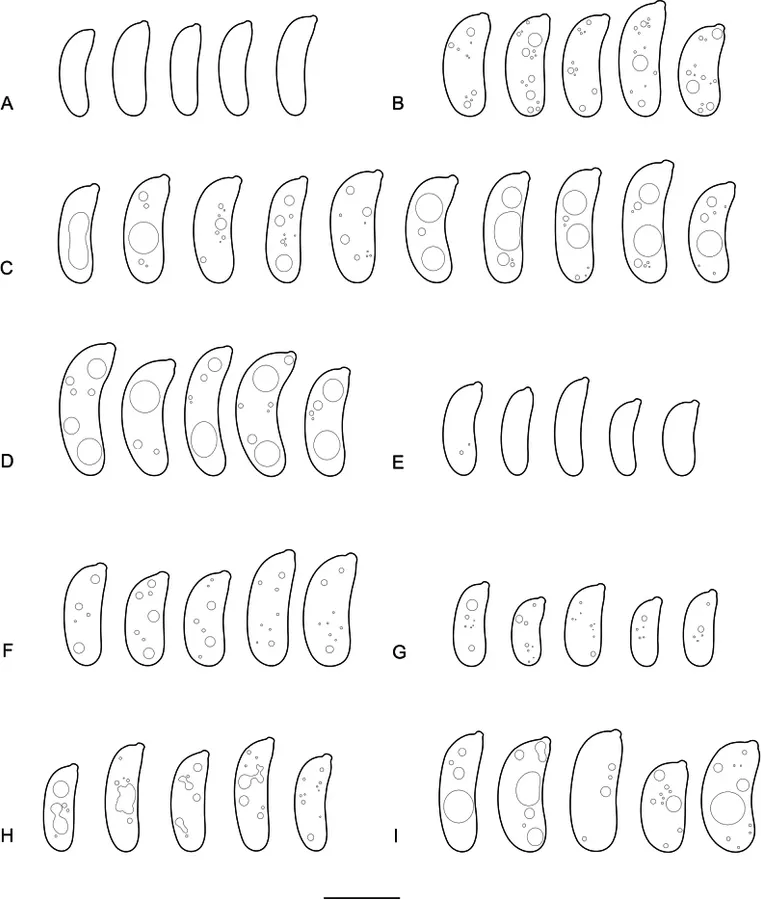
Basidiospores: A Exidia crenata (holotype of Tremella corrugata); B E. delita (holotype); C E. friesiana (five left – Spirin 7660, five right – Spirin 18006); D E. glandulosa (Spirin 18030); E E. impressa (neotype); F E. inornata (isotype); G E. pithya (neotype); H E. pithya (J. Olsson 19.12.2024); I E. plumbescens (three left – Spirin 5836, two right – T. Helo 20210767). Scale bar: 10 μm.
- Jenis
- Pelat ilmiah
- Kredit
- Viacheslav Spirin, Vera Malysheva, Nathan Schoutteten, Anton Savchenko, Bernard Rivoire, Jan Olsson, Thomas Læssøe, Leif Ryvarden, Django Grootmyers, Matti Kulju, Josef Vlasák, María Victoria Vignale, Ilya Viner
- Lisensi
- CC BY 4.0
- Sumber media
- Buka entri sumber
Dokumentasi tambahan
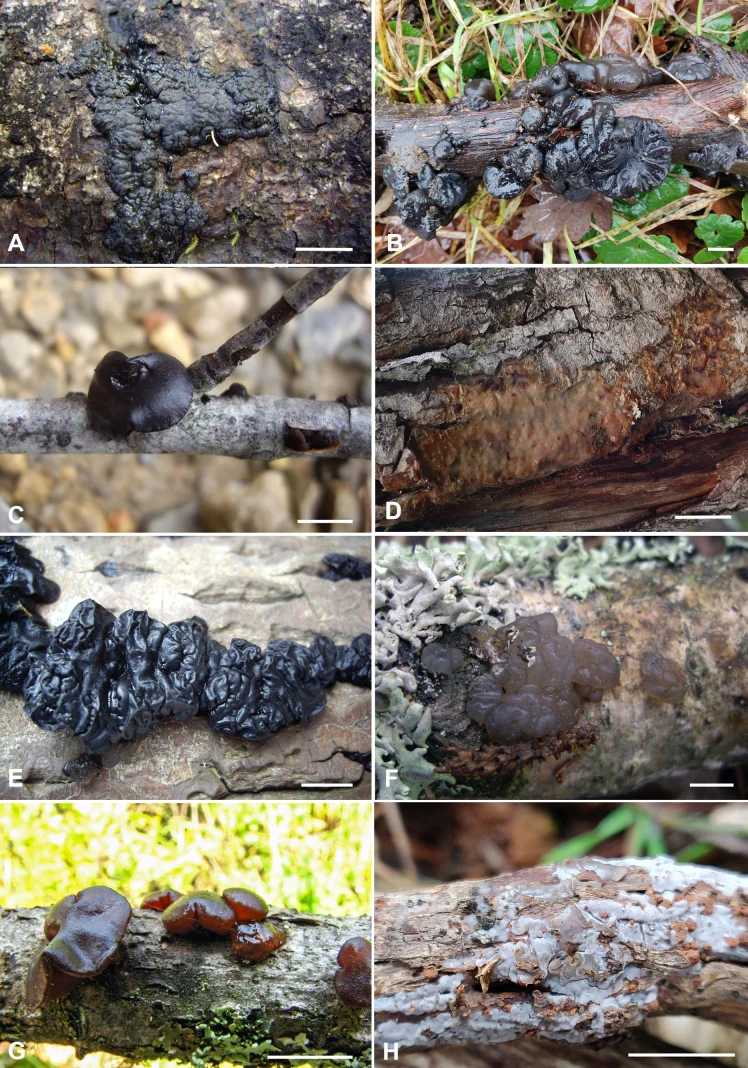
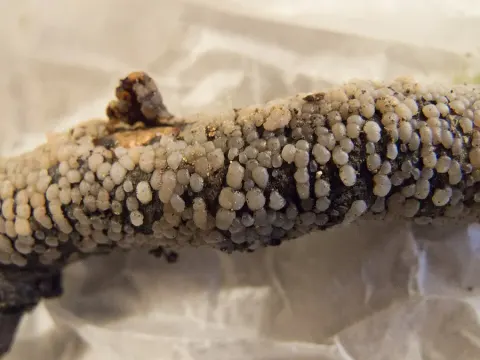
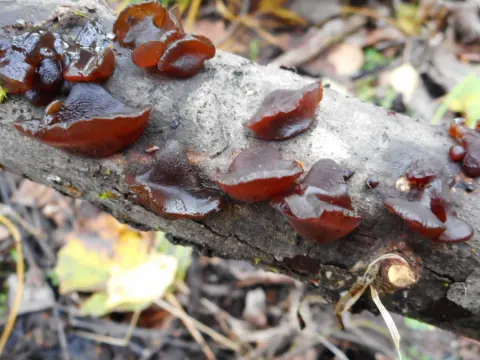
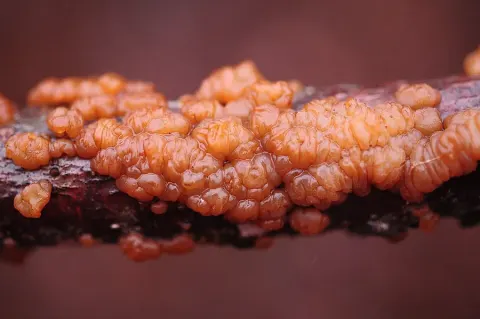
Pelat perbandingan tubuh buah. Panel E–F memakai nama Exidia pithya, yang dipetakan ke Exidia nigricans dalam backbone profil. Panel lainnya memuat spesies pembanding.
Kredit dan penggunaan
Viacheslav Spirin, Vera Malysheva, Nathan Schoutteten, Anton Savchenko, Bernard Rivoire, Jan Olsson, Thomas Læssøe, Leif Ryvarden, Django Grootmyers, Matti Kulju, Josef Vlasák, María Victoria Vignale, Ilya Viner
Ukuran dan format gambar disesuaikan tanpa pemotongan, retus, atau penambahan skala. Lisensi sumber dipertahankan.
Sumber profil
- [1] Exidia and Exidiopsis (Auriculariales, Basidiomycota): a reconsideration — Exidia pithya
- [2] Catalogue of Life Base2026-09-11 — Exidia nigricans
- [3] Dokumentasi visual — Exidia nigricans
- [4] Dokumentasi visual — Exidia nigricans
Rujukan halaman ini
Fungi. Exidia nigricans. Rilis data fungi-2026-10-12-expansion-2. https://fungi-atlas.mgadib.chatgpt.site/jamur/exidia-nigricans/.
Status: impor sumber; pemeriksaan editorial per profil belum selesai. Untuk klaim biologis, gunakan rujukan pada bagian terkait dan periksa konteks sumber aslinya.