01 / Morfologi

Ciri dan struktur

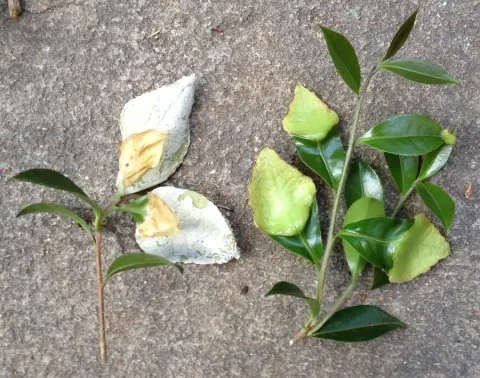
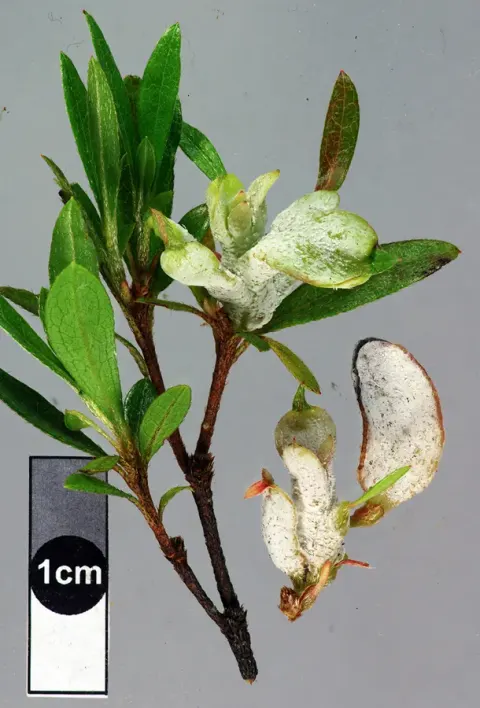
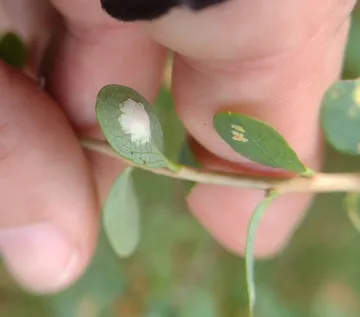
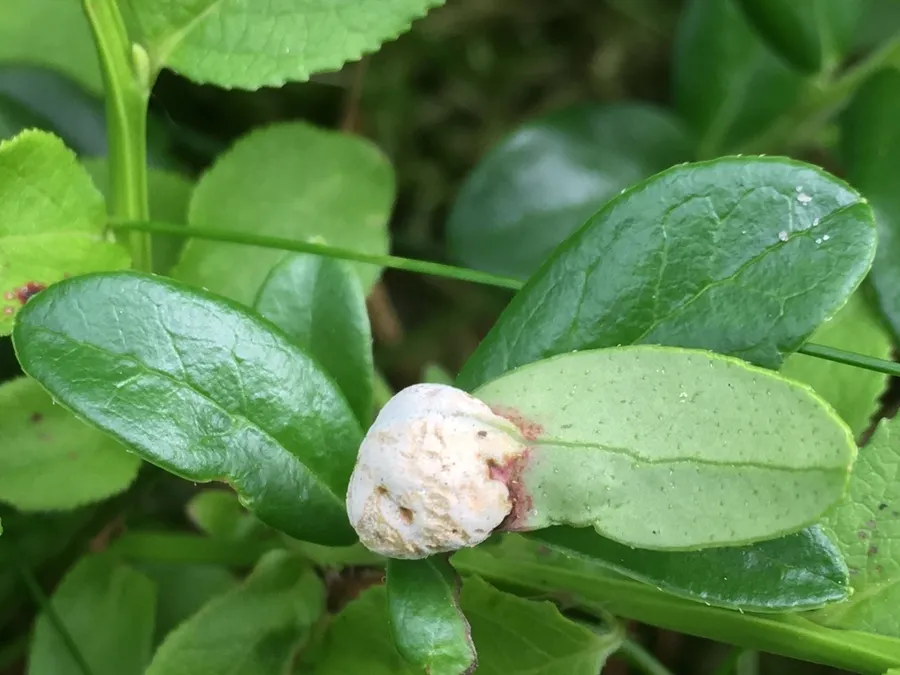
In its pathogenic state, E. vaccinii causes discoloration and, depending on the host, may cause hypertrophy and hyperplasia on the leaves and meristem, often forming flower-like structures (i.e. “pseudoflowers”). It may also cause green spots on blueberry fruits, which are sometimes tinted red and have occasional white spore masses. Symptoms within the host plant are often varied compared to other species of Exobasidium, and distinguishing among species has relied traditionally upon spore size. In a typical disease cycle, leaves on infected shoots will first turn greenish red to bright red when the host species would typically fruit. During the late stage of disease development, the undersurface (abaxial side) of leaves will become covered in a white mass, consisting of sparse hyphae, basidia, basidiospores, secondary spores, and secondary spores forming conidia. Basidiospores are musiform and among other members of the Ustilagomycetes. The intercellular hyphae are septate with short, lobed haustoria. Hyphae and haustoria contacting host cells cause significant amounts of pressure and subsequent distortion in the surrounding tissues. Haustoria contain membranous inclusion bodies and are associated with electron-dense deposits, much like other plant pathogenic fungi.

Sebagian uraian ditampilkan dalam bahasa sumber; terjemahannya belum tersedia atau belum lolos pemeriksaan.

Rujukan: [1]

Pengukuran mengikuti objek, spesimen atau kultur, dan metode yang disebutkan sumber. Baca uraian asli untuk konteks lengkap.

02 / Kehidupan

Habitat dan peran ekologis

E. vaccinii dimorf dan dapat ditanam dalam budaya; dalam keadaan tidak patogen dalam alamnya, kemungkinan besar hidup dalam bentuk ragi di tanah atau pada tanaman yang mirip dengan banyak kerabat kotornya. Dalam keadaan biotropiknya, E. vaccinii mendapatkan energi dari tanaman tuan rumah erikaceusnya. Most species dari rhododendron dan azalea yang asli dan dibudidayakan dianggap rentan, selain dari varietas blueberry yang tinggi dan rendah. E. vaccinii tersebar di seluruh belahan bumi utara, termasuk sebagian besar Eropa timur Utara America and barat, menurut penelitian yang diketahui. Hal ini juga telah dilaporkan di bagian-bagian dari Vaccinium endemik Asia on. Endemic species sebelumnya dilaporkan terinfeksi E. vaccinii di Hawaii has ditemukan sebagai spesies yang berbeda, Exobasidium darwinii. Systemically infected tanaman juga sering mengalami tingkat infeksi yang lebih tinggi dan beban empedu.

Rujukan: [1]

Habitat atau konteks temuan
kultur yang didokumentasikan
Substrat
Informasi belum tersedia pada sumber rilis ini.
Peran atau konteks
Belum dikategorikan pada rilis ini.
Temukan hubungan serupa
03 / Siklus hidup

Reproduksi

In its pathogenic state, E. vaccinii causes discoloration and, depending on the host, may cause hypertrophy and hyperplasia on the leaves and meristem, often forming flower-like structures (i.e. “pseudoflowers”). It may also cause green spots on blueberry fruits, which are sometimes tinted red and have occasional white spore masses. Symptoms within the host plant are often varied compared to other species of Exobasidium, and distinguishing among species has relied traditionally upon spore size. In a typical disease cycle, leaves on infected shoots will first turn greenish red to bright red when the host species would typically fruit. During the late stage of disease development, the undersurface (abaxial side) of leaves will become covered in a white mass, consisting of sparse hyphae, basidia, basidiospores, secondary spores, and secondary spores forming conidia.

Sebagian uraian ditampilkan dalam bahasa sumber; terjemahannya belum tersedia atau belum lolos pemeriksaan.

Rujukan: [1]

Sinonim menurut acuan taksonomi rilis: Exobasidium vaccinii var. vitis-idaeae; Fusidium vaccinii
04 / Batas informasi

Catatan identitas dan cakupan

  • Nama diterima mengikuti Catalogue of Life Base2026-09-11; uraian mempertahankan konsep dan nama sumber aslinya.
  • Original geographic, specimen and life-cycle scope retained; source import awaits individual editorial review.
  • Impor dan terjemahan otomatis belum diperiksa editorial per profil. Struktur reproduktif yang disebutkan tidak membuktikan seluruh siklus hidup diketahui.
  • Pengukuran pada uraian mengikuti spesimen, kultur, dan metode sumber; angka tidak diperluas ke semua populasi.

Catatan distribusi dalam narasi mengikuti sumbernya. Dokumentasi spesimen atau foto mengikuti catatan sumber. Bukti wilayah Indonesia dan penilaian konservasi tidak disimpulkan dari gambar.

05 / Dokumentasi

Melihat dengan konteks

Dokumentasi Exobasidium vaccinii menurut asosiasi foto pada record takson iNaturalist. Kredit: Enrico Tomschke. Identitas mengikuti sumber; bukan penentuan spesimen independen.

Jenis
Fotografi
Kredit
(c) Enrico Tomschke, some rights reserved (CC BY), uploaded by Enrico Tomschke
Lisensi
CC BY 4.0
Sumber media
Buka entri sumber

Gambar menunjukkan objek menurut identifikasi sumber, bukan verifikasi independen spesimen oleh Fungi. Tidak ada skala baru yang ditambahkan.

06 / Rujukan

Sumber profil

  1. [1] Exobasidium vaccinii — Wikipedia (en)Bagian sumber: Frozen revision 1306720086
    Tanggal penghimpunan sumber: 2026-10-12
    Teks sumber: CC BY-SA4.0 · Wikipedia contributors
  2. [2] Catalogue of Life Base2026-09-11 — Exobasidium vacciniiBagian sumber: ColDP NameUsage.tsv ID 3DLLL; accepted species; source 2073
    Tanggal penghimpunan sumber: 2026-10-12
  3. [3] Dokumentasi visual — Exobasidium vacciniiBagian sumber: Individual media record; identification follows the source, not independent determination
    Tanggal penghimpunan sumber: 2026-10-12
    Media sumber: CC BY 4.0 · (c) Enrico Tomschke, some rights reserved (CC BY), uploaded by Enrico Tomschke

Adaptasi teks: CC BY-SA 4.0. Wikipedia contributors — Exobasidium vaccinii — Wikipedia (en)

Uraian asli dan riwayat sumber

Riwayat atau halaman sumber

Ringkasan sumber

In its pathogenic state, E. vaccinii causes discoloration and, depending on the host, may cause hypertrophy and hyperplasia on the leaves and meristem, often forming flower-like structures (i.e. “pseudoflowers”). It may also cause green spots on blueberry fruits, which are sometimes tinted red and have occasional white spore masses. Symptoms within the host plant are often varied compared to other species of Exobasidium, and distinguishing among species has relied traditionally upon spore size. In a typical disease cycle, leaves on infected shoots will first turn greenish red to bright red when the host species would typically fruit.

Revisi sumber

Morfologi sumber

In its pathogenic state, E. vaccinii causes discoloration and, depending on the host, may cause hypertrophy and hyperplasia on the leaves and meristem, often forming flower-like structures (i.e. “pseudoflowers”). It may also cause green spots on blueberry fruits, which are sometimes tinted red and have occasional white spore masses. Symptoms within the host plant are often varied compared to other species of Exobasidium, and distinguishing among species has relied traditionally upon spore size. In a typical disease cycle, leaves on infected shoots will first turn greenish red to bright red when the host species would typically fruit. During the late stage of disease development, the undersurface (abaxial side) of leaves will become covered in a white mass, consisting of sparse hyphae, basidia, basidiospores, secondary spores, and secondary spores forming conidia. Basidiospores are musiform and among other members of the Ustilagomycetes. The intercellular hyphae are septate with short, lobed haustoria. Hyphae and haustoria contacting host cells cause significant amounts of pressure and subsequent distortion in the surrounding tissues. Haustoria contain membranous inclusion bodies and are associated with electron-dense deposits, much like other plant pathogenic fungi.

Revisi sumber

Ekologi sumber

E. vaccinii is dimorphic and can be grown in culture; in its non-pathogenic state in nature, it likely lives in a yeast-like form in the soil or on the plant similar to many of its smut relatives. In its biotrophic state, E. vaccinii gets its energy from its ericaceous host plants. Most species of native and cultivated rhododendron and azalea are considered susceptible, in addition to high and lowbush blueberry cultivars. E. vaccinii is distributed across the Northern Hemisphere, including most of eastern North America and western Europe, according to known studies. It has also been reported in parts of Asia on endemic Vaccinium. Endemic species previously reported to be infected with E. vaccinii in Hawaii has been discovered to be a different species, Exobasidium darwinii. Systemically infected plants also often experience higher infection rates and gall loads.

Revisi sumber

Struktur reproduksi sumber

In its pathogenic state, E. vaccinii causes discoloration and, depending on the host, may cause hypertrophy and hyperplasia on the leaves and meristem, often forming flower-like structures (i.e. “pseudoflowers”). It may also cause green spots on blueberry fruits, which are sometimes tinted red and have occasional white spore masses. Symptoms within the host plant are often varied compared to other species of Exobasidium, and distinguishing among species has relied traditionally upon spore size. In a typical disease cycle, leaves on infected shoots will first turn greenish red to bright red when the host species would typically fruit. During the late stage of disease development, the undersurface (abaxial side) of leaves will become covered in a white mass, consisting of sparse hyphae, basidia, basidiospores, secondary spores, and secondary spores forming conidia.

Revisi sumber

Rujukan halaman ini

Fungi. Exobasidium vaccinii. Rilis data fungi-2026-10-12-expansion-2. https://fungi-atlas.mgadib.chatgpt.site/jamur/exobasidium-vaccinii/.

Status: impor sumber; pemeriksaan editorial per profil belum selesai. Untuk klaim biologis, gunakan rujukan pada bagian terkait dan periksa konteks sumber aslinya.