Saprobic or patogen pada batang udara mati dari Maclura pomifera. Morph seksual tidak ditentukan. Morph asexual konidiomata 40–47 × 40–69 μm (\(\bar{x} \) = 43.3 × 48 µm, n = 20), pycnidial, globose ke subglobosa, elipsoidal, atau tidak teratur, terendam pada semi-merendam, karbonase. Pycnidial walls 15–40 μm, terdiri dari sel-sel yang berlapis 1–2 dari tekstura angularis. Sel Conidiophores reduced ke konidiogen. Conidiogenous cells 2–4 × 2–3 μm (\(\bar{x} \) = 2.6 × 2.2 µm, n = 20), phialidic dengan penebalan periklinal atau proliferasi berulang di puncak, hialin, halus, globose hingga silinder pendek.
Profil ini diimpor dari uraian spesies pada sumber berlisensi dan sebagian teks diterjemahkan otomatis. Pemeriksaan editorial per profil belum selesai. Bagian yang belum diterjemahkan atau belum lolos pemeriksaan terjemahan tetap ditampilkan dalam bahasa sumber. Angka dan nama ilmiah dipertahankan.
Saprobic or pathogenic on dead aerial stem of Maclura pomifera. Sexual morph Undetermined. Asexual morph Conidiomata 40–47 × 40–69 μm (\(\bar{x} \) = 43.3 × 48 µm, n = 20), pycnidial, globose to subglobose, ellipsoidal, or irregular, immersed to semi-immersed, carbonaceous. Pycnidial walls 15–40 μm, comprising 1–2-layered of cells of textura angularis. Conidiophores reduced to conidiogenous cells. Conidiogenous cells 2–4 × 2–3 μm (\(\bar{x} \) = 2.6 × 2.2 µm, n = 20), phialidic with periclinal thickening or percurrent proliferation at apex, hyaline, smooth, globose to short cylindrical. Conidia 2–6 × 3–5 μm (\(\bar{x} \) = 4.9 × 3.9 µm, n = 20), ovoid to ellipsoidal, hyaline when immature, brown at maturity, aseptate, smooth- and thin-walled. Culture characteristics: Colonies on MEA, 20–25 mm diam. after 7 days at 16 °C, margin regular, circular, aerial mycelia thinly hairy, white and flat; reverse grey and white at the margin.
Sebagian uraian ditampilkan dalam bahasa sumber; terjemahannya belum tersedia atau belum lolos pemeriksaan.
Pengukuran mengikuti objek, spesimen atau kultur, dan metode yang disebutkan sumber. Baca uraian asli untuk konteks lengkap.
02 / Kehidupan
Habitat dan peran ekologis
Saprobic or pathogenic on dead aerial stem of Maclura pomifera. Sexual morph Undetermined. Asexual morph Conidiomata 40–47 × 40–69 μm (\(\bar{x} \) = 43.3 × 48 µm, n = 20), pycnidial, globose to subglobose, ellipsoidal, or irregular, immersed to semi-immersed, carbonaceous. Pycnidial walls 15–40 μm, comprising 1–2-layered of cells of textura angularis. Conidiophores reduced to conidiogenous cells. Conidiogenous cells 2–4 × 2–3 μm (\(\bar{x} \) = 2.6 × 2.2 µm, n = 20), phialidic with periclinal thickening or percurrent proliferation at apex, hyaline, smooth, globose to short cylindrical. Conidia 2–6 × 3–5 μm (\(\bar{x} \) = 4.9 × 3.9 µm, n = 20), ovoid to ellipsoidal, hyaline when immature, brown at maturity, aseptate, smooth- and thin-walled. Material examined: ITALY, Province of Forlì-Cesena [FC], Predappio Alta-Predappio, on dead aerial stem of Maclura pomifera (Moraceae), 5 May 2017, E. Camporesi, IT 3345 (MFLU 17-1006, holotype), ex-type living cultures, MFLUCC 18-1129. Notes: Strain MFLUCC 18-1129 was isolated from dead stem of Maclura pomifera in Italy. Foliophoma camporesii has a close phylogenetic affinity to F. fallens, the type species of Foliophoma (Fig. 14). It differs from F. fallens in having smaller conidiomata (40–47 × 40–69 μm versus 120–250 μm) and brown conidia.
Sebagian uraian ditampilkan dalam bahasa sumber; terjemahannya belum tersedia atau belum lolos pemeriksaan.
Saprobic or pathogenic on dead aerial stem of Maclura pomifera. Sexual morph Undetermined. Asexual morph Conidiomata 40–47 × 40–69 μm (\(\bar{x} \) = 43.3 × 48 µm, n = 20), pycnidial, globose to subglobose, ellipsoidal, or irregular, immersed to semi-immersed, carbonaceous. Pycnidial walls 15–40 μm, comprising 1–2-layered of cells of textura angularis. Conidiophores reduced to conidiogenous cells. Conidiogenous cells 2–4 × 2–3 μm (\(\bar{x} \) = 2.6 × 2.2 µm, n = 20), phialidic with periclinal thickening or percurrent proliferation at apex, hyaline, smooth, globose to short cylindrical. Conidia 2–6 × 3–5 μm (\(\bar{x} \) = 4.9 × 3.9 µm, n = 20), ovoid to ellipsoidal, hyaline when immature, brown at maturity, aseptate, smooth- and thin-walled.
Sebagian uraian ditampilkan dalam bahasa sumber; terjemahannya belum tersedia atau belum lolos pemeriksaan.
Nama diterima mengikuti Catalogue of Life Base2026-09-11; uraian mempertahankan konsep dan nama sumber aslinya.
Preserve original monograph treatment localities, hosts and specimen/substrate scope. Materials examined document specimens, not the full global range.
Impor dan terjemahan otomatis belum diperiksa editorial per profil. Struktur reproduktif yang disebutkan tidak membuktikan seluruh siklus hidup diketahui.
Pengukuran pada uraian mengikuti spesimen, kultur, dan metode sumber; angka tidak diperluas ke semua populasi.
Catatan distribusi dalam narasi mengikuti sumbernya. Dokumentasi spesimen atau foto mengikuti catatan sumber. Bukti wilayah Indonesia dan penilaian konservasi tidak disimpulkan dari gambar.
05 / Dokumentasi
Melihat dengan konteks
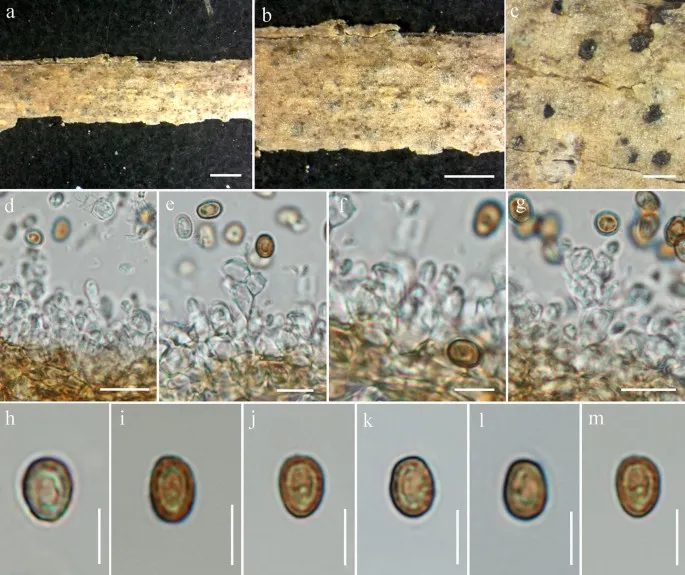
Foliophoma camporesii (MFLU 17-1006, holotype). a, b Appearance of conidiomata on host surface. c Close up of conidioma. d – g Conidiogenesis. h – m Conidia. Scale bars: a, b = 200 μm, c = 100 μm, d, e, g = 10 μm, f, h – m = 5 μm
Jenis
Pelat ilmiah
Kredit
Penulis dan sumber artikel: Hyde, Kevin D.; Dong, Yang; Phookamsak, Rungtiwa; Jeewon, Rajesh; Bhat, D. Jayarama; Jones, E. B. Gareth; Liu, Ning-Guo; Abeywickrama, Pranami D.; Mapook, Ausana; Wei, Deping; Perera, Rekhani H.; Manawasinghe, Ishara S.; Pem, Dhandevi; Bundhun, Digvijayini; Karunarathna, Anuruddha; Ekanayaka, Anusha H.; Bao, Dan-Feng; Li, Junfu; Samarakoon, Milan C.; Chaiwan, Napalai; Lin, Chuan-Gen; Phutthacharoen, Kunthida; Zhang, Sheng-Nan; Senanayake, Indunil C.; Goonasekara, Ishani D.; Thambugala, Kasun M.; Phukhamsakda, Chayanard; Tennakoon, Danushka S.; Jiang, Hong-Bo; Yang, Jing; Zeng, Ming; Huanraluek, Naruemon; Liu, Jian-Kui (Jack); Wijesinghe, Subodini N.; Tian, Qing; Tibpromma, Saowaluck; Brahmanage, Rashika S.; Boonmee, Saranyaphat; Huang, Shi-Ke; Thiyagaraja, Vinodhini; Lu, Yong-Zhong; Jayawardena, Ruvishika S.; Dong, Wei; Yang, Er-Fu; Singh, Sanjay K.; Singh, Shiv Mohan; Rana, Shiwali; Lad, Sneha S.; Anand, Garima; Devadatha, Bandarupalli; Niranjan, M.; Sarma, V. Venkateswara; Liimatainen, Kare; Aguirre-Hudson, Begoña; Niskanen, Tuula; Overall, Andy; Alvarenga, Renato Lúcio Mendes; Gibertoni, Tatiana Baptista; Pfliegler, Walter P.; Horváth, Enikő; Imre, Alexandra; Alves, Amanda Lucia; da Silva Santos, Ana Carla; Tiago, Patricia Vieira; Bulgakov, Timur S.; Wanasinghe, Dhanushaka N.; Bahkali, Ali H.; Doilom, Mingkwan; Elgorban, Abdallah M.; Maharachchikumbura, Sajeewa S. N.; Rajeshkumar, Kunhiraman C.; Haelewaters, Danny; Mortimer, Peter E.; Zhao, Qi; Lumyong, Saisamorn; Xu, Jianchu; Sheng, Jun
Saprobic or pathogenic on dead aerial stem of Maclura pomifera.
Sexual morph Undetermined.
Asexual morph Conidiomata 40–47 × 40–69 μm (\(\bar{x} \) = 43.3 × 48 µm, n = 20), pycnidial, globose to subglobose, ellipsoidal, or irregular, immersed to semi-immersed, carbonaceous.
Pycnidial walls 15–40 μm, comprising 1–2-layered of cells of textura angularis.
Conidiophores reduced to conidiogenous cells.
Conidiogenous cells 2–4 × 2–3 μm (\(\bar{x} \) = 2.6 × 2.2 µm, n = 20), phialidic with periclinal thickening or percurrent proliferation at apex, hyaline, smooth, globose to short cylindrical.
Saprobic or pathogenic on dead aerial stem of Maclura pomifera. Sexual morph Undetermined. Asexual morph Conidiomata 40–47 × 40–69 μm (\(\bar{x} \) = 43.3 × 48 µm, n = 20), pycnidial, globose to subglobose, ellipsoidal, or irregular, immersed to semi-immersed, carbonaceous. Pycnidial walls 15–40 μm, comprising 1–2-layered of cells of textura angularis. Conidiophores reduced to conidiogenous cells. Conidiogenous cells 2–4 × 2–3 μm (\(\bar{x} \) = 2.6 × 2.2 µm, n = 20), phialidic with periclinal thickening or percurrent proliferation at apex, hyaline, smooth, globose to short cylindrical. Conidia 2–6 × 3–5 μm (\(\bar{x} \) = 4.9 × 3.9 µm, n = 20), ovoid to ellipsoidal, hyaline when immature, brown at maturity, aseptate, smooth- and thin-walled.
Culture characteristics: Colonies on MEA, 20–25 mm diam. after 7 days at 16 °C, margin regular, circular, aerial mycelia thinly hairy, white and flat; reverse grey and white at the margin.
Saprobic or pathogenic on dead aerial stem of Maclura pomifera.
Sexual morph Undetermined.
Asexual morph Conidiomata 40–47 × 40–69 μm (\(\bar{x} \) = 43.3 × 48 µm, n = 20), pycnidial, globose to subglobose, ellipsoidal, or irregular, immersed to semi-immersed, carbonaceous.
Pycnidial walls 15–40 μm, comprising 1–2-layered of cells of textura angularis.
Conidiophores reduced to conidiogenous cells.
Conidiogenous cells 2–4 × 2–3 μm (\(\bar{x} \) = 2.6 × 2.2 µm, n = 20), phialidic with periclinal thickening or percurrent proliferation at apex, hyaline, smooth, globose to short cylindrical.
Conidia 2–6 × 3–5 μm (\(\bar{x} \) = 4.9 × 3.9 µm, n = 20), ovoid to ellipsoidal, hyaline when immature, brown at maturity, aseptate, smooth- and thin-walled.
Material examined: ITALY, Province of Forlì-Cesena [FC], Predappio Alta-Predappio, on dead aerial stem of Maclura pomifera (Moraceae), 5 May 2017, E.
Camporesi, IT 3345 (MFLU 17-1006, holotype), ex-type living cultures, MFLUCC 18-1129.
Notes: Strain MFLUCC 18-1129 was isolated from dead stem of Maclura pomifera in Italy.
Foliophoma camporesii has a close phylogenetic affinity to F. fallens, the type species of Foliophoma (Fig. 14).
It differs from F. fallens in having smaller conidiomata (40–47 × 40–69 μm versus 120–250 μm) and brown conidia.
Saprobic or pathogenic on dead aerial stem of Maclura pomifera.
Sexual morph Undetermined.
Asexual morph Conidiomata 40–47 × 40–69 μm (\(\bar{x} \) = 43.3 × 48 µm, n = 20), pycnidial, globose to subglobose, ellipsoidal, or irregular, immersed to semi-immersed, carbonaceous.
Pycnidial walls 15–40 μm, comprising 1–2-layered of cells of textura angularis.
Conidiophores reduced to conidiogenous cells.
Conidiogenous cells 2–4 × 2–3 μm (\(\bar{x} \) = 2.6 × 2.2 µm, n = 20), phialidic with periclinal thickening or percurrent proliferation at apex, hyaline, smooth, globose to short cylindrical.
Conidia 2–6 × 3–5 μm (\(\bar{x} \) = 4.9 × 3.9 µm, n = 20), ovoid to ellipsoidal, hyaline when immature, brown at maturity, aseptate, smooth- and thin-walled.
Status: impor sumber; pemeriksaan editorial per profil belum selesai. Untuk klaim biologis, gunakan rujukan pada bagian terkait dan periksa konteks sumber aslinya.
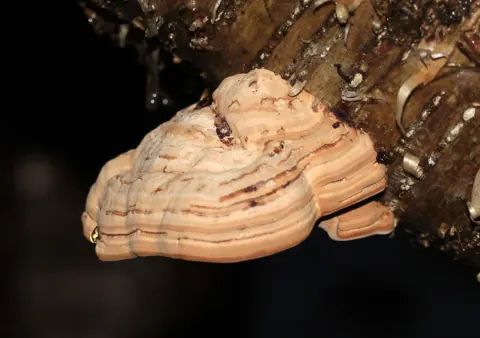
Fomes fomentarius memiliki tubuh buah antara 5 dan 45 cm di seberang, 3 dan 25 cm lebar dan 2 dan 25 cm tebal, yang melekat secara luas pada pohon di mana jamur tumbuh. Bagian bawah memiliki pori-pori bulat warna krim ketika baru, matang…
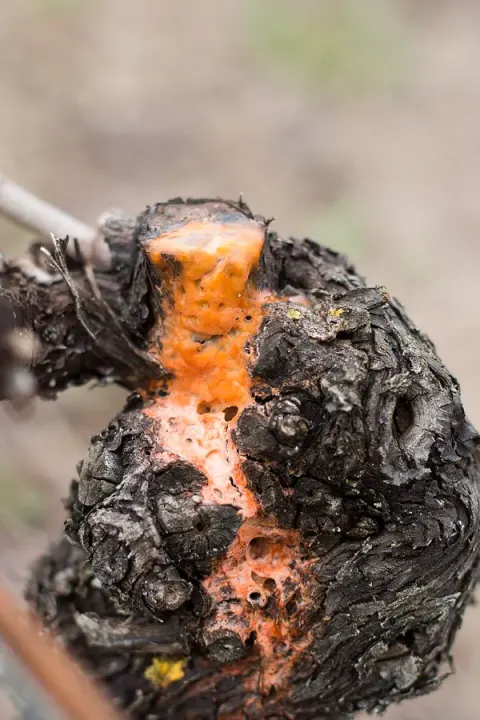
Jenis: Jamur berwarna radikal; Deskripsi: Koloni pada agar karmin merah ke saffron, mycelium udara putih, flokok, cokelat merah sporodochial stromata berkembang kemudian. Chlamydospores intercalary, globose ke oval, 10–12 × 15–20 μm, halus.
Status seksual tidak diamati. Asexual state: Sporodochia not observed. Conidiophores borne on aerial mycelia, (8.6–)13.7–31.3(–50.3) μm, (mean ± SD = 22.5 ± 8.8 μm, n = 39), unbranched or branched, bearing terminal or intercalary…