01 / Morfologi

Ciri dan struktur

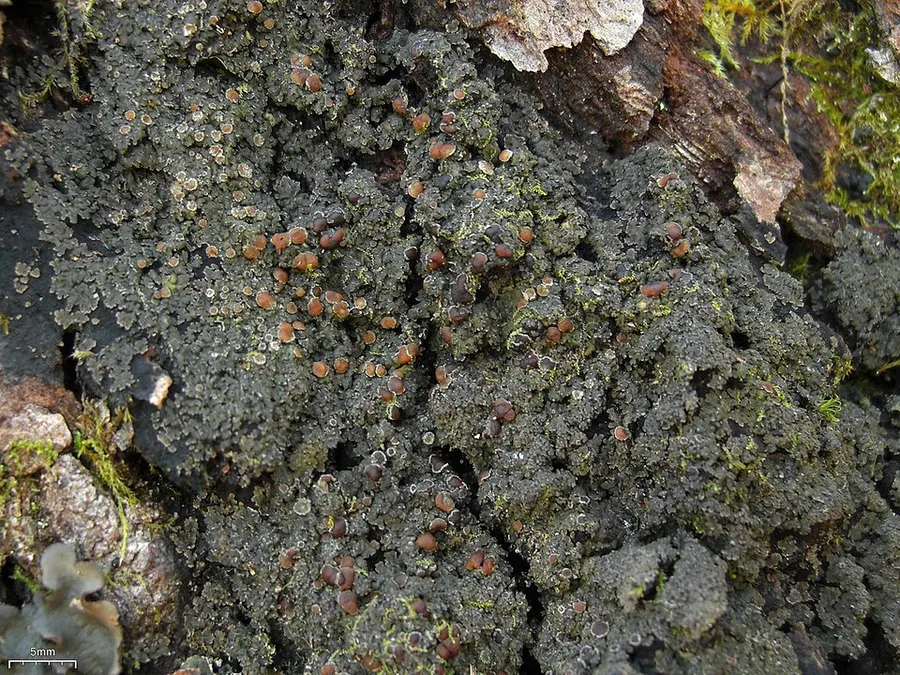
The lichen has plentiful that are round or have a scalloped edge, measuring 2–3 mm in diameter and displaying chestnut-brown coloration. These squamules have white felty margins and are frequently found on a black . The lichen does not have any soredia or isidia. Additionally, apothecia with notable white rims are typically visible. The ascospores of this lichen are 23–27 by 9–11 μm and have a relatively thick, transparent outer wall that often narrows to a fine point at one or both ends. All of the standard chemical spot tests are negative in Fuscopannaria leucosticta.

Sebagian uraian ditampilkan dalam bahasa sumber; terjemahannya belum tersedia atau belum lolos pemeriksaan.

Rujukan: [1]

Pengukuran mengikuti objek, spesimen atau kultur, dan metode yang disebutkan sumber. Baca uraian asli untuk konteks lengkap.

02 / Kehidupan

Habitat dan peran ekologis

Fuscopannaria leucosticta used to be widely distributed in temperate eastern North America, but its range has declined due to habitat destruction and reduction. In eastern Canada, it prefers old, wet forests. Its distribution includes Central America and the Caribbean, extending as far south as Cuba. In Mexico, it is found at a high-elevation location (2400 m in a misty montane of pine-oak forest in Chiapas. It is typically found growing on bark, although it has been occasionally recorded growing on rock, usually with mosses. A study of its habitat associations and distributions in Nova Scotia, Canada, indicate that the predicted distribution of this lichen is most affected by temperature. In the early 2000s, it had been designated "Yellow" status in Nova Scotia's species at risk list, indicating the species is sensitive and may require special attention to prevent extinction or extirpation. Because of its rarity in Eastern Canada, its distribution and population size are uncertain, making conservation planning difficult. A MaxEnt (Maximum Entropy, a machine learning algorithm used for predicting the distribution of species or other phenomena based on environmental variables) distribution model incorporating various environmental variables, including cedar presence and lack of human-induced disturbance, predicted high probability areas, and subsequent field verifications revealed 13 previously unsurveyed locations with high probability of occurrence, which can help guide future conservation efforts for the management of rare and at-risk species.

Sebagian uraian ditampilkan dalam bahasa sumber; terjemahannya belum tersedia atau belum lolos pemeriksaan.

Rujukan: [1]

Habitat atau konteks temuan
hutan
Substrat
kulit kayu
Peran atau konteks
Pembentuk liken
Temukan hubungan serupa
03 / Siklus hidup

Reproduksi

The lichen has plentiful that are round or have a scalloped edge, measuring 2–3 mm in diameter and displaying chestnut-brown coloration. These squamules have white felty margins and are frequently found on a black . The lichen does not have any soredia or isidia. Additionally, apothecia with notable white rims are typically visible. The ascospores of this lichen are 23–27 by 9–11 μm and have a relatively thick, transparent outer wall that often narrows to a fine point at one or both ends.

Sebagian uraian ditampilkan dalam bahasa sumber; terjemahannya belum tersedia atau belum lolos pemeriksaan.

Rujukan: [1]

Sinonim menurut acuan taksonomi rilis: Pannaria craspedia var. leucosticta; Pannaria lepidiota subsp. leucosticta; Pannaria leucosticta; Pannularia leucosticta; Parmelia leucosticta
04 / Batas informasi

Catatan identitas dan cakupan

  • Nama diterima mengikuti Catalogue of Life Base2026-09-11; uraian mempertahankan konsep dan nama sumber aslinya.
  • Original geographic, specimen and life-cycle scope retained; source import awaits individual editorial review.
  • Impor dan terjemahan otomatis belum diperiksa editorial per profil. Struktur reproduktif yang disebutkan tidak membuktikan seluruh siklus hidup diketahui.
  • Pengukuran pada uraian mengikuti spesimen, kultur, dan metode sumber; angka tidak diperluas ke semua populasi.

Catatan distribusi dalam narasi mengikuti sumbernya. Dokumentasi spesimen atau foto mengikuti catatan sumber. Bukti wilayah Indonesia dan penilaian konservasi tidak disimpulkan dari gambar.

05 / Dokumentasi

Melihat dengan konteks

Dokumentasi Fuscopannaria leucosticta dari Wikimedia Commons. Fuscopannaria leucosticta 20091114. US, NC, Smoky Mountains Identifikasi mengikuti record berkas sumber.

Jenis
Fotografi
Kredit
Jason Hollinger
Lisensi
CC BY 2.0
Sumber media
Buka entri sumber

Gambar menunjukkan objek menurut identifikasi sumber, bukan verifikasi independen spesimen oleh Fungi. Tidak ada skala baru yang ditambahkan.

06 / Rujukan

Sumber profil

  1. [1] Fuscopannaria leucosticta — Wikipedia (en)Bagian sumber: Frozen revision 1311412021
    Tanggal penghimpunan sumber: 2026-10-12
    Teks sumber: CC BY-SA4.0 · Wikipedia contributors
  2. [2] Catalogue of Life Base2026-09-11 — Fuscopannaria leucostictaBagian sumber: ColDP NameUsage.tsv ID 6K4LG; accepted species; source 2073
    Tanggal penghimpunan sumber: 2026-10-12
  3. [3] Dokumentasi visual — Fuscopannaria leucostictaBagian sumber: Individual media record; identification follows the source, not independent determination
    Tanggal penghimpunan sumber: 2026-10-12
    Media sumber: CC BY 2.0 · Jason Hollinger

Adaptasi teks: CC BY-SA 4.0. Wikipedia contributors — Fuscopannaria leucosticta — Wikipedia (en)

Uraian asli dan riwayat sumber

Riwayat atau halaman sumber

Ringkasan sumber

Fuscopannaria leucosticta, commonly known as the rimmed shingle lichen, is a species of lichen in the family Pannariaceae. It has a (scaley) thallus that lacks soredia and isidia (vegetative propagules), but has abundant apothecia (spore-bearing structures) with distinct white rims. Although its main centres of distribution are eastern North America and southeast Asia, where it grows in damp forests, it has been reported from various other high-altitude, humid locations.

Revisi sumber

Morfologi sumber

The lichen has plentiful that are round or have a scalloped edge, measuring 2–3 mm in diameter and displaying chestnut-brown coloration. These squamules have white felty margins and are frequently found on a black . The lichen does not have any soredia or isidia. Additionally, apothecia with notable white rims are typically visible. The ascospores of this lichen are 23–27 by 9–11 μm and have a relatively thick, transparent outer wall that often narrows to a fine point at one or both ends. All of the standard chemical spot tests are negative in Fuscopannaria leucosticta.

Revisi sumber

Ekologi sumber

Fuscopannaria leucosticta used to be widely distributed in temperate eastern North America, but its range has declined due to habitat destruction and reduction. In eastern Canada, it prefers old, wet forests. Its distribution includes Central America and the Caribbean, extending as far south as Cuba. In Mexico, it is found at a high-elevation location (2400 m in a misty montane of pine-oak forest in Chiapas. It is typically found growing on bark, although it has been occasionally recorded growing on rock, usually with mosses. A study of its habitat associations and distributions in Nova Scotia, Canada, indicate that the predicted distribution of this lichen is most affected by temperature. In the early 2000s, it had been designated "Yellow" status in Nova Scotia's species at risk list, indicating the species is sensitive and may require special attention to prevent extinction or extirpation. Because of its rarity in Eastern Canada, its distribution and population size are uncertain, making conservation planning difficult. A MaxEnt (Maximum Entropy, a machine learning algorithm used for predicting the distribution of species or other phenomena based on environmental variables) distribution model incorporating various environmental variables, including cedar presence and lack of human-induced disturbance, predicted high probability areas, and subsequent field verifications revealed 13 previously unsurveyed locations with high probability of occurrence, which can help guide future conservation efforts for the management of rare and at-risk species.

Revisi sumber

Struktur reproduksi sumber

The lichen has plentiful that are round or have a scalloped edge, measuring 2–3 mm in diameter and displaying chestnut-brown coloration. These squamules have white felty margins and are frequently found on a black . The lichen does not have any soredia or isidia. Additionally, apothecia with notable white rims are typically visible. The ascospores of this lichen are 23–27 by 9–11 μm and have a relatively thick, transparent outer wall that often narrows to a fine point at one or both ends.

Revisi sumber

Rujukan halaman ini

Fungi. Fuscopannaria leucosticta. Rilis data fungi-2026-10-12-expansion-2. https://fungi-atlas.mgadib.chatgpt.site/jamur/fuscopannaria-leucosticta/.

Status: impor sumber; pemeriksaan editorial per profil belum selesai. Untuk klaim biologis, gunakan rujukan pada bagian terkait dan periksa konteks sumber aslinya.