Ciri dan struktur
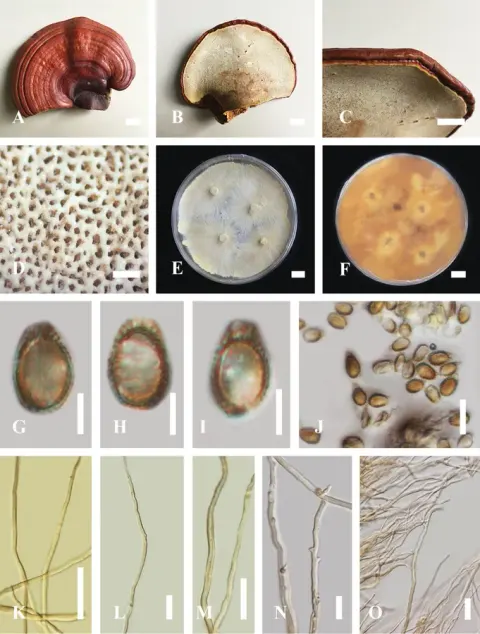
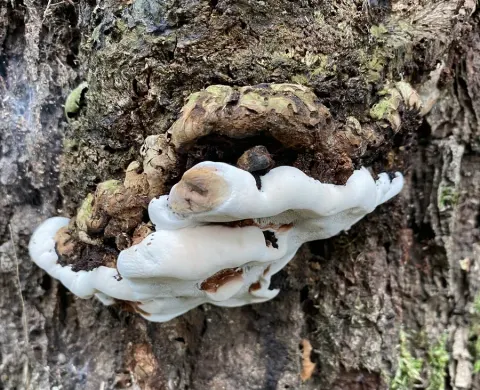
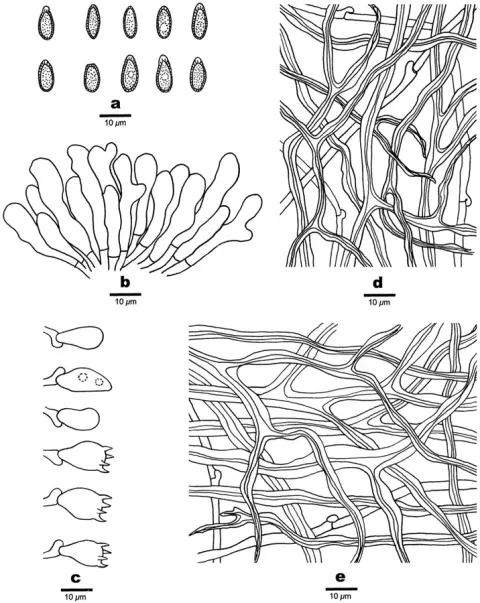
Basidiome annual, sessile or stipitate, solitary or sometimes concrescent or forming several (up to 3) pileus, light in weight, consistency corky-woody; pileus projecting 4.5–8 cm, 6.5–15 cm wide, up to 0.8–3 cm thick at the base, 0.5–0.7 cm at the margin; dimidiate, flabelliform to conchate in pole view, applanate or convex in section; stipe absent or 1.5–4.5 (–8) × 0.5–3 cm, horizontal or dorsally lateral, short and thick or long and tortuous, slightly swollen at the base, laccate, reddish brown (9F6) to dark brown (9F4) or violet brown (10F8) to almost black, stumpy or cylindrical, sometimes with laterals branches; pileal surface smooth, laccate, radially rugose or with concentric deep sulcations or occasionally, slightly zonate with dark lines, fully reddish brown (9F8) to violet brown (10F8), or gradually lighter towards the margin with a yellowish orange (5A7) band; margin white to pale yellow (4A3) or greyish yellow (4C7) to yellowish orange (5A7), entire to slightly lobulated, sometimes incurved; pore surface white, yellowish white (3A2), dull yellow (3B3), or sun yellow (2A5) when fresh and actively growing, greyish yellow (4C7), yellowish brown (5E7), or brownish orange (5C3) on drying, bruising dark brown (6F5), sometimes marked with spots of same aspect than pilear surface (laccate, reddish brown, 9F8); pores 4–5 per mm, round to mainly angular; context 0.3–2.4 cm thick, fibrous, homogeneous to slightly heterogeneous, sometimes zonate, greyish yellow (4B5) to greyish orange (5B3) toward the crust, and brownish orange (6C4) to light brown (6D4) in a narrow zone above the tubes, changing to yellow when cut in fresh specimens, with none to few to several (up to 4) resinous incrustations or occasionally resinous bands (up to 4), sometimes with yellow (3B8) spots throughout the context, with a yellow (3B8) to yellowish orange (4A7) thin line just below the crust; tubes 0.2–0.6 cm long, unstratified, concolorous with lower part of the context.
Habitat dan peran ekologis
Brazil, Colombia, Costa Rica, Cuba, French Guiana, Mexico, Nicaragua, South–eastern USA (Florida).
- Habitat atau konteks temuan
- Informasi belum tersedia pada sumber rilis ini.
- Substrat
- Informasi belum tersedia pada sumber rilis ini.
- Peran atau konteks
- Belum dikategorikan pada rilis ini.
Reproduksi
Basidiome annual, sessile or stipitate, solitary or sometimes concrescent or forming several (up to 3) pileus, light in weight, consistency corky-woody; pileus projecting 4.5–8 cm, 6.5–15 cm wide, up to 0.8–3 cm thick at the base, 0.5–0.7 cm at the margin; dimidiate, flabelliform to conchate in pole view, applanate or convex in section; stipe absent or 1.5–4.5 (–8) × 0.5–3 cm, horizontal or dorsally lateral, short and thick or long and tortuous, slightly swollen at the base, laccate, reddish brown (9F6) to dark brown (9F4) or violet brown (10F8) to almost black, stumpy or cylindrical, sometimes with laterals branches; pileal surface smooth, laccate, radially rugose or with concentric deep sulcations or occasionally, slightly zonate with dark lines, fully reddish brown (9F8) to violet brown (10F8), or gradually lighter towards the margin with a yellowish orange (5A7) band; margin white to pale yellow (4A3) or greyish yellow (4C7) to yellowish orange (5A7), entire to slightly lobulated, sometimes incurved; pore surface white, yellowish white (3A2), dull yellow (3B3), or sun yellow (2A5) when fresh and actively growing, greyish yellow (4C7), yellowish brown (5E7), or brownish orange (5C3) on drying, bruising dark brown (6F5), sometimes marked with spots of same aspect than pilear surface (laccate, reddish brown, 9F8); pores 4–5 per mm, round to mainly angular; context 0.3–2.4 cm thick, fibrous, homogeneous to slightly heterogeneous, sometimes zonate, greyish yellow (4B5) to greyish orange (5B3) toward the crust, and brownish orange (6C4) to light brown (6D4) in a narrow zone above the tubes, changing to yellow when cut in fresh specimens, with none to few to several (up to 4) resinous incrustations or occasionally resinous bands (up to 4), sometimes with yellow (3B8) spots throughout the context, with a yellow (3B8) to yellowish orange (4A7) thin line just below the crust; tubes 0.2–0.6 cm long, unstratified, concolorous with lower part of the context.
Catatan identitas dan cakupan
- Nama diterima mengikuti Catalogue of Life Base2026-09-11; uraian mempertahankan konsep dan nama sumber aslinya.
- Preserve original treatment localities, hosts and substrate scope. Materials examined describe documented specimens, not the full global range.
- Impor dan terjemahan otomatis belum diperiksa editorial per profil. Struktur reproduktif yang disebutkan tidak membuktikan seluruh siklus hidup diketahui.
- Pengukuran pada uraian mengikuti spesimen, kultur, dan metode sumber; angka tidak diperluas ke semua populasi.
Catatan distribusi dalam narasi mengikuti sumbernya. Dokumentasi spesimen atau foto mengikuti catatan sumber. Bukti wilayah Indonesia dan penilaian konservasi tidak disimpulkan dari gambar.
Melihat dengan konteks
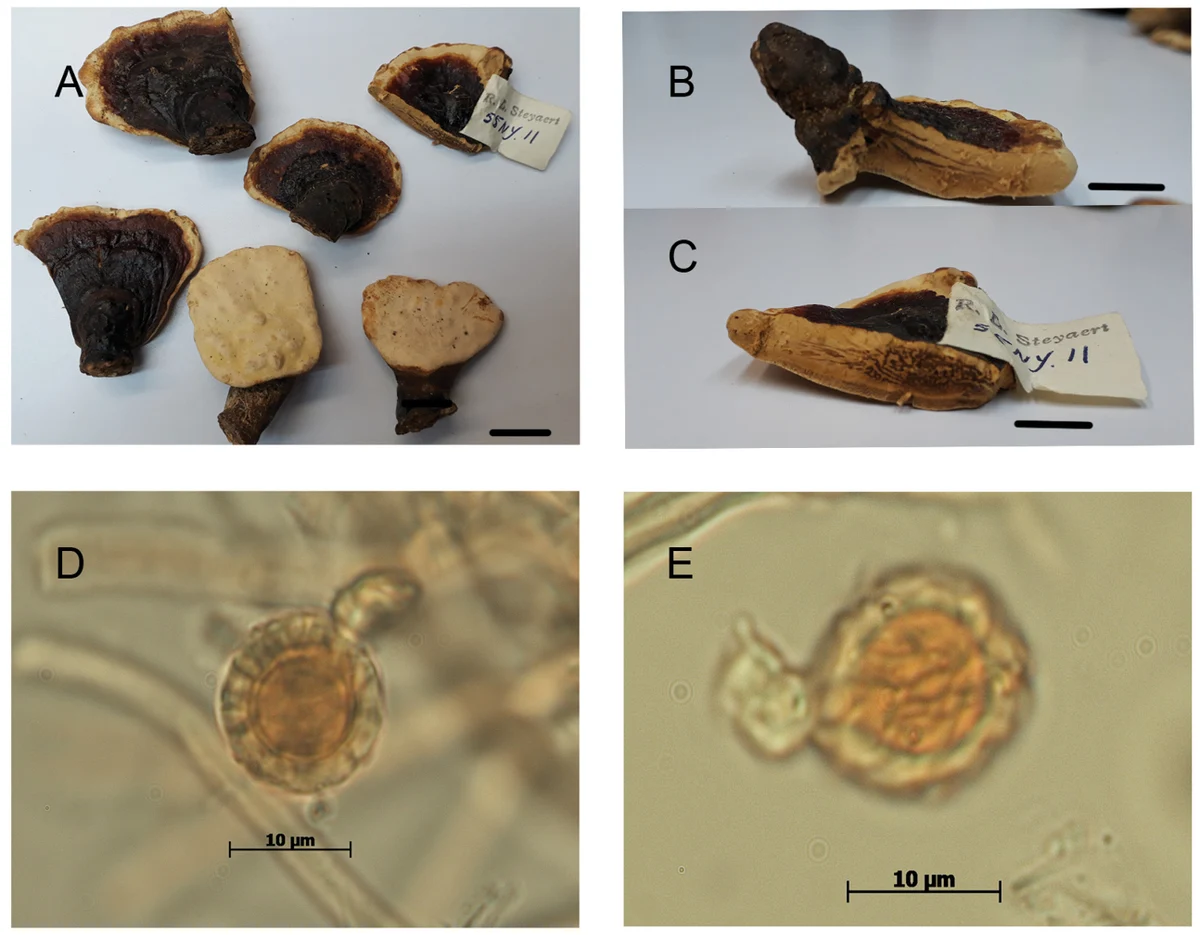
Pelat morfologi Ganoderma stipitatum, holotipe NY 985678: tubuh buah (A), jaringan konteks (B–C), dan klamidospora (D–E). Pembagian panel mengikuti sumber.
- Jenis
- Fotografi dan mikrograf
- Kredit
- Cabarroi-Hernández M, Villalobos-Arámbula AR, Torres-Torres MG, Decock C, Guzmán-Dávalos L (2019)
- Lisensi
- CC BY 4.0
- Sumber media
- Buka entri sumber
Sumber profil
- [1] The Ganoderma weberianum - resinaceum lineage: multilocus phylogenetic analysis and morphology confirm G. mexicanum and G. parvulum in the Neotropics — Ganoderma parvulum
- [2] Catalogue of Life Base2026-09-11 — Ganoderma stipitatum
- [3] Dokumentasi visual — Ganoderma stipitatum
Rujukan halaman ini
Fungi. Ganoderma stipitatum. Rilis data fungi-2026-10-12-expansion-2. https://fungi-atlas.mgadib.chatgpt.site/jamur/ganoderma-stipitatum/.
Status: impor sumber; pemeriksaan editorial per profil belum selesai. Untuk klaim biologis, gunakan rujukan pada bagian terkait dan periksa konteks sumber aslinya.