01 / Morfologi

Ciri dan struktur

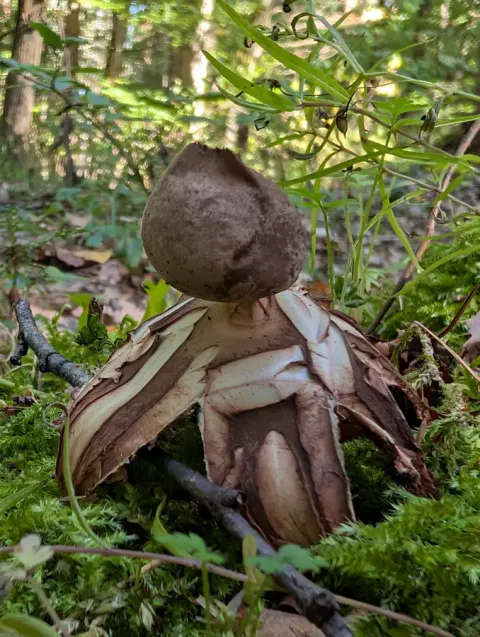
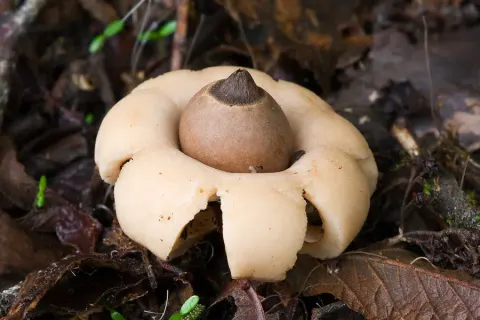
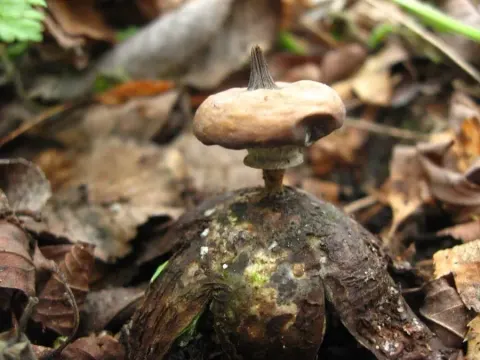
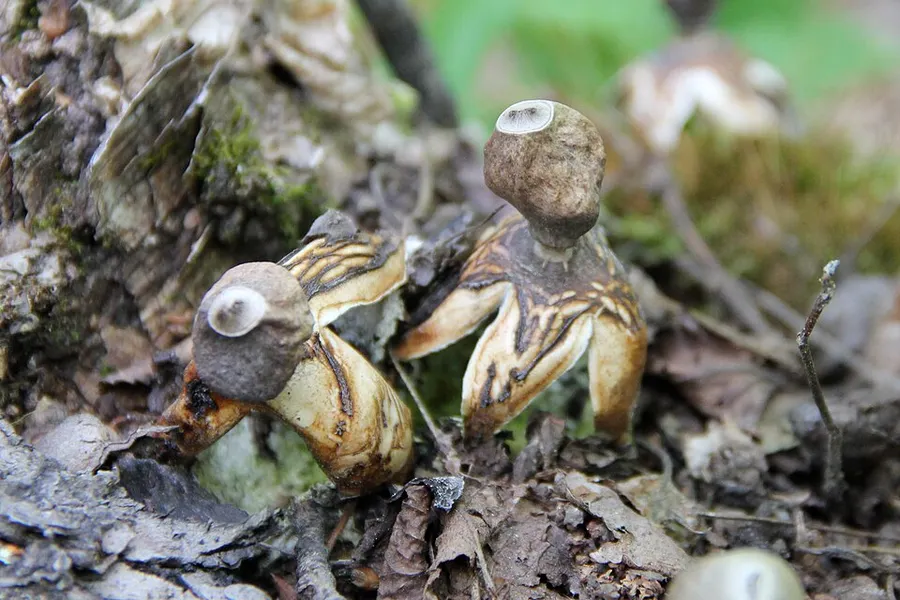
As in all Geastrum fungi, the internal spore-producing gleba is enclosed in the peridium, a protective structure composed of four layers of tissue: an inner endoperidium, and outer exoperidium that may further be divided into an external mycelial, a tough and membranous middle fibrillose layer, and an internal fleshy layer (known as the pseudoparenchyma). The immature, unopened fruit body is roughly spherical to somewhat flattened or irregular in shape. It lies partly or wholly submerged, encrusted with debris. The expanded fruit body is usually taller than it is wide, about 10 – 40 mm high, with mycelial cup included about 15 – 55 mm. The exoperidium (the outer tissue layer of the four-layered peridium) splits in the middle into three to six, but usually four or five rays. The exoperidium is typically fornicate—a structural feature that arises when the mesoperidium separates from the exoperidium, adhering only at the edge. In this way, the endoperidium (the internal tissue layer that encloses the spore sac) is lifted upwards with the downward movement of the rays. In this species, the tips of the rays remain attached to the mycelial layer, which remain attached to the substrate as a cup in the ground. Unlike those of some other Geastrum species, the rays of G. quadrifidum are not hygroscopic: they do not open and close in response to changes in humidity. Generally, the rays are broad, but they may seem narrow as their edges are often rolled inwards. The width of the exoperidium (when still attached to the mycelial cup) is 8 – 25 mm, when fully expanded about 15 – 90 mm. The pseudoparenchymatous layer when fresh is about 1–2 mm thick, initially whitish, later turning beige to brownish (sometimes over reddish tints), and dark brown when old.

Sebagian uraian ditampilkan dalam bahasa sumber; terjemahannya belum tersedia atau belum lolos pemeriksaan.

Rujukan: [1]

Pengukuran mengikuti objek, spesimen atau kultur, dan metode yang disebutkan sumber. Baca uraian asli untuk konteks lengkap.

02 / Kehidupan

Habitat dan peran ekologis

Although Geastrum quadrifidum has a wide distribution, it is not a common species. European countries dari mana jamur telah dilaporkan termasuk Belgia, Denmark, Prancis, Jerman, Montenegro, Norwegia, Polandia, dan Swedia. Di Asia, telah dikumpulkan di China and Jepang. Utara American distribution membentang dari Canada south ke Meksiko, dan mencakup Hawaii. Ia juga ditemukan di Australia and Selandia Baru, Afrika Selatan, dan Amerika Selatan. Because of jarangnya, telah ditempatkan di Regional Red Lists of beberapa European countries, termasuk Montenegro, Denmark, Norwegia, dan Polandia. Like most bumi bintang, G. quadrifidum adalah jamur saprobik, dan menghabiskan sebagian besar siklus hidupnya sebagai benang tipis dari mycelium, memperoleh nutrisi dengan membusuk sampah daun dan detritus serupa, mengubahnya menjadi humus dan mengmineralkan bahan organik di tanah. Badan buah jamur umumnya ditemukan di hutan konifer, di mana mereka muncul di musim panas dan musim gugur. Di Meksiko, ia ditemukan di hutan duri tropis dan hutan pinus pada musim panas. Di Inggris, semua koleksi telah dibuat di hutan banteng di tanah berlapis batu.

Sebagian uraian ditampilkan dalam bahasa sumber; terjemahannya belum tersedia atau belum lolos pemeriksaan.

Rujukan: [1]

Habitat atau konteks temuan
hutan
Substrat
Informasi belum tersedia pada sumber rilis ini.
Peran atau konteks
Pengurai
Temukan hubungan serupa
03 / Siklus hidup

Reproduksi

As in all Geastrum fungi, the internal spore-producing gleba is enclosed in the peridium, a protective structure composed of four layers of tissue: an inner endoperidium, and outer exoperidium that may further be divided into an external mycelial, a tough and membranous middle fibrillose layer, and an internal fleshy layer (known as the pseudoparenchyma). The immature, unopened fruit body is roughly spherical to somewhat flattened or irregular in shape. It lies partly or wholly submerged, encrusted with debris. The expanded fruit body is usually taller than it is wide, about 10 – 40 mm high, with mycelial cup included about 15 – 55 mm. The exoperidium (the outer tissue layer of the four-layered peridium) splits in the middle into three to six, but usually four or five rays.

Sebagian uraian ditampilkan dalam bahasa sumber; terjemahannya belum tersedia atau belum lolos pemeriksaan.

Rujukan: [1]

Sinonim menurut acuan taksonomi rilis: Geastrum minus; Geastrum quadrifidum var. majus; Geastrum quadrifidum var. minus; Geastrum quadrifidum var. sabulosum
04 / Batas informasi

Catatan identitas dan cakupan

  • Nama diterima mengikuti Catalogue of Life Base2026-09-11; uraian mempertahankan konsep dan nama sumber aslinya.
  • Original geographic, specimen and life-cycle scope retained; source import awaits individual editorial review.
  • Impor dan terjemahan otomatis belum diperiksa editorial per profil. Struktur reproduktif yang disebutkan tidak membuktikan seluruh siklus hidup diketahui.
  • Pengukuran pada uraian mengikuti spesimen, kultur, dan metode sumber; angka tidak diperluas ke semua populasi.

Catatan distribusi dalam narasi mengikuti sumbernya. Dokumentasi spesimen atau foto mengikuti catatan sumber. Bukti wilayah Indonesia dan penilaian konservasi tidak disimpulkan dari gambar.

05 / Dokumentasi

Melihat dengan konteks

Dokumentasi Geastrum quadrifidum dari Wikimedia Commons. Fruit bodies of the earthstar fungus Geastrum quadrifidum Pers.:Pers. Specimens found growing on forest floor near La Ronge, Saskatchewan, Canada. Identifikasi mengikuti record berkas sumber.

Jenis
Fotografi
Kredit
Sasata
Lisensi
CC BY 3.0
Sumber media
Buka entri sumber

Gambar menunjukkan objek menurut identifikasi sumber, bukan verifikasi independen spesimen oleh Fungi. Tidak ada skala baru yang ditambahkan.

06 / Rujukan

Sumber profil

  1. [1] Geastrum quadrifidum — Wikipedia (en)Bagian sumber: Frozen revision 1306506300
    Tanggal penghimpunan sumber: 2026-10-12
    Teks sumber: CC BY-SA4.0 · Wikipedia contributors
  2. [2] Catalogue of Life Base2026-09-11 — Geastrum quadrifidumBagian sumber: ColDP NameUsage.tsv ID L24XW; accepted species; source 2073
    Tanggal penghimpunan sumber: 2026-10-12
  3. [3] Dokumentasi visual — Geastrum quadrifidumBagian sumber: Individual media record; identification follows the source, not independent determination
    Tanggal penghimpunan sumber: 2026-10-12
    Media sumber: CC BY 3.0 · Sasata

Adaptasi teks: CC BY-SA 4.0. Wikipedia contributors — Geastrum quadrifidum — Wikipedia (en)

Uraian asli dan riwayat sumber

Riwayat atau halaman sumber

Ringkasan sumber

Geastrum quadrifidum, commonly known as the rayed earthstar or four-footed earthstar, is an inedible species of mushroom belonging to the genus Geastrum, or earthstar fungi. First described scientifically by Christian Hendrik Persoon in 1794, G. quadrifidum is a cosmopolitan—but not common—species of Europe, the Americas, Africa, Asia, and Australasia. The fungus is a saprobe, feeding off decomposing organic matter present in the soil and litter of coniferous forests. The small, tough, fruit bodies are grayish-brown balls that are initially enclosed by a skin, or peridium, made up of four distinct layers of tissue.

Revisi sumber

Morfologi sumber

As in all Geastrum fungi, the internal spore-producing gleba is enclosed in the peridium, a protective structure composed of four layers of tissue: an inner endoperidium, and outer exoperidium that may further be divided into an external mycelial, a tough and membranous middle fibrillose layer, and an internal fleshy layer (known as the pseudoparenchyma). The immature, unopened fruit body is roughly spherical to somewhat flattened or irregular in shape. It lies partly or wholly submerged, encrusted with debris. The expanded fruit body is usually taller than it is wide, about 10 – 40 mm high, with mycelial cup included about 15 – 55 mm. The exoperidium (the outer tissue layer of the four-layered peridium) splits in the middle into three to six, but usually four or five rays. The exoperidium is typically fornicate—a structural feature that arises when the mesoperidium separates from the exoperidium, adhering only at the edge. In this way, the endoperidium (the internal tissue layer that encloses the spore sac) is lifted upwards with the downward movement of the rays. In this species, the tips of the rays remain attached to the mycelial layer, which remain attached to the substrate as a cup in the ground. Unlike those of some other Geastrum species, the rays of G. quadrifidum are not hygroscopic: they do not open and close in response to changes in humidity. Generally, the rays are broad, but they may seem narrow as their edges are often rolled inwards. The width of the exoperidium (when still attached to the mycelial cup) is 8 – 25 mm, when fully expanded about 15 – 90 mm. The pseudoparenchymatous layer when fresh is about 1–2 mm thick, initially whitish, later turning beige to brownish (sometimes over reddish tints), and dark brown when old.

Revisi sumber

Ekologi sumber

Although Geastrum quadrifidum has a wide distribution, it is not a common species. European countries from which the fungus has been reported include Belgium, Denmark, France, Germany, Montenegro, Norway, Poland, and Sweden. In Asia, it has been collected in China and Japan. The North American distribution extends from Canada south to Mexico, and includes Hawaii. It is also found in Australia and New Zealand, South Africa, and South America. Because of its rarity, it has been placed on the Regional Red Lists of several European countries, including Montenegro, Denmark, Norway, and Poland. Like most earthstars, G. quadrifidum is a saprobic fungus, and spends most of its life cycle as thin strands of mycelium, deriving nutrients by decomposing leaf litter and similar detritus, converting it to humus and mineralizing organic matter in the soil. The fungal fruit bodies are generally found in coniferous woodland, where they appear in summer and autumn. In Mexico, it was found in tropical thorn forest and pine-oak forest in the summer. In Britain, all collections have been made in beech forest on calcareous soil.

Revisi sumber

Struktur reproduksi sumber

As in all Geastrum fungi, the internal spore-producing gleba is enclosed in the peridium, a protective structure composed of four layers of tissue: an inner endoperidium, and outer exoperidium that may further be divided into an external mycelial, a tough and membranous middle fibrillose layer, and an internal fleshy layer (known as the pseudoparenchyma). The immature, unopened fruit body is roughly spherical to somewhat flattened or irregular in shape. It lies partly or wholly submerged, encrusted with debris. The expanded fruit body is usually taller than it is wide, about 10 – 40 mm high, with mycelial cup included about 15 – 55 mm. The exoperidium (the outer tissue layer of the four-layered peridium) splits in the middle into three to six, but usually four or five rays.

Revisi sumber

Rujukan halaman ini

Fungi. Geastrum quadrifidum. Rilis data fungi-2026-10-12-expansion-2. https://fungi-atlas.mgadib.chatgpt.site/jamur/geastrum-quadrifidum/.

Status: impor sumber; pemeriksaan editorial per profil belum selesai. Untuk klaim biologis, gunakan rujukan pada bagian terkait dan periksa konteks sumber aslinya.