01 / Morfologi

Ciri dan struktur

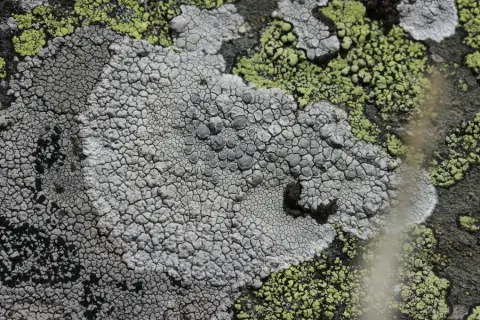
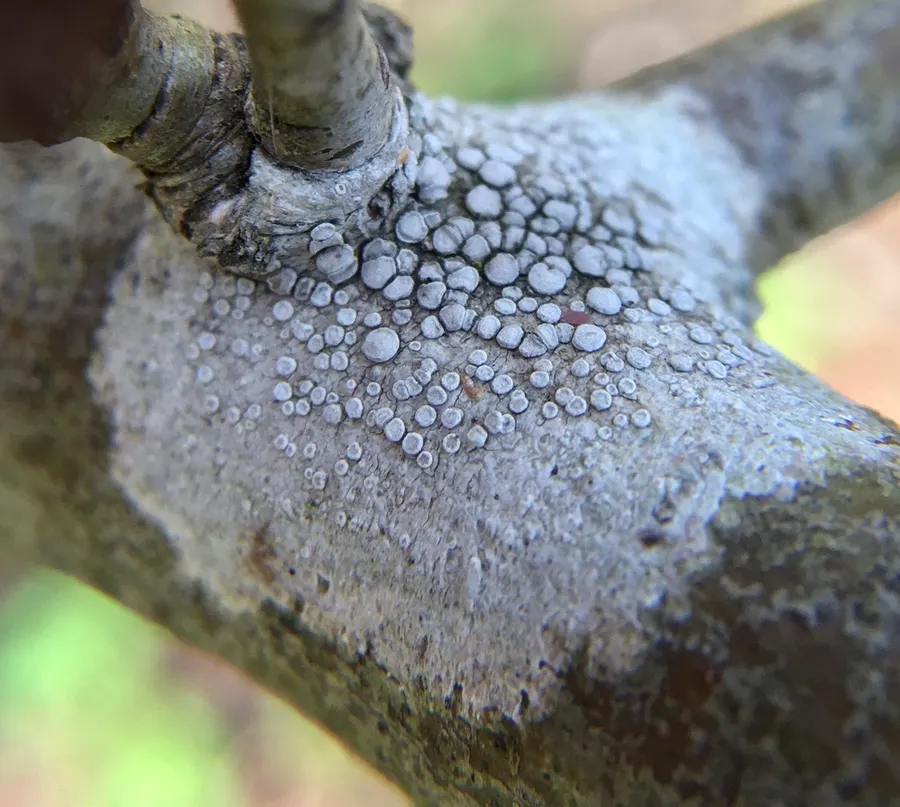
Glaucomaria carpinea has a crust-like (crustose) thallus that is either continuous or cracked. It has a whitish to grey colour, with a smooth texture and is not covered with a powdery substance (). This lichen is sometimes bordered by a white growth (prothallus) at its edges. Its apothecia (fruiting bodies) are typically crowded together and can be round or angular due to mutual compression. These apothecia are flat or slightly convex, measuring 0.5–1.5 mm across, and have an orange-brown to flesh-coloured heavily covered in white . The margin of the apothecia is thin, slightly prominent, and typically not wavy. The outer ring of the apothecia (the ) features a well-developed composed of vertically aligned hyphae (an arrangement), with a medulla containing crystals that dissolve in a solution of potassium hydroxide (K). The inner ring () is thin and colourless, also filled with K-soluble crystals. The (topmost layer of the apothecia) is pale brown with a layer of fine crystals, with both the pigment and crystals dissolving in K to produce a bright yellow colour change (C+ bright yellow). The hymenium, the spore-producing layer, is colourless and 50–70 μm high. The paraphyses (sterile filaments in the hymenium) are slightly thickened at the top. The layer below the hymenium () is colourless. The asci (spore-bearing cells) of Glaucomaria carpinea are elongated-club shaped (elongate-) and very thin-walled, containing eight spores each. These asci have a tall structure in the middle () that reacts to iodine and potassium hydroxide by turning blue (K/I+ blue), surrounded by a blue outer layer.

Sebagian uraian ditampilkan dalam bahasa sumber; terjemahannya belum tersedia atau belum lolos pemeriksaan.

Rujukan: [1]

Pengukuran mengikuti objek, spesimen atau kultur, dan metode yang disebutkan sumber. Baca uraian asli untuk konteks lengkap.

02 / Kehidupan

Habitat dan peran ekologis

Glaucomaria carpinea has a nearly cosmopolitan distribution. It has been recorded from Africa, Asia, Europe, Macaronesia, New Zealand, and North America. Its usual is the smooth bark of deciduous trees, especially on twigs, branches, and young trunks.

Sebagian uraian ditampilkan dalam bahasa sumber; terjemahannya belum tersedia atau belum lolos pemeriksaan.

Rujukan: [1]

Habitat atau konteks temuan
Informasi belum tersedia pada sumber rilis ini.
Substrat
Informasi belum tersedia pada sumber rilis ini.
Peran atau konteks
Pembentuk liken
Temukan hubungan serupa
03 / Siklus hidup

Reproduksi

The outer ring of the apothecia (the ) features a well-developed composed of vertically aligned hyphae (an arrangement), with a medulla containing crystals that dissolve in a solution of potassium hydroxide (K). The inner ring () is thin and colourless, also filled with K-soluble crystals. The (topmost layer of the apothecia) is pale brown with a layer of fine crystals, with both the pigment and crystals dissolving in K to produce a bright yellow colour change (C+ bright yellow). The hymenium, the spore-producing layer, is colourless and 50–70 μm high. The paraphyses (sterile filaments in the hymenium) are slightly thickened at the top. The layer below the hymenium () is colourless. The asci (spore-bearing cells) of Glaucomaria carpinea are elongated-club shaped (elongate-) and very thin-walled, containing eight spores each.

Sebagian uraian ditampilkan dalam bahasa sumber; terjemahannya belum tersedia atau belum lolos pemeriksaan.

Rujukan: [1]

Sinonim menurut acuan taksonomi rilis: Courtoisia angulosa; Lecanora albella f. angulosa; Lecanora albella subsp. angulosa; Lecanora albella var. angulosa; Lecanora angulosa; Lecanora carpinea; Lecanora pallida f. angulosa; Lecanora pallida subsp. angulosa; Lecanora pallida var. angulosa; Lecanora subfusca f. angulosa; Lecanora subfusca var. angulosa; Lichen angulosus; Lichen carpineus; Parmelia albella var. angulosa; Parmelia angulosa; Parmelia pallida var. angulosa; Patellaria angulosa; Patellaria pallida var. angulosa; Psora subfusca var. angulosa; Scutellaria angulosa; Scutellaria carpinea; Variolaria faginea carpineus; Verrucaria angulosa
04 / Batas informasi

Catatan identitas dan cakupan

  • Nama diterima mengikuti Catalogue of Life Base2026-09-11; uraian mempertahankan konsep dan nama sumber aslinya.
  • Original geographic, specimen and life-cycle scope retained; source import awaits individual editorial review.
  • Impor dan terjemahan otomatis belum diperiksa editorial per profil. Struktur reproduktif yang disebutkan tidak membuktikan seluruh siklus hidup diketahui.
  • Pengukuran pada uraian mengikuti spesimen, kultur, dan metode sumber; angka tidak diperluas ke semua populasi.

Catatan distribusi dalam narasi mengikuti sumbernya. Dokumentasi spesimen atau foto mengikuti catatan sumber. Bukti wilayah Indonesia dan penilaian konservasi tidak disimpulkan dari gambar.

05 / Dokumentasi

Melihat dengan konteks

Dokumentasi Glaucomaria carpinea menurut asosiasi foto pada record takson iNaturalist. Kredit: Paul Cook. Identitas mengikuti sumber; bukan penentuan spesimen independen.

Jenis
Fotografi
Kredit
(c) Paul Cook, some rights reserved (CC BY), uploaded by Paul Cook
Lisensi
CC BY 4.0
Sumber media
Buka entri sumber

Gambar menunjukkan objek menurut identifikasi sumber, bukan verifikasi independen spesimen oleh Fungi. Tidak ada skala baru yang ditambahkan.

06 / Rujukan

Sumber profil

  1. [1] Glaucomaria carpinea — Wikipedia (en)Bagian sumber: Frozen revision 1330475745
    Tanggal penghimpunan sumber: 2026-10-12
    Teks sumber: CC BY-SA4.0 · Wikipedia contributors
  2. [2] Catalogue of Life Base2026-09-11 — Glaucomaria carpineaBagian sumber: ColDP NameUsage.tsv ID 3G6FG; accepted species; source 2073
    Tanggal penghimpunan sumber: 2026-10-12
  3. [3] Dokumentasi visual — Glaucomaria carpineaBagian sumber: Individual media record; identification follows the source, not independent determination
    Tanggal penghimpunan sumber: 2026-10-12
    Media sumber: CC BY 4.0 · (c) Paul Cook, some rights reserved (CC BY), uploaded by Paul Cook

Adaptasi teks: CC BY-SA 4.0. Wikipedia contributors — Glaucomaria carpinea — Wikipedia (en)

Uraian asli dan riwayat sumber

Riwayat atau halaman sumber

Ringkasan sumber

Glaucomaria carpinea is a species of corticolous (bark-dwelling), crustose lichen in the family Lecanoraceae. It is a widely distributed species.

Revisi sumber

Morfologi sumber

Glaucomaria carpinea has a crust-like (crustose) thallus that is either continuous or cracked. It has a whitish to grey colour, with a smooth texture and is not covered with a powdery substance (). This lichen is sometimes bordered by a white growth (prothallus) at its edges. Its apothecia (fruiting bodies) are typically crowded together and can be round or angular due to mutual compression. These apothecia are flat or slightly convex, measuring 0.5–1.5 mm across, and have an orange-brown to flesh-coloured heavily covered in white . The margin of the apothecia is thin, slightly prominent, and typically not wavy. The outer ring of the apothecia (the ) features a well-developed composed of vertically aligned hyphae (an arrangement), with a medulla containing crystals that dissolve in a solution of potassium hydroxide (K). The inner ring () is thin and colourless, also filled with K-soluble crystals. The (topmost layer of the apothecia) is pale brown with a layer of fine crystals, with both the pigment and crystals dissolving in K to produce a bright yellow colour change (C+ bright yellow). The hymenium, the spore-producing layer, is colourless and 50–70 μm high. The paraphyses (sterile filaments in the hymenium) are slightly thickened at the top. The layer below the hymenium () is colourless. The asci (spore-bearing cells) of Glaucomaria carpinea are elongated-club shaped (elongate-) and very thin-walled, containing eight spores each. These asci have a tall structure in the middle () that reacts to iodine and potassium hydroxide by turning blue (K/I+ blue), surrounded by a blue outer layer.

Revisi sumber

Ekologi sumber

Glaucomaria carpinea has a nearly cosmopolitan distribution. It has been recorded from Africa, Asia, Europe, Macaronesia, New Zealand, and North America. Its usual is the smooth bark of deciduous trees, especially on twigs, branches, and young trunks.

Revisi sumber

Struktur reproduksi sumber

The outer ring of the apothecia (the ) features a well-developed composed of vertically aligned hyphae (an arrangement), with a medulla containing crystals that dissolve in a solution of potassium hydroxide (K). The inner ring () is thin and colourless, also filled with K-soluble crystals. The (topmost layer of the apothecia) is pale brown with a layer of fine crystals, with both the pigment and crystals dissolving in K to produce a bright yellow colour change (C+ bright yellow). The hymenium, the spore-producing layer, is colourless and 50–70 μm high. The paraphyses (sterile filaments in the hymenium) are slightly thickened at the top. The layer below the hymenium () is colourless. The asci (spore-bearing cells) of Glaucomaria carpinea are elongated-club shaped (elongate-) and very thin-walled, containing eight spores each.

Revisi sumber

Rujukan halaman ini

Fungi. Glaucomaria carpinea. Rilis data fungi-2026-10-12-expansion-2. https://fungi-atlas.mgadib.chatgpt.site/jamur/glaucomaria-carpinea/.

Status: impor sumber; pemeriksaan editorial per profil belum selesai. Untuk klaim biologis, gunakan rujukan pada bagian terkait dan periksa konteks sumber aslinya.