Ciri dan struktur
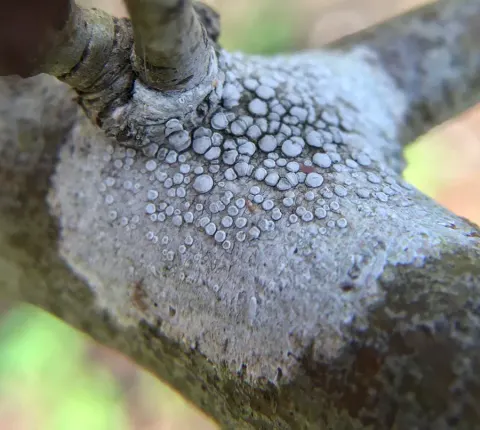
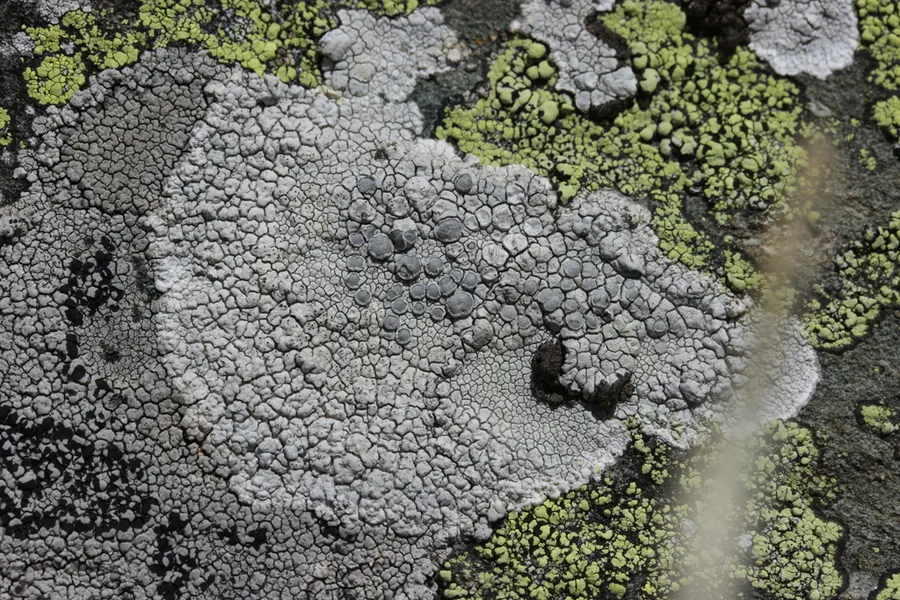
The thallus is a crustose lichen that forms continuous, clearly bounded patches or a mosaic of cracked surface units. It is typically (cracked), often rather thick and uneven, with flat to slightly convex . Colour is usually white-grey, but some thalli are darker grey with greenish or brownish tones; the surface is generally fairly smooth. A is usually pale or hard to see, though it can appear grey-black where neighbouring thalli of the same species meet. Soredia are ordinarily absent, although sorediate material has been reported in a named variety. Apothecia are about 0.5–2 mm across (occasionally to 3 mm) and are immersed in the thallus or only slightly raised; they develop singly or in clusters where neighbouring discs touch. The is unbroken and may be finely scalloped to wavy or somewhat contorted, but it does not rise above the surrounding thallus surface. Discs range from pinkish to brown and are flat to convex, typically covered by a dense pale grey to blue-grey (a powdery coating). Microscopically, the is pale brown to dark olive-brown and contains crystals that do not dissolve in K. The hymenium is about 80–90 μm tall, with mostly unbranched paraphyses around 2–3 μm in diameter (tips to about 3.5 μm). Ascospores measure roughly 9–14.5 × 5.5–7 μm (occasionally to 15 × 7.5 μm), and the conidia are slender and thread-like to slightly curved, about 14–25 × about 1 μm. In spot tests the thallus is C−, K+ (yellow), and the medulla is UV+ (yellow); the apothecial disc is C+ (yellow), Pd−, and UV+ (pale orange). Reported secondary metabolites include atranorin, chloroatranorin, sordidone, eugenitol, roccellic acid, and thiophanic acid.
Habitat dan peran ekologis
Glaucomaria rupicola has an extensive geographic range, occurring in both the Northern and Southern Hemispheres; it is described as having a "bipolar to subcosmopolitan" distribution. In the Northern Hemisphere it is widespread across Europe, North America, and Asia. This lichen is also present in the Southern Hemisphere, with records from South America and other regions outside its northern range. It was reported for the first time in the Azores archipelago (North Atlantic Ocean) in 2024. Similarly, a 2025 survey documented the first record of G. rupicola in Gilgit-Baltistan, Pakistan (western Himalayas). Glaucomaria rupicola is a saxicolous lichen that typically grows on hard, exposed rocky substrates. It shows a preference for siliceous (acidic) rocks such as granite. The species occurs from coastal areas at sea level to high mountain environments, demonstrating a wide altitudinal range. On wave-exposed seashores, it is frequently found in the xeric supralittoral zone just above the high-tide line, reflecting a strong maritime influence in its ecology. Inland, G. rupicola also colonises rock outcrops, boulders, and even occasionally man-made stone structures; it is common in montane and subalpine regions and can form extensive crusts in open, well-lit habitats.
- Habitat atau konteks temuan
- Informasi belum tersedia pada sumber rilis ini.
- Substrat
- Informasi belum tersedia pada sumber rilis ini.
- Peran atau konteks
- Pembentuk liken
Reproduksi
The thallus is a crustose lichen that forms continuous, clearly bounded patches or a mosaic of cracked surface units. It is typically (cracked), often rather thick and uneven, with flat to slightly convex . Colour is usually white-grey, but some thalli are darker grey with greenish or brownish tones; the surface is generally fairly smooth. A is usually pale or hard to see, though it can appear grey-black where neighbouring thalli of the same species meet. Soredia are ordinarily absent, although sorediate material has been reported in a named variety. Apothecia are about 0.5–2 mm across (occasionally to 3 mm) and are immersed in the thallus or only slightly raised; they develop singly or in clusters where neighbouring discs touch.
Catatan identitas dan cakupan
- Nama diterima mengikuti Catalogue of Life Base2026-09-11; uraian mempertahankan konsep dan nama sumber aslinya.
- Original geographic, specimen and life-cycle scope retained; source import awaits individual editorial review.
- Impor dan terjemahan otomatis belum diperiksa editorial per profil. Struktur reproduktif yang disebutkan tidak membuktikan seluruh siklus hidup diketahui.
- Pengukuran pada uraian mengikuti spesimen, kultur, dan metode sumber; angka tidak diperluas ke semua populasi.
Catatan distribusi dalam narasi mengikuti sumbernya. Dokumentasi spesimen atau foto mengikuti catatan sumber. Bukti wilayah Indonesia dan penilaian konservasi tidak disimpulkan dari gambar.
Melihat dengan konteks
Dokumentasi Lecanora rupicola menurut asosiasi foto pada record takson iNaturalist. Kredit: Björn Sothmann. Identitas mengikuti sumber; bukan penentuan spesimen independen.
- Jenis
- Fotografi
- Kredit
- (c) Björn Sothmann, some rights reserved (CC BY-SA), uploaded by Björn Sothmann
- Lisensi
- CC BY-SA 4.0
- Sumber media
- Buka entri sumber
Dokumentasi tambahan
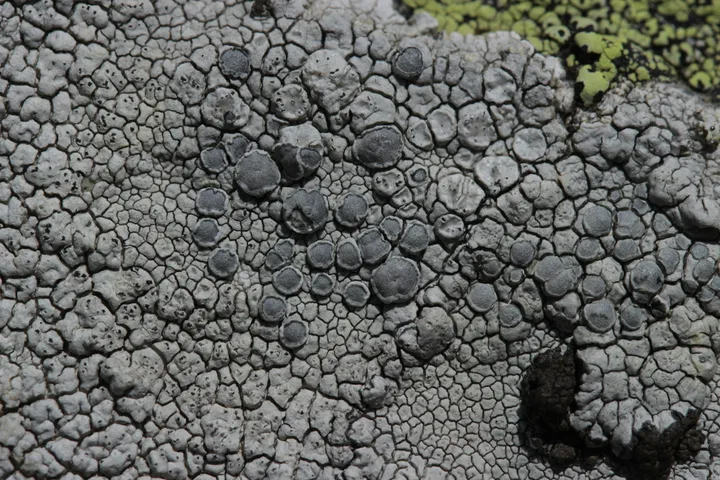
Foto yang diasosiasikan dengan Glaucomaria rupicola pada iNaturalist. Identifikasi mengikuti sumber; bukan penentuan spesimen independen.
Kredit dan penggunaan
(c) Björn Sothmann, some rights reserved (CC BY-SA), uploaded by Björn Sothmann
Ukuran dan format gambar disesuaikan tanpa pemotongan, retus, atau penambahan skala. Lisensi sumber dipertahankan.
Sumber profil
- [1] Glaucomaria rupicola — Wikipedia (en)
- [2] Catalogue of Life Base2026-09-11 — Glaucomaria rupicola
- [3] Dokumentasi visual — Glaucomaria rupicola
- [4] Dokumentasi visual — Glaucomaria rupicola
Rujukan halaman ini
Fungi. Glaucomaria rupicola. Rilis data fungi-2026-10-12-expansion-2. https://fungi-atlas.mgadib.chatgpt.site/jamur/glaucomaria-rupicola/.
Status: impor sumber; pemeriksaan editorial per profil belum selesai. Untuk klaim biologis, gunakan rujukan pada bagian terkait dan periksa konteks sumber aslinya.