01 / Morfologi

Ciri dan struktur

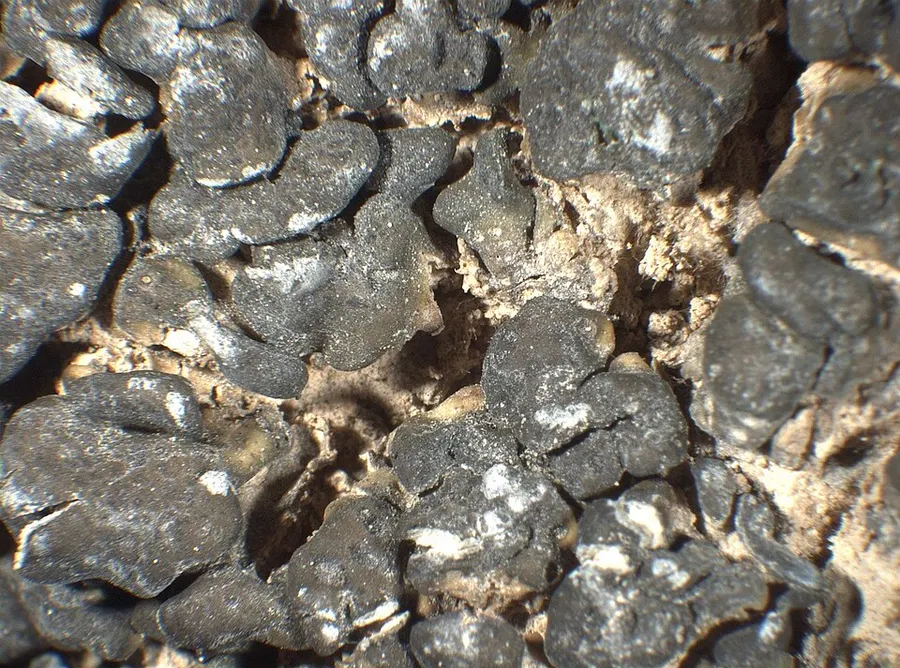
Gloeoheppia turgida has a (scaly) thallus made up of small, leaf-like . These are round to elongate and , sometimes overlapping, and become strongly convex and swollen, reaching up to about 4 mm across. Their margins curve downwards and are often rolled under, and the thallus is anchored to the substrate by coarse fungal hyphae. The thallus lacks a and is attached by rhizoidal strands, and its hyphae form a network around a small, single-celled cyanobiont. The upper surface is smooth and dark olive to greenish black, becoming paler in shaded situations, and may carry a thin white, powdery deposit (a ); it is covered by a relatively thick layer of dead tissue. The underside is smooth, olive to pale flesh-coloured and lacks a differentiated cortex. The medulla contains an that extends through most, or sometimes all, of its depth. Where a lower algal-free zone is present it consists of tightly packed, fungal cells. Vegetative propagules such as isidia and soredia have not been reported. Sexual reproduction occurs in immersed apothecia (fruiting bodies) produced one to many per squamule; the exposed are dark brown to blackish and typically about 0.2–0.8 mm across, and the hymenium and stain deep blue in iodine. The asci usually contain eight spores, but 10–12-spored asci have also been observed, and the colourless, ellipsoid ascospores measure about 10–14 by 6–8 μm. Physiological measurements on thalli collected in the Judean Desert found that humid air alone did not activate positive net photosynthesis; instead, the lichen required wetting with liquid water. Immediately after spraying, net photosynthesis remained low (under 20% of its maximum), which the authors attributed to diffusion limitation in the water-saturated thallus.

Sebagian uraian ditampilkan dalam bahasa sumber; terjemahannya belum tersedia atau belum lolos pemeriksaan.

Rujukan: [1]

Pengukuran mengikuti objek, spesimen atau kultur, dan metode yang disebutkan sumber. Baca uraian asli untuk konteks lengkap.

02 / Kehidupan

Habitat dan peran ekologis

Gloeoheppia turgida has been collected on calcareous soil and rock in the Mediterranean, Macaronesian, and Saharo-Arabian regions. It has also been collected in xeric soil-lichen communities in the Judaean Desert (Israel), on the slopes of the Dead Sea near Ein Boqeq.

Sebagian uraian ditampilkan dalam bahasa sumber; terjemahannya belum tersedia atau belum lolos pemeriksaan.

Rujukan: [1]

Habitat atau konteks temuan
Informasi belum tersedia pada sumber rilis ini.
Substrat
Informasi belum tersedia pada sumber rilis ini.
Peran atau konteks
Pembentuk liken
Temukan hubungan serupa
03 / Siklus hidup

Reproduksi

Vegetative propagules such as isidia and soredia have not been reported. Sexual reproduction occurs in immersed apothecia (fruiting bodies) produced one to many per squamule; the exposed are dark brown to blackish and typically about 0.2–0.8 mm across, and the hymenium and stain deep blue in iodine. The asci usually contain eight spores, but 10–12-spored asci have also been observed, and the colourless, ellipsoid ascospores measure about 10–14 by 6–8 μm.

Sebagian uraian ditampilkan dalam bahasa sumber; terjemahannya belum tersedia atau belum lolos pemeriksaan.

Rujukan: [1]

Sinonim menurut acuan taksonomi rilis: Endocarpon turgidum; Heppia turgida; Lichen hepaticus turgidum
04 / Batas informasi

Catatan identitas dan cakupan

  • Nama diterima mengikuti Catalogue of Life Base2026-09-11; uraian mempertahankan konsep dan nama sumber aslinya.
  • Original geographic, specimen and life-cycle scope retained; source import awaits individual editorial review.
  • Impor dan terjemahan otomatis belum diperiksa editorial per profil. Struktur reproduktif yang disebutkan tidak membuktikan seluruh siklus hidup diketahui.
  • Pengukuran pada uraian mengikuti spesimen, kultur, dan metode sumber; angka tidak diperluas ke semua populasi.

Catatan distribusi dalam narasi mengikuti sumbernya. Dokumentasi spesimen atau foto mengikuti catatan sumber. Bukti wilayah Indonesia dan penilaian konservasi tidak disimpulkan dari gambar.

05 / Dokumentasi

Melihat dengan konteks

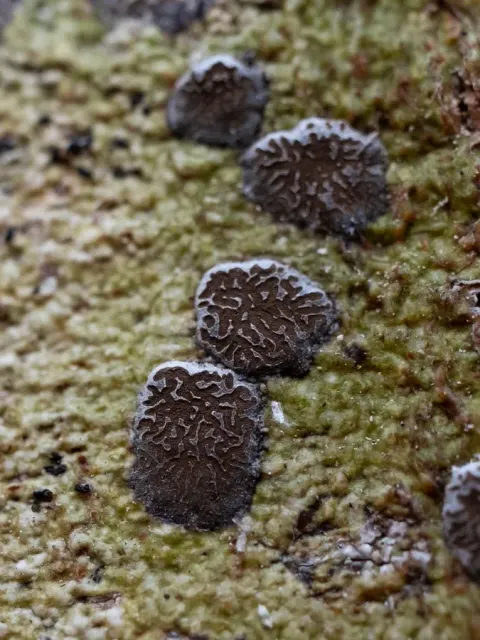
Dokumentasi Gloeoheppia turgida dari Wikimedia Commons. Thallus of the lichen Gloeoheppia turgida Identifikasi mengikuti record berkas sumber.

Jenis
Fotografi
Kredit
Pier Luigi Nimis
Sumber media
Buka entri sumber

Gambar menunjukkan objek menurut identifikasi sumber, bukan verifikasi independen spesimen oleh Fungi. Tidak ada skala baru yang ditambahkan.

06 / Rujukan

Sumber profil

  1. [1] Gloeoheppia turgida — Wikipedia (en)Bagian sumber: Frozen revision 1348865784
    Tanggal penghimpunan sumber: 2026-10-12
    Teks sumber: CC BY-SA4.0 · Wikipedia contributors
  2. [2] Catalogue of Life Base2026-09-11 — Gloeoheppia turgidaBagian sumber: ColDP NameUsage.tsv ID 3GBH9; accepted species; source 2073
    Tanggal penghimpunan sumber: 2026-10-12
  3. [3] Dokumentasi visual — Gloeoheppia turgidaBagian sumber: Individual media record; identification follows the source, not independent determination
    Tanggal penghimpunan sumber: 2026-10-12
    Media sumber: CC BY-SA 4.0 · Pier Luigi Nimis

Adaptasi teks: CC BY-SA 4.0. Wikipedia contributors — Gloeoheppia turgida — Wikipedia (en)

Uraian asli dan riwayat sumber

Riwayat atau halaman sumber

Ringkasan sumber

Gloeoheppia turgida is a species of gelatinous lichen in the family Gloeoheppiaceae. The species was first described in 1810 by Erik Acharius as Endocarpon turgidum, based on a Swiss collection made by Johann Christoph Schleicher. It was transferred to the genus Gloeoheppia in 1935, and a later revision upheld Gloeoheppia as distinct from Heppia, and fixed the application of Acharius's name by designating Schleicher's specimen as the lectotype. The species forms small, scaly squamules up to 4 mm across that become strongly swollen and convex, with a dark olive to greenish-black upper surface that may carry a thin white, powdery .

Revisi sumber

Morfologi sumber

Gloeoheppia turgida has a (scaly) thallus made up of small, leaf-like . These are round to elongate and , sometimes overlapping, and become strongly convex and swollen, reaching up to about 4 mm across. Their margins curve downwards and are often rolled under, and the thallus is anchored to the substrate by coarse fungal hyphae. The thallus lacks a and is attached by rhizoidal strands, and its hyphae form a network around a small, single-celled cyanobiont. The upper surface is smooth and dark olive to greenish black, becoming paler in shaded situations, and may carry a thin white, powdery deposit (a ); it is covered by a relatively thick layer of dead tissue. The underside is smooth, olive to pale flesh-coloured and lacks a differentiated cortex. The medulla contains an that extends through most, or sometimes all, of its depth. Where a lower algal-free zone is present it consists of tightly packed, fungal cells. Vegetative propagules such as isidia and soredia have not been reported. Sexual reproduction occurs in immersed apothecia (fruiting bodies) produced one to many per squamule; the exposed are dark brown to blackish and typically about 0.2–0.8 mm across, and the hymenium and stain deep blue in iodine. The asci usually contain eight spores, but 10–12-spored asci have also been observed, and the colourless, ellipsoid ascospores measure about 10–14 by 6–8 μm. Physiological measurements on thalli collected in the Judean Desert found that humid air alone did not activate positive net photosynthesis; instead, the lichen required wetting with liquid water. Immediately after spraying, net photosynthesis remained low (under 20% of its maximum), which the authors attributed to diffusion limitation in the water-saturated thallus.

Revisi sumber

Ekologi sumber

Gloeoheppia turgida has been collected on calcareous soil and rock in the Mediterranean, Macaronesian, and Saharo-Arabian regions. It has also been collected in xeric soil-lichen communities in the Judaean Desert (Israel), on the slopes of the Dead Sea near Ein Boqeq.

Revisi sumber

Struktur reproduksi sumber

Vegetative propagules such as isidia and soredia have not been reported. Sexual reproduction occurs in immersed apothecia (fruiting bodies) produced one to many per squamule; the exposed are dark brown to blackish and typically about 0.2–0.8 mm across, and the hymenium and stain deep blue in iodine. The asci usually contain eight spores, but 10–12-spored asci have also been observed, and the colourless, ellipsoid ascospores measure about 10–14 by 6–8 μm.

Revisi sumber

Rujukan halaman ini

Fungi. Gloeoheppia turgida. Rilis data fungi-2026-10-12-expansion-2. https://fungi-atlas.mgadib.chatgpt.site/jamur/gloeoheppia-turgida/.

Status: impor sumber; pemeriksaan editorial per profil belum selesai. Untuk klaim biologis, gunakan rujukan pada bagian terkait dan periksa konteks sumber aslinya.