01 / Morfologi

Ciri dan struktur

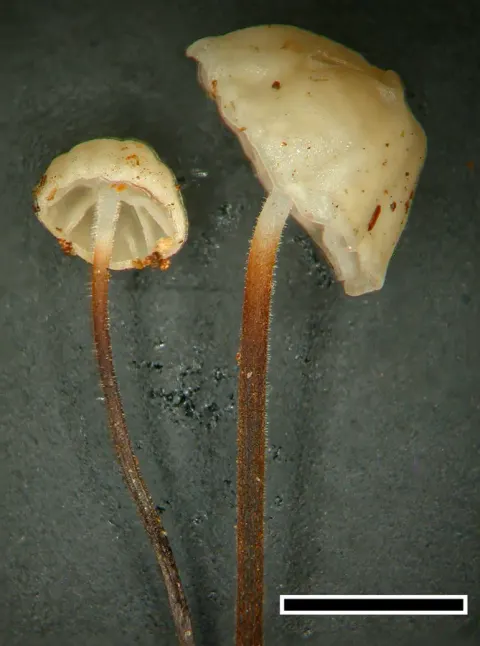
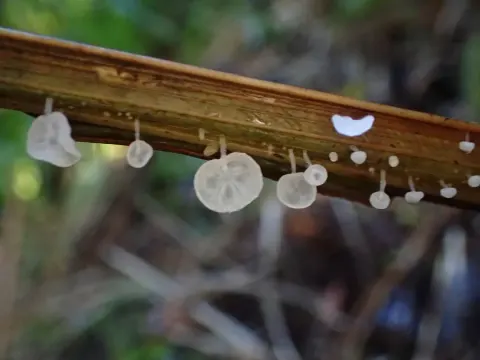
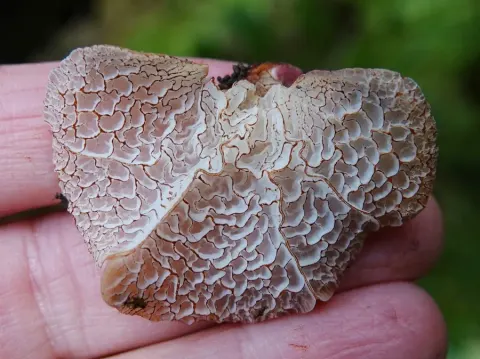
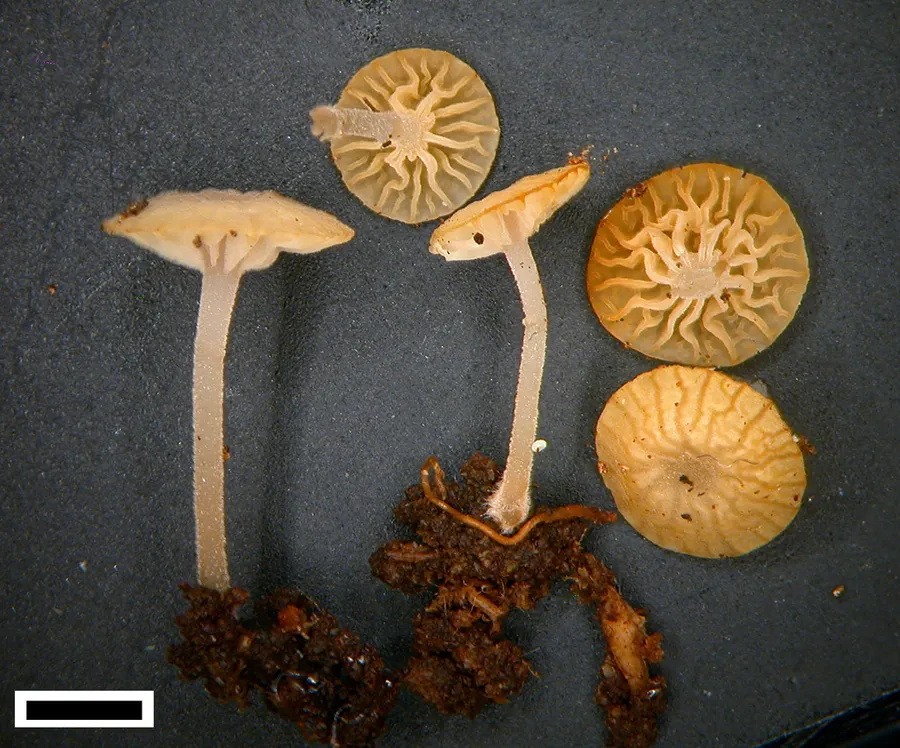
Pi1eus 3-8 mm diam, hemispherical when young, becoming convex or plano-convex in age, disc neither depressed nor umbilicate, margin weakly plicate; surface dull, dry, minutely pruinose; at first white overall, soon becoming pale grey, finally changing to pale brown. Texture membranaceous; context very thin, white.- Lamellae broadly adnate to subdecurrent, subdistant (912) with 0-1 series of lamellulae, white; edges even, concolorous.- Stipe 5-7 x 0.5 mm, central, equal, cylindrical, often curved, tough, minutely pruinose overall, non-insititious, base with short, strigose, concolorous hairs attached to substrate; white overall or with the base becoming pale brown in age.- Odor and taste not distinctive. Basidiospores 5.5-7.0 x 3.5-4.0(-4.5) µm, ovoid to ellipsoid, smooth, thin-walled, hyaline, inamyloid. - Basidia 18-22 x 5-6 µm, subclavate, 4-spored, unclamped.- Cheilogloeocystidia common, 40-60 x 10-14 µm, broadly fusoid to narrowly lageniform, subcapitate, thin-walled, hyaline or with yellow contents.- Pleurogloeocystidia uncommon, like cheilogloeocystidia.- Pileipellis a hymeniform layer of broadly clavate to globose, smooth, hyaline cells, 12-20 x 8-16 µm; with numerous pileogloeocystidia interspersed, 20-40 x 6-8 µm, cylindrical-subcapitate to lageniform-capitate, often with yellow contents.- Tissues inamyloid, non-gelatinous. - Caulogloeocystidia numerous, 30-45 x 7-10 µm, like cheilogloeocystidia. - Clamp connections absent.

Sebagian uraian ditampilkan dalam bahasa sumber; terjemahannya belum tersedia atau belum lolos pemeriksaan.

Rujukan: [1]

Pengukuran mengikuti objek, spesimen atau kultur, dan metode yang disebutkan sumber. Baca uraian asli untuk konteks lengkap.

02 / Kehidupan

Habitat dan peran ekologis

Habit, habitat and distribution.- Solitary, rarely cespitose, in groups on rotting wood in Nothofagus-Melicytus-Weinmannia forest. New Zealand.

Sebagian uraian ditampilkan dalam bahasa sumber; terjemahannya belum tersedia atau belum lolos pemeriksaan.

Rujukan: [1]

Habitat atau konteks temuan
hutan
Substrat
kayu
Peran atau konteks
Belum dikategorikan pada rilis ini.
Temukan hubungan serupa
03 / Siklus hidup

Reproduksi

Pi1eus 3-8 mm diam, hemispherical when young, becoming convex or plano-convex in age, disc neither depressed nor umbilicate, margin weakly plicate; surface dull, dry, minutely pruinose; at first white overall, soon becoming pale grey, finally changing to pale brown. Texture membranaceous; context very thin, white.- Lamellae broadly adnate to subdecurrent, subdistant (912) with 0-1 series of lamellulae, white; edges even, concolorous.- Stipe 5-7 x 0.5 mm, central, equal, cylindrical, often curved, tough, minutely pruinose overall, non-insititious, base with short, strigose, concolorous hairs attached to substrate; white overall or with the base becoming pale brown in age.- Odor and taste not distinctive.

Sebagian uraian ditampilkan dalam bahasa sumber; terjemahannya belum tersedia atau belum lolos pemeriksaan.

Rujukan: [1]

04 / Batas informasi

Catatan identitas dan cakupan

  • Nama diterima mengikuti Catalogue of Life Base2026-09-11; uraian mempertahankan konsep dan nama sumber aslinya.
  • Historical description as cited by BiotaNZ. Preserve explicit New Zealand/locality, host and specimen qualifiers. Distribution is the cited source scope, not a current global range.
  • Impor dan terjemahan otomatis belum diperiksa editorial per profil. Struktur reproduktif yang disebutkan tidak membuktikan seluruh siklus hidup diketahui.
  • Pengukuran pada uraian mengikuti spesimen, kultur, dan metode sumber; angka tidak diperluas ke semua populasi.

Catatan distribusi dalam narasi mengikuti sumbernya. Dokumentasi spesimen atau foto mengikuti catatan sumber. Bukti wilayah Indonesia dan penilaian konservasi tidak disimpulkan dari gambar.

05 / Dokumentasi

Melihat dengan konteks

Dokumentasi Gloiocephala gracilis menurut asosiasi foto pada record takson iNaturalist. Kredit: Jerry Cooper. Identitas mengikuti sumber; bukan penentuan spesimen independen.

Jenis
Fotografi
Kredit
(c) Jerry Cooper, some rights reserved (CC BY), uploaded by Jerry Cooper
Lisensi
CC BY 4.0
Sumber media
Buka entri sumber

Gambar menunjukkan objek menurut identifikasi sumber, bukan verifikasi independen spesimen oleh Fungi. Tidak ada skala baru yang ditambahkan.

06 / Rujukan

Sumber profil

  1. [1] Desjardin, D.E.; Horak, E. 1997: Marasmius and Gloiocephala in the South Pacific Region: Papua New Guinea, New Caledonia, and New Zealand taxa. Bibliotheca Mycologica. 168. — Gloiocephala gracilisBagian sumber: biota:1cb0e8fe-36b9-11d5-9548-00d0592d548c:1cb18b9f-36b9-11d5-9548-00d0592d548c
    Tanggal penghimpunan sumber: 2026-10-12
    Teks sumber: CC BY 4.0 · Desjardin, D.E.; Horak, E. 1997: Marasmius and Gloiocephala in the South Pacific Region: Papua New Guinea, New Caledonia, and New Zealand taxa. Bibliotheca Mycologica. 168.
  2. [2] Catalogue of Life Base2026-09-11 — Gloiocephala gracilisBagian sumber: ColDP NameUsage.tsv ID 6KJY9; accepted species; source 2073
    Tanggal penghimpunan sumber: 2026-10-12
  3. [3] Dokumentasi visual — Gloiocephala gracilisBagian sumber: Individual media record; identification follows the source, not independent determination
    Tanggal penghimpunan sumber: 2026-10-12
    Media sumber: CC BY 4.0 · (c) Jerry Cooper, some rights reserved (CC BY), uploaded by Jerry Cooper

Adaptasi teks: CC BY 4.0. Desjardin, D.E.; Horak, E. 1997: Marasmius and Gloiocephala in the South Pacific Region: Papua New Guinea, New Caledonia, and New Zealand taxa. Bibliotheca Mycologica. 168. — Desjardin, D.E.; Horak, E. 1997: Marasmius and Gloiocephala in the South Pacific Region: Papua New Guinea, New Caledonia, and New Zealand taxa. Bibliotheca Mycologica. 168. — Gloiocephala gracilis

Uraian asli dan riwayat sumber

Riwayat atau halaman sumber

Ringkasan sumber

Pi1eus 3-8 mm diam, hemispherical when young, becoming convex or plano-convex in age, disc neither depressed nor umbilicate, margin weakly plicate; surface dull, dry, minutely pruinose; at first white overall, soon becoming pale grey, finally changing to pale brown. Texture membranaceous; context very thin, white.- Lamellae broadly adnate to subdecurrent, subdistant (912) with 0-1 series of lamellulae, white; edges even, concolorous.- Stipe 5-7 x 0.5 mm, central, equal, cylindrical, often curved, tough, minutely pruinose overall, non-insititious, base with short, strigose, concolorous hairs attached to substrate; white overall or with the base becoming pale brown in age.- Odor and taste not distinctive.

Revisi sumber

Morfologi sumber

Pi1eus 3-8 mm diam, hemispherical when young, becoming convex or plano-convex in age, disc neither depressed nor umbilicate, margin weakly plicate; surface dull, dry, minutely pruinose; at first white overall, soon becoming pale grey, finally changing to pale brown. Texture membranaceous; context very thin, white.- Lamellae broadly adnate to subdecurrent, subdistant (912) with 0-1 series of lamellulae, white; edges even, concolorous.- Stipe 5-7 x 0.5 mm, central, equal, cylindrical, often curved, tough, minutely pruinose overall, non-insititious, base with short, strigose, concolorous hairs attached to substrate; white overall or with the base becoming pale brown in age.- Odor and taste not distinctive. Basidiospores 5.5-7.0 x 3.5-4.0(-4.5) µm, ovoid to ellipsoid, smooth, thin-walled, hyaline, inamyloid. - Basidia 18-22 x 5-6 µm, subclavate, 4-spored, unclamped.- Cheilogloeocystidia common, 40-60 x 10-14 µm, broadly fusoid to narrowly lageniform, subcapitate, thin-walled, hyaline or with yellow contents.- Pleurogloeocystidia uncommon, like cheilogloeocystidia.- Pileipellis a hymeniform layer of broadly clavate to globose, smooth, hyaline cells, 12-20 x 8-16 µm; with numerous pileogloeocystidia interspersed, 20-40 x 6-8 µm, cylindrical-subcapitate to lageniform-capitate, often with yellow contents.- Tissues inamyloid, non-gelatinous. - Caulogloeocystidia numerous, 30-45 x 7-10 µm, like cheilogloeocystidia. - Clamp connections absent.

Revisi sumber

Ekologi sumber

Habit, habitat and distribution.- Solitary, rarely cespitose, in groups on rotting wood in Nothofagus-Melicytus-Weinmannia forest. New Zealand.

Revisi sumber

Struktur reproduksi sumber

Pi1eus 3-8 mm diam, hemispherical when young, becoming convex or plano-convex in age, disc neither depressed nor umbilicate, margin weakly plicate; surface dull, dry, minutely pruinose; at first white overall, soon becoming pale grey, finally changing to pale brown. Texture membranaceous; context very thin, white.- Lamellae broadly adnate to subdecurrent, subdistant (912) with 0-1 series of lamellulae, white; edges even, concolorous.- Stipe 5-7 x 0.5 mm, central, equal, cylindrical, often curved, tough, minutely pruinose overall, non-insititious, base with short, strigose, concolorous hairs attached to substrate; white overall or with the base becoming pale brown in age.- Odor and taste not distinctive.

Revisi sumber

Rujukan halaman ini

Fungi. Gloiocephala gracilis. Rilis data fungi-2026-10-12-expansion-2. https://fungi-atlas.mgadib.chatgpt.site/jamur/gloiocephala-gracilis/.

Status: impor sumber; pemeriksaan editorial per profil belum selesai. Untuk klaim biologis, gunakan rujukan pada bagian terkait dan periksa konteks sumber aslinya.