01 / Morfologi

Ciri dan struktur

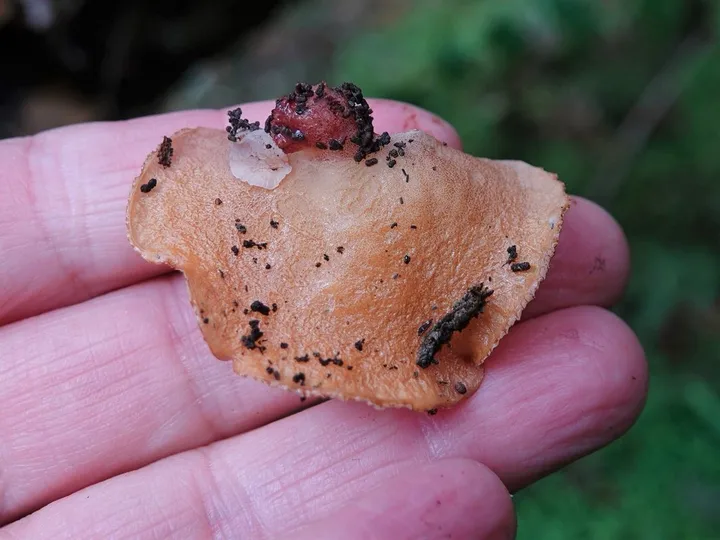
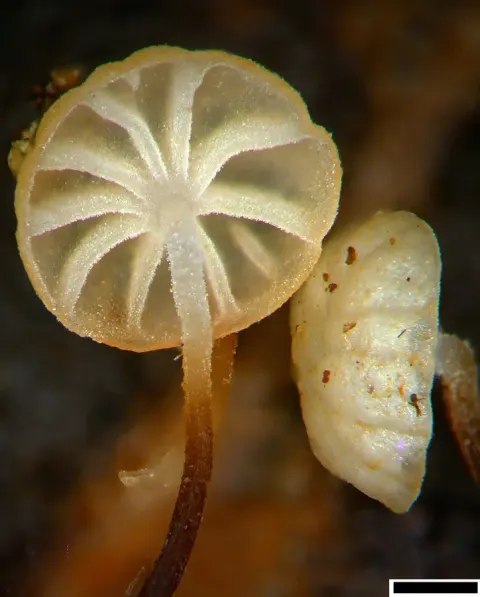
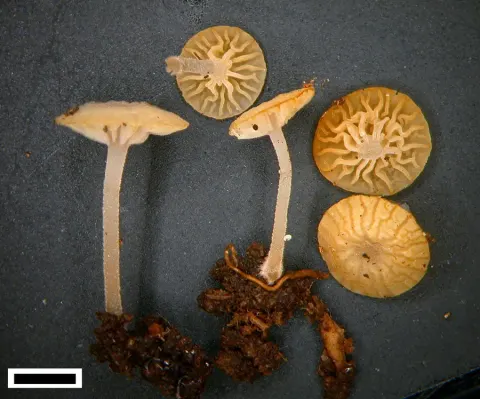
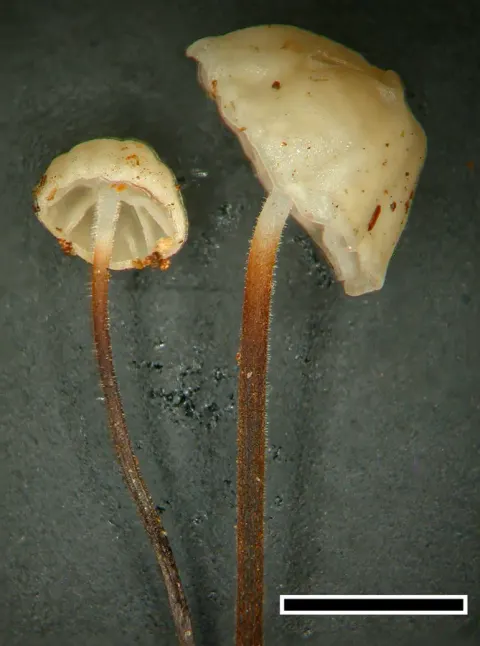
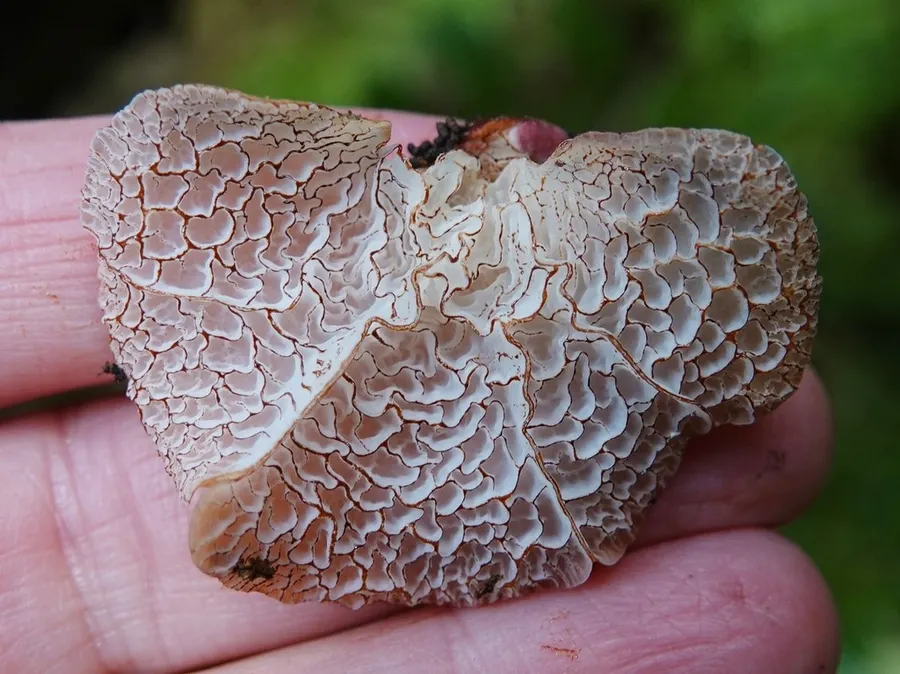
Basidiome 12 x 9 mm diam., orbicular to reniform, fleshy, fragile, easily detached from substratum, stipitate. Pileus pinkish cream, "chamois to cinnamon buff", becoming red with age, gelatinous, surface viscid, tessellate corresponding with lamellae. Hymenophore white to pinkish buff at first but becoming crimson to rusty red, "orange cinnamon to mikado brown, deep corinthian red to acajou red" (colours in quotation marks from Ridgway (1912), fide R. H, Petersen pers. comm.), staining appearing first at the margins of the long lamellae, strongly intervenose, with a small number (3-5) of long lamellae reaching the stipe, and between them secondary lamellae anastomosing at a lower level. During drying, the margins of lamellae exude a sticky-looking red substance. Stipe 2 x 1 mm, excentric to mainly lateral, cylindric, solid, pink, pubescent. Smell and taste unknown. Spore print white, copious. Spores 10.5-14.5 x 6.5-9.0 (13.0 x 7.5) µm, Q = 1.73, elliptical in face view, flattened on adaxial side and often conspicuously humped on abaxial side in lateral view, hyaline, inamyloid, not dextrinoid, acyanophilic, thin-walled, some with refractive globules; contents of spores discolour ferruginous red with age. Basidia 35-45 x 5-12 µm, elongate-clavate, with 4 sterigmata, up to 6 µm long, contents yellow granular when young. Cheilocystidia 70-100 x 3-9 µm, cylindrical to narrowly clavate, thin-walled, contents becoming reddish with age, or sometimes with red material forming a cap, crowded, forming a wide, sterile, lamellar margin. Pleurocystidia none but some fusoid basidioles present.

Sebagian uraian ditampilkan dalam bahasa sumber; terjemahannya belum tersedia atau belum lolos pemeriksaan.

Rujukan: [1]

Pengukuran mengikuti objek, spesimen atau kultur, dan metode yang disebutkan sumber. Baca uraian asli untuk konteks lengkap.

02 / Kehidupan

Habitat dan peran ekologis

On decaying nikau palm fronds (Rhopalostylis sapida Wendi. & Drude, an indigenous palm), in mixed podocarp dicotyledonous forest.

Sebagian uraian ditampilkan dalam bahasa sumber; terjemahannya belum tersedia atau belum lolos pemeriksaan.

Rujukan: [1]

Habitat atau konteks temuan
hutan
Substrat
Informasi belum tersedia pada sumber rilis ini.
Peran atau konteks
Belum dikategorikan pada rilis ini.
Temukan hubungan serupa
03 / Siklus hidup

Reproduksi

Basidiome 12 x 9 mm diam., orbicular to reniform, fleshy, fragile, easily detached from substratum, stipitate. Pileus pinkish cream, "chamois to cinnamon buff", becoming red with age, gelatinous, surface viscid, tessellate corresponding with lamellae. Hymenophore white to pinkish buff at first but becoming crimson to rusty red, "orange cinnamon to mikado brown, deep corinthian red to acajou red" (colours in quotation marks from Ridgway (1912), fide R. H, Petersen pers. comm.), staining appearing first at the margins of the long lamellae, strongly intervenose, with a small number (3-5) of long lamellae reaching the stipe, and between them secondary lamellae anastomosing at a lower level. During drying, the margins of lamellae exude a sticky-looking red substance.

Sebagian uraian ditampilkan dalam bahasa sumber; terjemahannya belum tersedia atau belum lolos pemeriksaan.

Rujukan: [1]

Sinonim menurut acuan taksonomi rilis: Campanella rubescens
04 / Batas informasi

Catatan identitas dan cakupan

  • Nama diterima mengikuti Catalogue of Life Base2026-09-11; uraian mempertahankan konsep dan nama sumber aslinya.
  • Historical description as cited by BiotaNZ. Preserve explicit New Zealand/locality, host and specimen qualifiers. Distribution is the cited source scope, not a current global range.
  • Impor dan terjemahan otomatis belum diperiksa editorial per profil. Struktur reproduktif yang disebutkan tidak membuktikan seluruh siklus hidup diketahui.
  • Pengukuran pada uraian mengikuti spesimen, kultur, dan metode sumber; angka tidak diperluas ke semua populasi.

Catatan distribusi dalam narasi mengikuti sumbernya. Dokumentasi spesimen atau foto mengikuti catatan sumber. Bukti wilayah Indonesia dan penilaian konservasi tidak disimpulkan dari gambar.

05 / Dokumentasi

Melihat dengan konteks

Dokumentasi Gloiocephala rubescens menurut asosiasi foto pada record takson iNaturalist. Kredit: Jacqui Geux. Identitas mengikuti sumber; bukan penentuan spesimen independen.

Jenis
Fotografi
Kredit
(c) Jacqui Geux, some rights reserved (CC BY), uploaded by Jacqui Geux
Lisensi
CC BY 4.0
Sumber media
Buka entri sumber

Gambar menunjukkan objek menurut identifikasi sumber, bukan verifikasi independen spesimen oleh Fungi. Tidak ada skala baru yang ditambahkan.

Dokumentasi tambahan

06 / Rujukan

Sumber profil

  1. [1] Segedin, B.P. 1993: Studies in the Agaricales of New Zealand: some new and revised species of Campanella (Tricholomataceae: Collybieae). New Zealand Journal of Botany 31: 375-384. — Campanella rubescensBagian sumber: biota:1cb0fae9-36b9-11d5-9548-00d0592d548c:1cb18076-36b9-11d5-9548-00d0592d548c
    Tanggal penghimpunan sumber: 2026-10-12
    Teks sumber: CC BY 4.0 · Segedin, B.P. 1993: Studies in the Agaricales of New Zealand: some new and revised species of Campanella (Tricholomataceae: Collybieae). New Zealand Journal of Botany 31: 375-384.
  2. [2] Catalogue of Life Base2026-09-11 — Gloiocephala rubescensBagian sumber: ColDP NameUsage.tsv ID 3GCB9; accepted species; source 2073
    Tanggal penghimpunan sumber: 2026-10-12
  3. [3] Dokumentasi visual — Gloiocephala rubescensBagian sumber: Identitas mengikuti sumber dokumentasi; bukan penentuan spesimen independen.
    Tanggal penghimpunan sumber: 2026-10-17
    Media sumber: CC BY 4.0 · (c) Jacqui Geux, some rights reserved (CC BY), uploaded by Jacqui Geux
  4. [4] Dokumentasi visual — Gloiocephala rubescensBagian sumber: Identitas mengikuti sumber dokumentasi; bukan penentuan spesimen independen.
    Tanggal penghimpunan sumber: 2026-10-17
    Teks sumber: CC BY 4.0 · (c) Jacqui Geux, some rights reserved (CC BY), uploaded by Jacqui Geux

Adaptasi teks: CC BY 4.0. Segedin, B.P. 1993: Studies in the Agaricales of New Zealand: some new and revised species of Campanella (Tricholomataceae: Collybieae). New Zealand Journal of Botany 31: 375-384. — Segedin, B.P. 1993: Studies in the Agaricales of New Zealand: some new and revised species of Campanella (Tricholomataceae: Collybieae). New Zealand Journal of Botany 31: 375-384. — Campanella rubescens

Uraian asli dan riwayat sumber

Riwayat atau halaman sumber

Ringkasan sumber

Basidiome 12 x 9 mm diam., orbicular to reniform, fleshy, fragile, easily detached from substratum, stipitate. Pileus pinkish cream, "chamois to cinnamon buff", becoming red with age, gelatinous, surface viscid, tessellate corresponding with lamellae. Hymenophore white to pinkish buff at first but becoming crimson to rusty red, "orange cinnamon to mikado brown, deep corinthian red to acajou red" (colours in quotation marks from Ridgway (1912), fide R. H, Petersen pers. comm.), staining appearing first at the margins of the long lamellae, strongly intervenose, with a small number (3-5) of long lamellae reaching the stipe, and between them secondary lamellae anastomosing at a lower level.

Revisi sumber

Morfologi sumber

Basidiome 12 x 9 mm diam., orbicular to reniform, fleshy, fragile, easily detached from substratum, stipitate. Pileus pinkish cream, "chamois to cinnamon buff", becoming red with age, gelatinous, surface viscid, tessellate corresponding with lamellae. Hymenophore white to pinkish buff at first but becoming crimson to rusty red, "orange cinnamon to mikado brown, deep corinthian red to acajou red" (colours in quotation marks from Ridgway (1912), fide R. H, Petersen pers. comm.), staining appearing first at the margins of the long lamellae, strongly intervenose, with a small number (3-5) of long lamellae reaching the stipe, and between them secondary lamellae anastomosing at a lower level. During drying, the margins of lamellae exude a sticky-looking red substance. Stipe 2 x 1 mm, excentric to mainly lateral, cylindric, solid, pink, pubescent. Smell and taste unknown. Spore print white, copious. Spores 10.5-14.5 x 6.5-9.0 (13.0 x 7.5) µm, Q = 1.73, elliptical in face view, flattened on adaxial side and often conspicuously humped on abaxial side in lateral view, hyaline, inamyloid, not dextrinoid, acyanophilic, thin-walled, some with refractive globules; contents of spores discolour ferruginous red with age. Basidia 35-45 x 5-12 µm, elongate-clavate, with 4 sterigmata, up to 6 µm long, contents yellow granular when young. Cheilocystidia 70-100 x 3-9 µm, cylindrical to narrowly clavate, thin-walled, contents becoming reddish with age, or sometimes with red material forming a cap, crowded, forming a wide, sterile, lamellar margin. Pleurocystidia none but some fusoid basidioles present.

Revisi sumber

Ekologi sumber

On decaying nikau palm fronds (Rhopalostylis sapida Wendi. & Drude, an indigenous palm), in mixed podocarp dicotyledonous forest.

Revisi sumber

Struktur reproduksi sumber

Basidiome 12 x 9 mm diam., orbicular to reniform, fleshy, fragile, easily detached from substratum, stipitate. Pileus pinkish cream, "chamois to cinnamon buff", becoming red with age, gelatinous, surface viscid, tessellate corresponding with lamellae. Hymenophore white to pinkish buff at first but becoming crimson to rusty red, "orange cinnamon to mikado brown, deep corinthian red to acajou red" (colours in quotation marks from Ridgway (1912), fide R. H, Petersen pers. comm.), staining appearing first at the margins of the long lamellae, strongly intervenose, with a small number (3-5) of long lamellae reaching the stipe, and between them secondary lamellae anastomosing at a lower level. During drying, the margins of lamellae exude a sticky-looking red substance.

Revisi sumber

Rujukan halaman ini

Fungi. Gloiocephala rubescens. Rilis data fungi-2026-10-12-expansion-2. https://fungi-atlas.mgadib.chatgpt.site/jamur/gloiocephala-rubescens/.

Status: impor sumber; pemeriksaan editorial per profil belum selesai. Untuk klaim biologis, gunakan rujukan pada bagian terkait dan periksa konteks sumber aslinya.