Ciri dan struktur
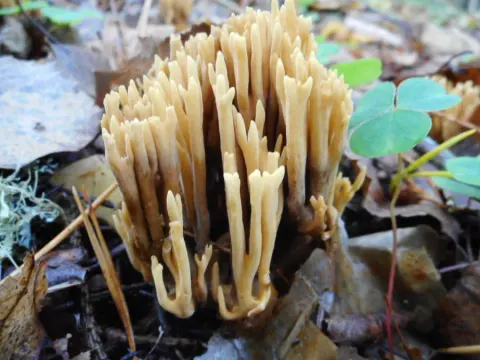
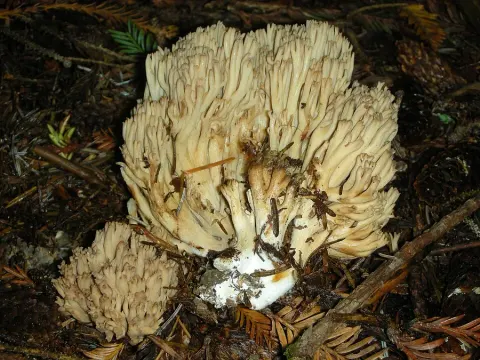
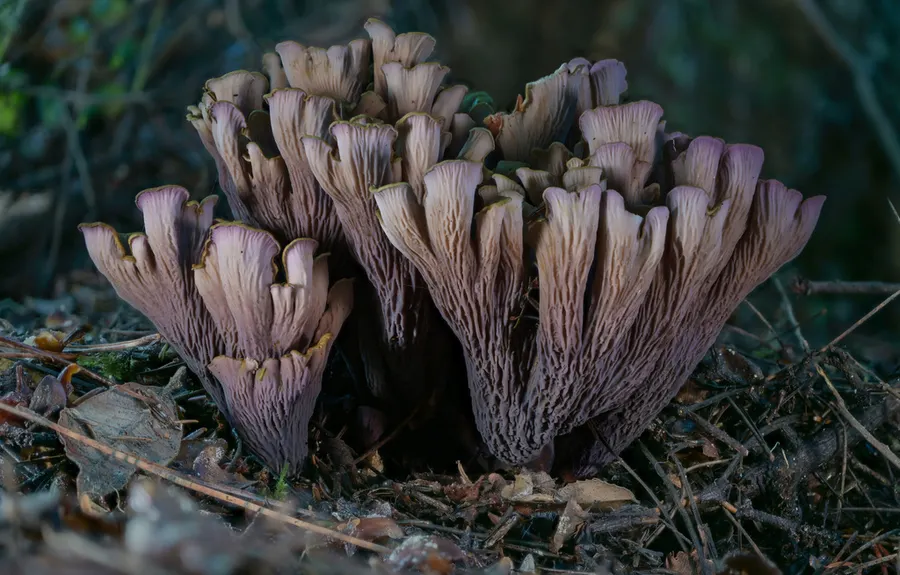
The basidiocarps, or fruit bodies, of immature Gomphus clavatus are club-shaped and have one cap, but later spread out and have a so-called merismatoid appearance—several vase-shaped caps rising from a common stem. The fruit body is up to 20 cm tall and 15 cm wide; it is fan-shaped with wavy edges. The upper surfaces of the fruit bodies are covered with brown hyphae (microscopic filaments) that form small, distinct patches towards the margin, but combine to form a continuous felt-like fine-haired area, or tomentum, over the center of the cap. The color of the upper cap surface is orange-brown to violet, but fades to a lighter brown with age. and covered with fine hairs that become coarser (hispid) towards the base. It is often compound, with several fruit bodies arising from the basal portion. Fruit bodies may bruise reddish-brown where handled. The flesh can be whitish-pink to lilac or cinnamon-buff. Thick under the center of the cap, it thins out towards the margins. It can be crunchy, though it is softer than that of the chanterelle. The taste and odor are mild. The spore print is yellow to orange-yellow. The spores are elliptical, wrinkled or slightly warted, and 10–14 by 5–7.5 μm. They are nonamyloid, meaning they have a negative color reaction with the iodine in Melzer's reagent. The spore-bearing structures, the basidia, are elongated or club-shaped, hyaline (glassy or translucent), and four-spored, with dimensions of 60–90 by 8.5–11.5 μm. G. clavatus does not contain cystidia, the sterile cells associated with basidia in many species. Clamp connections are present.
Habitat dan peran ekologis
Growing on tanah, Gomphus clavatus jamur muncul secara terpisah, dalam kelompok atau klump, atau bahkan kadang-kadang cincin peri. Spesies ini biasanya ditemukan di hutan konifer, dan dengan preferensi untuk wilayah lembab, berbayar dengan daun yang dalam, atau puing-puing kayu yang busuk di tanah. Hal ini sama umum di pohon-pohon yang lebih tua atau lebih muda. Fruit bodies mudah dilewatkan karena warna mereka bercampur dengan yang di lantai hutan. Hal ini lebih umum pada ketinggian lebih dari 2000 ft. Gomphus clavatus telah dilaporkan membentuk asosiasi simbiotik (mikoriza) dengan berbagai pohon: Abies alba, Abies cephalonica, Abies firma, Abies nephrolepis, Abies religiosa, Picea species, Pinus densiflora, Pseudotsuga menziesii, dan Tsuga heterophylla. Hal ini juga dilaporkan dengan beech (Fagus sylvatica) di Eropa. Di Asia, Gomphus clavatus telah dilaporkan dari China, Jepang, Korea, Malaysia, Nepal, dan Pakistan. European countries di mana jamur telah dilaporkan termasuk Austria, Republik Ceko, Prancis, Jerman, Yunani, Italia, Lithuania, Polandia, Rumania, Rusia, Swedia, Swiss, dan Turki. Di Amerika Utara, jamur telah ditemukan di seluruh Kanada, Meksiko, dan Amerika Serikat (Oktober ⁇ December on Barat Coast and Juli ⁇ October elsewhere), yang banyak di Pasifik Barat Laut.
- Habitat atau konteks temuan
- hutan
- Substrat
- tanah
- Peran atau konteks
- Mitra tumbuhan
Reproduksi
The basidiocarps, or fruit bodies, of immature Gomphus clavatus are club-shaped and have one cap, but later spread out and have a so-called merismatoid appearance—several vase-shaped caps rising from a common stem. The fruit body is up to 20 cm tall and 15 cm wide; it is fan-shaped with wavy edges. The upper surfaces of the fruit bodies are covered with brown hyphae (microscopic filaments) that form small, distinct patches towards the margin, but combine to form a continuous felt-like fine-haired area, or tomentum, over the center of the cap. The color of the upper cap surface is orange-brown to violet, but fades to a lighter brown with age. and covered with fine hairs that become coarser (hispid) towards the base.
Catatan identitas dan cakupan
- Nama diterima mengikuti Catalogue of Life Base2026-09-11; uraian mempertahankan konsep dan nama sumber aslinya.
- Original geographic, specimen and life-cycle scope retained; source import awaits individual editorial review.
- Impor dan terjemahan otomatis belum diperiksa editorial per profil. Struktur reproduktif yang disebutkan tidak membuktikan seluruh siklus hidup diketahui.
- Pengukuran pada uraian mengikuti spesimen, kultur, dan metode sumber; angka tidak diperluas ke semua populasi.
Catatan distribusi dalam narasi mengikuti sumbernya. Dokumentasi spesimen atau foto mengikuti catatan sumber. Bukti wilayah Indonesia dan penilaian konservasi tidak disimpulkan dari gambar.
Melihat dengan konteks
Dokumentasi Gomphus clavatus menurut asosiasi foto pada record takson iNaturalist. Kredit: Alan Rockefeller. Identitas mengikuti sumber; bukan penentuan spesimen independen.
- Jenis
- Fotografi
- Kredit
- (c) Alan Rockefeller, some rights reserved (CC BY), uploaded by Alan Rockefeller
- Lisensi
- CC BY 4.0
- Sumber media
- Buka entri sumber
Dokumentasi tambahan
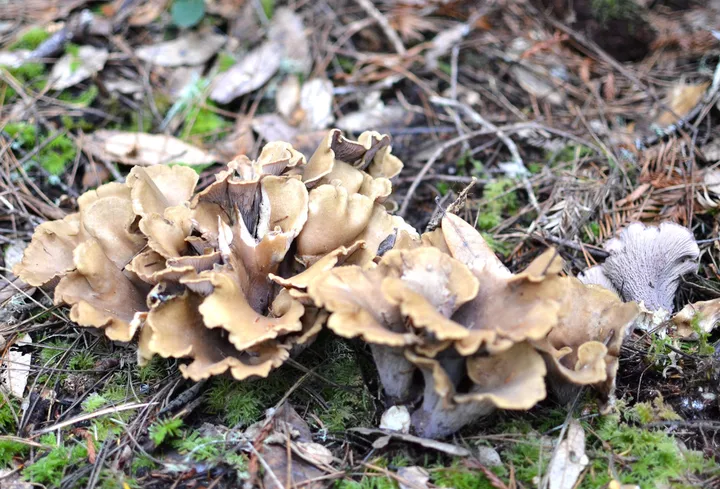
Foto yang diasosiasikan dengan Gomphus clavatus pada iNaturalist. Identifikasi mengikuti sumber; bukan penentuan spesimen independen.
Kredit dan penggunaan
(c) dloarie, some rights reserved (CC BY), uploaded by dloarie
Ukuran dan format gambar disesuaikan tanpa pemotongan, retus, atau penambahan skala. Lisensi sumber dipertahankan.
Sumber profil
- [1] Gomphus clavatus — Wikipedia (en)
- [2] Catalogue of Life Base2026-09-11 — Gomphus clavatus
- [3] Dokumentasi visual — Gomphus clavatus
- [4] Dokumentasi visual — Gomphus clavatus
Rujukan halaman ini
Fungi. Gomphus clavatus. Rilis data fungi-2026-10-12-expansion-2. https://fungi-atlas.mgadib.chatgpt.site/jamur/gomphus-clavatus/.
Status: impor sumber; pemeriksaan editorial per profil belum selesai. Untuk klaim biologis, gunakan rujukan pada bagian terkait dan periksa konteks sumber aslinya.