Ciri dan struktur
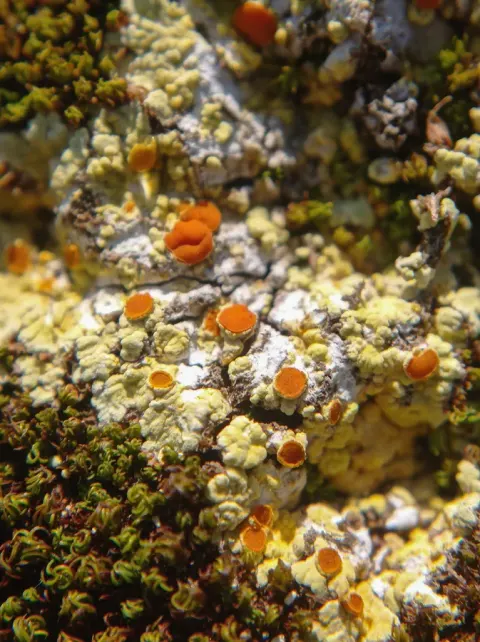
Gyalolechia bracteata forms a crust-like growth (thallus) on soil that appears granular or broken into small, island-like patches. The lichen is predominantly orange-yellow in colour, though some areas may appear white where the underlying fungal tissue () shows through. The surface has a frosted or powdery appearance. Unlike some related species, the edges of the lichen crust do not form distinct finger-like projections or lobes. The lichen commonly produces small, -shaped reproductive structures (apothecia) that are orange when fully developed and typically measure around 1 millimetre across. These structures produce microscopic spores that are transparent and single-celled, measuring 11–15 μm long by 5.5–8 μm wide.
Habitat dan peran ekologis
In Europe, Gyalolechia bracteata is a rare lichen species found in xerothermic (dry and warm) habitats. In Poland, it has been documented in the nature reserve along the lower Vistula River, where it forms part of a relict community of terricolous (ground-dwelling) lichens. This community, resembling the Toninio-Psoretum decipientis fulgensietum bracteatae association, survives on eroded sandy slopes isolated from agricultural runoff. G. bracteata is considered vulnerable on Poland's Red List of Threatened Lichens and is strictly protected by law. Its nearest known localities outside Poland are in southern Sweden and southern Poland, indicating a discontinuous continental distribution. The species' survival in this area, along with other rare xerothermic lichens, is attributed to specific habitat conditions that have persisted since early postglacial periods, as well as human activities that maintained open landscapes. Gyalolechia bracteata can be found across a wide range of elevations throughout the United States, growing in both arctic tundra environments and cool desert landscapes. While this lichen sometimes grows on limestone-rich (calcareous) soils in dry regions, it becomes particularly abundant on gypsum-containing soils, where it forms extensive communities alongside the pink soil lichen Psora decipiens.
- Habitat atau konteks temuan
- Informasi belum tersedia pada sumber rilis ini.
- Substrat
- Informasi belum tersedia pada sumber rilis ini.
- Peran atau konteks
- Pembentuk liken
Reproduksi
Unlike some related species, the edges of the lichen crust do not form distinct finger-like projections or lobes. The lichen commonly produces small, -shaped reproductive structures (apothecia) that are orange when fully developed and typically measure around 1 millimetre across. These structures produce microscopic spores that are transparent and single-celled, measuring 11–15 μm long by 5.5–8 μm wide.
Catatan identitas dan cakupan
- Nama diterima mengikuti Catalogue of Life Base2026-09-11; uraian mempertahankan konsep dan nama sumber aslinya.
- Original geographic, specimen and life-cycle scope retained; source import awaits individual editorial review.
- Impor dan terjemahan otomatis belum diperiksa editorial per profil. Struktur reproduktif yang disebutkan tidak membuktikan seluruh siklus hidup diketahui.
- Pengukuran pada uraian mengikuti spesimen, kultur, dan metode sumber; angka tidak diperluas ke semua populasi.
Catatan distribusi dalam narasi mengikuti sumbernya. Dokumentasi spesimen atau foto mengikuti catatan sumber. Bukti wilayah Indonesia dan penilaian konservasi tidak disimpulkan dari gambar.
Melihat dengan konteks
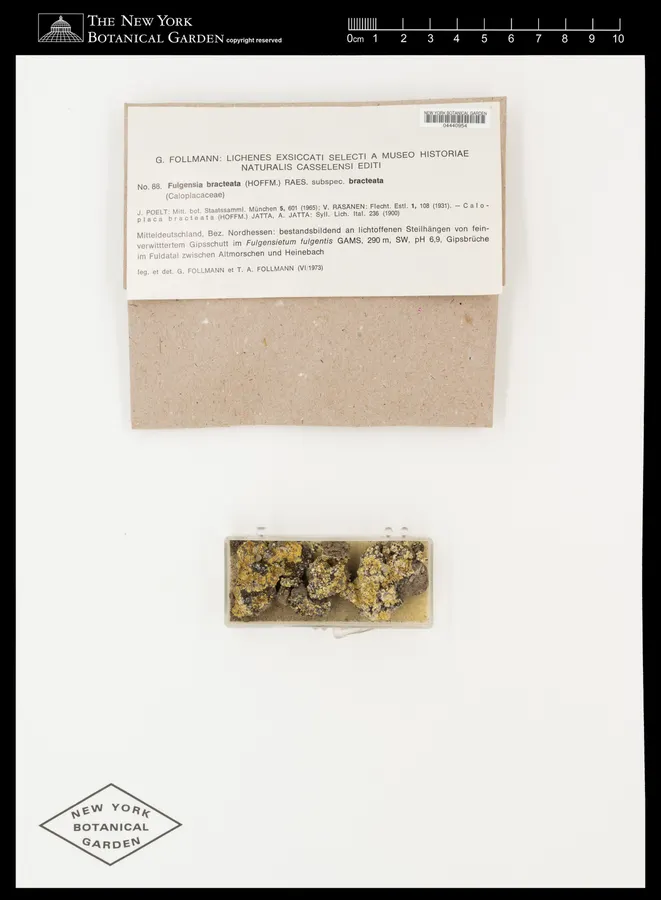
Voucher herbarium Fulgensia bracteata (04440954), The New York Botanical Garden. Identifikasi mengikuti record spesimen sumber. Foto bahan, kemasan, atau label herbarium sebagaimana tersedia pada record institusi; bukan foto lapangan atau penentuan spesimen independen.
- Jenis
- Voucher herbarium
- Kredit
- The New York Botanical Garden
- Lisensi
- CC BY 4.0
- Sumber media
- Buka entri sumber
Sumber profil
- [1] Gyalolechia bracteata — Wikipedia (en)
- [2] Catalogue of Life Base2026-09-11 — Gyalolechia bracteata
- [3] Dokumentasi visual — Fulgensia bracteata
Rujukan halaman ini
Fungi. Gyalolechia bracteata. Rilis data fungi-2026-10-12-expansion-2. https://fungi-atlas.mgadib.chatgpt.site/jamur/gyalolechia-bracteata/.
Status: impor sumber; pemeriksaan editorial per profil belum selesai. Untuk klaim biologis, gunakan rujukan pada bagian terkait dan periksa konteks sumber aslinya.