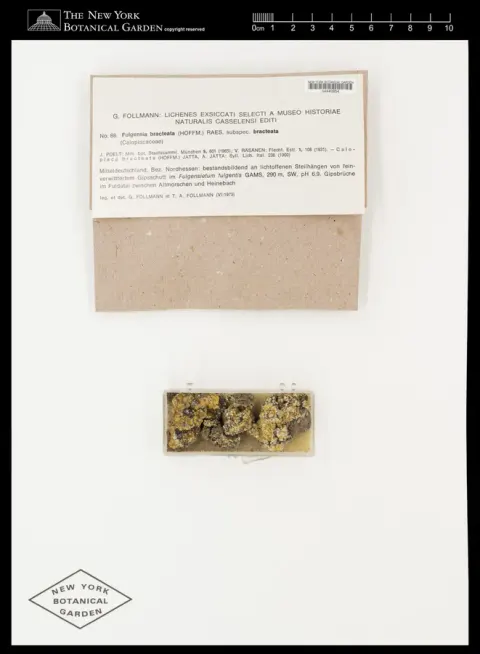
Ciri dan struktur
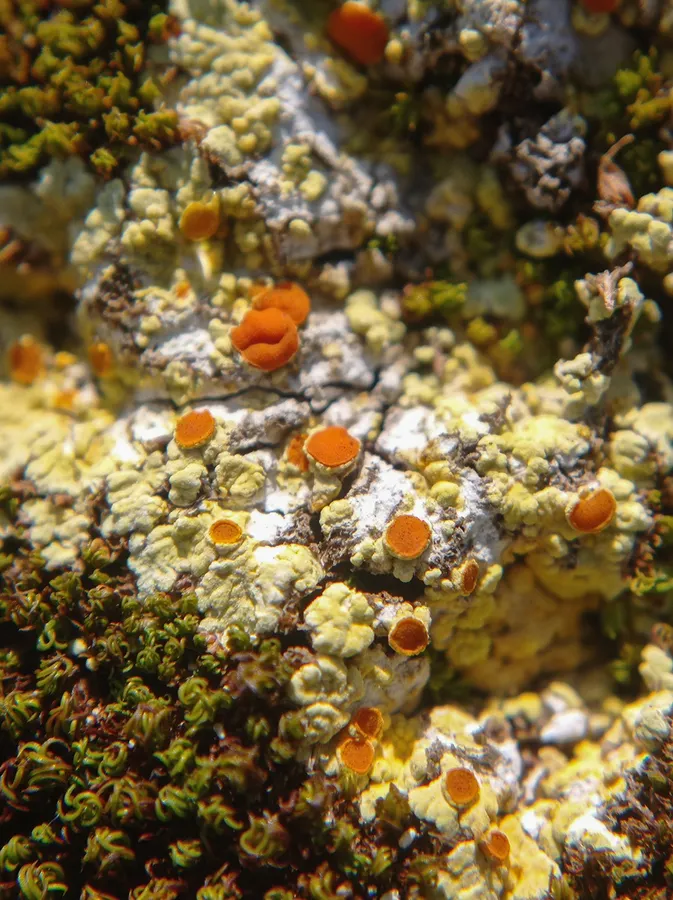
Gyalolechia fulgens has a distinctive appearance and colouration, which makes it readily identifiable. The body of the lichen, known as the thallus, typically spans between 1 and 3 cm in diameter. It has a vibrant orange-yellow to whitish hue and forms a rosette-like shape, though it can also appear irregular and fragmented. The thallus is somewhat in form, meaning it has a crust-like centre with outwardly radiating . The marginal lobes of the thallus are neatly defined and usually longer than they are broad, often exceeding 1 mm in width. These lobes tend to remain distinct or may overlap, particularly towards the centre. As the lichen ages, the central area often develops a - texture—characterised by wart-like protrusions—and becomes coarsely dusted with a pale, powdery substance known as . , which are specialised scale-like reproductive propagules, are variably present on the surface of Gyalolechia fulgens. In many populations, part of the thallus surface is dedicated to the production of these structures. When schizidia are shed, they reveal the underlying white medulla, which is the inner layer of the thallus. Apothecia, the spore-producing structures, are often found on this lichen. They are small, measuring 0.5 to 1.5 mm in diameter. Initially concave with a (a rim-like structure surrounding the apothecia), they become convex over time, with the margin appearing more or less excluded. The deep orange colour of the apothecia contrasts with the paler colour of the thallus. The of Gyalolechia fulgens measure 9 to 12 by 3.5 to 5 μm and are typically either non-septate (without divisions) or one-septate (with a single division).
Habitat dan peran ekologis
Gyalolechia fulgens is typically found in environments that are well-lit and offer well-drained, basic . This lichen thrives on stable and firm surfaces such as chalk grasslands and compacted shell-sand. It is frequently found in warm and sheltered locations that are still open to the elements, favouring sites that are close to sea level. These habitats are often adjacent to dunes. A notable aspect of the habitat of Gyalolechia fulgens is its association with certain moss species, particularly Trichostomum crispulum. Geographically, Gyalolechia fulgens has a wide distribution. It is found across Europe and is widespread in the warmer regions of the Northern Hemisphere. The lichen is also present in Australia and New Zealand, indicating its adaptability to various climatic conditions within these regions. In the United Kingdom, it is considered rare. In Wales, it seems to be restricted to coastal areas. Gyalolechia fulgens belongs to a group of specialised lichens that thrive in highly open environments that typically feature areas of exposed soil and often include small rock outcrops. These settings are characterised by minimal competition from larger, vascular plants, allowing these lichens the space and resources they need to grow.
- Habitat atau konteks temuan
- Informasi belum tersedia pada sumber rilis ini.
- Substrat
- Informasi belum tersedia pada sumber rilis ini.
- Peran atau konteks
- Pembentuk liken
Reproduksi
, which are specialised scale-like reproductive propagules, are variably present on the surface of Gyalolechia fulgens. In many populations, part of the thallus surface is dedicated to the production of these structures. When schizidia are shed, they reveal the underlying white medulla, which is the inner layer of the thallus. Apothecia, the spore-producing structures, are often found on this lichen. They are small, measuring 0.5 to 1.5 mm in diameter. Initially concave with a (a rim-like structure surrounding the apothecia), they become convex over time, with the margin appearing more or less excluded. The deep orange colour of the apothecia contrasts with the paler colour of the thallus. The of Gyalolechia fulgens measure 9 to 12 by 3.5 to 5 μm and are typically either non-septate (without divisions) or one-septate (with a single division).
Catatan identitas dan cakupan
- Nama diterima mengikuti Catalogue of Life Base2026-09-11; uraian mempertahankan konsep dan nama sumber aslinya.
- Original geographic, specimen and life-cycle scope retained; source import awaits individual editorial review.
- Impor dan terjemahan otomatis belum diperiksa editorial per profil. Struktur reproduktif yang disebutkan tidak membuktikan seluruh siklus hidup diketahui.
- Pengukuran pada uraian mengikuti spesimen, kultur, dan metode sumber; angka tidak diperluas ke semua populasi.
Catatan distribusi dalam narasi mengikuti sumbernya. Dokumentasi spesimen atau foto mengikuti catatan sumber. Bukti wilayah Indonesia dan penilaian konservasi tidak disimpulkan dari gambar.
Melihat dengan konteks
Dokumentasi Gyalolechia fulgens menurut asosiasi foto pada record takson iNaturalist. Kredit: Tim Johnson. Identitas mengikuti sumber; bukan penentuan spesimen independen.
- Jenis
- Fotografi
- Kredit
- (c) Tim Johnson, some rights reserved (CC BY), uploaded by Tim Johnson
- Lisensi
- CC BY 4.0
- Sumber media
- Buka entri sumber
Dokumentasi tambahan
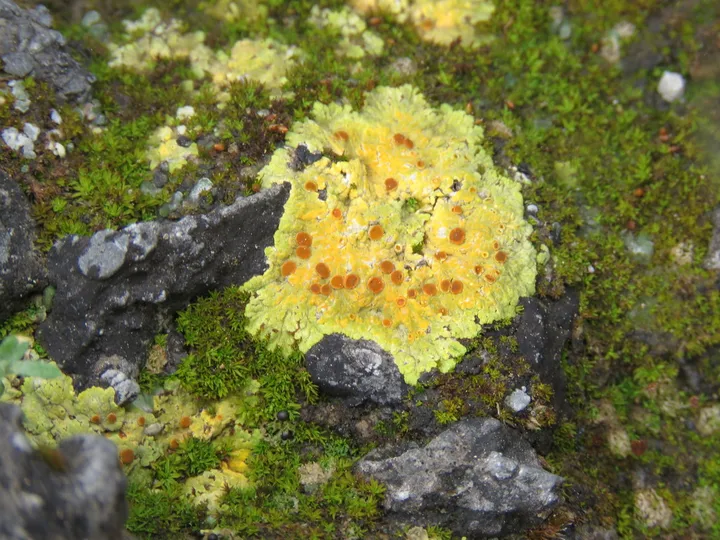
Foto yang diasosiasikan dengan Gyalolechia fulgens pada iNaturalist. Identifikasi mengikuti sumber; bukan penentuan spesimen independen.
Kredit dan penggunaan
(c) Ronald Flipphi, some rights reserved (CC BY-SA), uploaded by Ronald Flipphi
Ukuran dan format gambar disesuaikan tanpa pemotongan, retus, atau penambahan skala. Lisensi sumber dipertahankan.
Sumber profil
- [1] Gyalolechia fulgens — Wikipedia (en)
- [2] Catalogue of Life Base2026-09-11 — Gyalolechia fulgens
- [3] Dokumentasi visual — Gyalolechia fulgens
- [4] Dokumentasi visual — Gyalolechia fulgens
Rujukan halaman ini
Fungi. Gyalolechia fulgens. Rilis data fungi-2026-10-12-expansion-2. https://fungi-atlas.mgadib.chatgpt.site/jamur/gyalolechia-fulgens/.
Status: impor sumber; pemeriksaan editorial per profil belum selesai. Untuk klaim biologis, gunakan rujukan pada bagian terkait dan periksa konteks sumber aslinya.