Ciri dan struktur
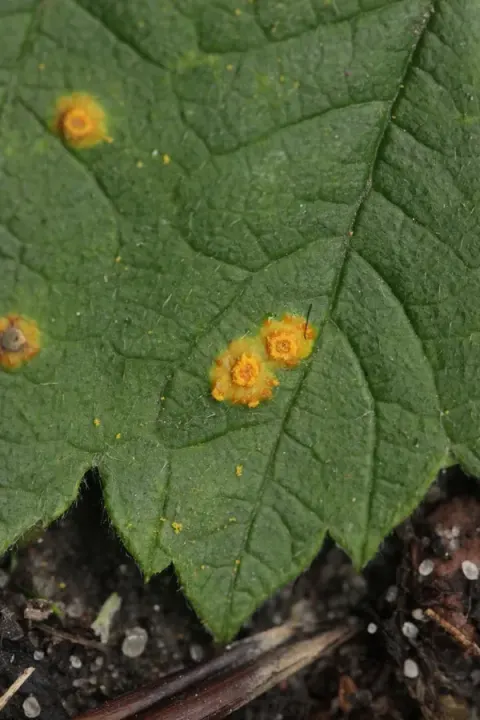
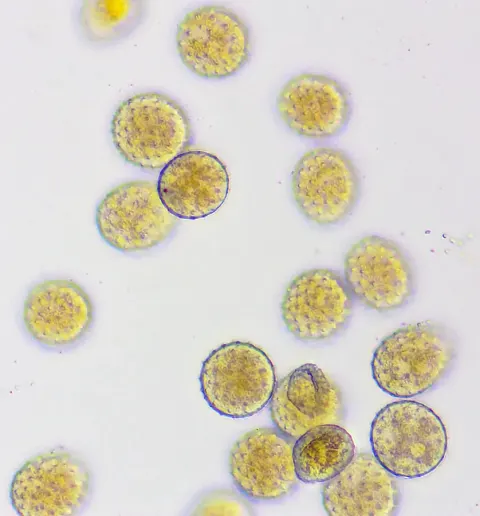
Wild and cultivated raspberries and blackberries are the most common host for Gymnoconia interstitialis. A resistant host has been discovered in Illinois – the Snyder. Signs of the disease begin to appear in the spring. In the spring infected plants' newly formed shoot can be weak and spindly with stunted canes. Glandular bodies form on the top side of the leaves, even before they are entirely unfolded. Once fully mature, these bodies appear as black specks with chlorosis (yellowing) around them. Not all leaves or leaflets of the plant will have the specks. Several weeks after the initial appearance of the bodies, a rust will begin to form on the underside of the leaf. The rust is composed of sori, who will eventually break open and release an orange-colored mass of spores—this is where the disease gets the name "orange rust". Typically, this release of spores is quite intense and ends up filling the whole underside of the leaf with the orange spores. The affected leaves dwarf and roll into themselves, rendering them useless. Gymnoconia interstitialis is a fungus – specifically a basidiomycete. The mycelium lives from year to year in the affected plant. 7 cortex (near the cambium). The parenchyma inside of the leaves becomes infected. When in a young plant, hyphae may be found in any of the tissues. In the affected organs of the plant, the mycelium develops haustoria, which appear as side branching from the mycelium. The haustoria penetrate through cell walls to extract nutrients, while the fungus follows the growing-tip of the plant. The mycelium also grow downward to the root crown and new shoots growing from the crown will be rusted the following year.
Habitat dan peran ekologis
It can stretch as far south as Florida, or as far west as California, and is also quite common in Europe and Asia (the disease cycles of this rust that are found in Europe are considered "long", as opposed to some of the "short" cycles found in the United States.) Black raspberries of New York commonly are affected by this disease, but the region north of Connecticut has been successful in containing the disease to a certain area. Wild and cultivated raspberries and blackberries are the most common host for Gymnoconia interstitialis. A resistant host has been discovered in Illinois – the Snyder. Signs of the disease begin to appear in the spring. In the spring infected plants' newly formed shoot can be weak and spindly with stunted canes. Glandular bodies form on the top side of the leaves, even before they are entirely unfolded. Once fully mature, these bodies appear as black specks with chlorosis (yellowing) around them. Not all leaves or leaflets of the plant will have the specks. Several weeks after the initial appearance of the bodies, a rust will begin to form on the underside of the leaf. The rust is composed of sori, who will eventually break open and release an orange-colored mass of spores—this is where the disease gets the name "orange rust".
- Habitat atau konteks temuan
- Informasi belum tersedia pada sumber rilis ini.
- Substrat
- Informasi belum tersedia pada sumber rilis ini.
- Peran atau konteks
- Belum dikategorikan pada rilis ini.
Reproduksi
Wild and cultivated raspberries and blackberries are the most common host for Gymnoconia interstitialis. A resistant host has been discovered in Illinois – the Snyder. Signs of the disease begin to appear in the spring. In the spring infected plants' newly formed shoot can be weak and spindly with stunted canes. Glandular bodies form on the top side of the leaves, even before they are entirely unfolded. Once fully mature, these bodies appear as black specks with chlorosis (yellowing) around them. Not all leaves or leaflets of the plant will have the specks. Several weeks after the initial appearance of the bodies, a rust will begin to form on the underside of the leaf. The rust is composed of sori, who will eventually break open and release an orange-colored mass of spores—this is where the disease gets the name "orange rust".
Catatan identitas dan cakupan
- Nama diterima mengikuti Catalogue of Life Base2026-09-11; uraian mempertahankan konsep dan nama sumber aslinya.
- Original geographic, specimen and life-cycle scope retained; source import awaits individual editorial review.
- Impor dan terjemahan otomatis belum diperiksa editorial per profil. Struktur reproduktif yang disebutkan tidak membuktikan seluruh siklus hidup diketahui.
- Pengukuran pada uraian mengikuti spesimen, kultur, dan metode sumber; angka tidak diperluas ke semua populasi.
Catatan distribusi dalam narasi mengikuti sumbernya. Dokumentasi spesimen atau foto mengikuti catatan sumber. Bukti wilayah Indonesia dan penilaian konservasi tidak disimpulkan dari gambar.
Melihat dengan konteks
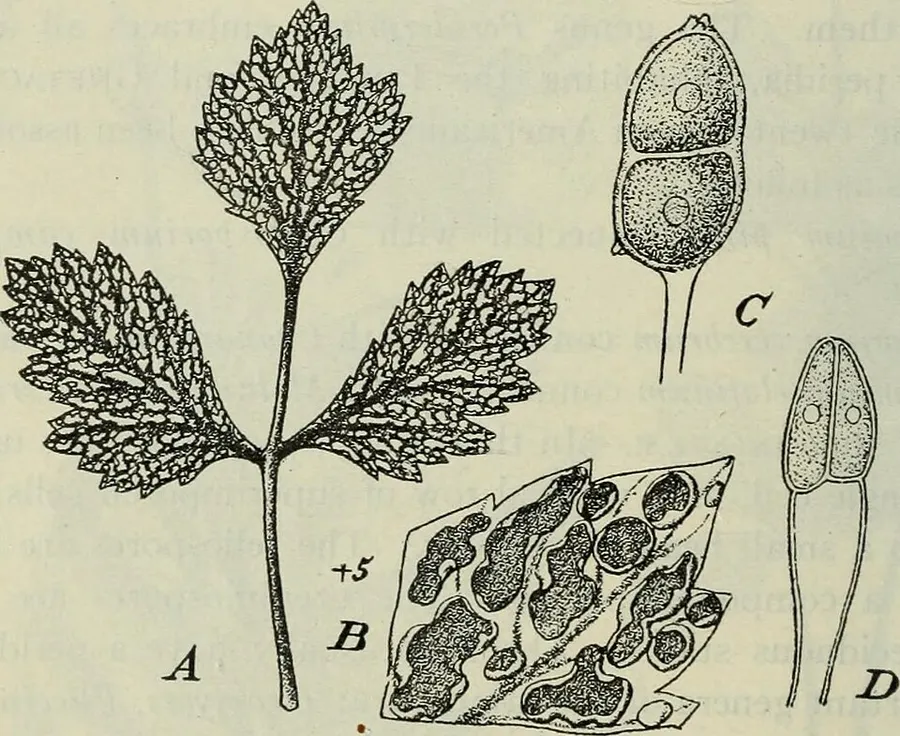
Dokumentasi Gymnoconia interstitialis dari Wikimedia Commons. Image from page 219 of "A text-book of mycology and plant pathology" (1917) Fig. 71.—A-C, Gymnoconia interstitialis. A, Æcidia on leaf of Rubus canadensis; B, piece of leaf enlarged; C, teliospore; D, teliospore of Sphenospora pallida, 500/ I.(After Dietel: Die Natürlichen Pflanzenfamilien I. lA**, p. 70.) Identifikasi mengikuti record berkas sumber.
- Jenis
- Fotografi
- Kredit
- John W. Harshberger
- Lisensi
- Public domain
- Sumber media
- Buka entri sumber
Sumber profil
- [1] Gymnoconia interstitialis — Wikipedia (en)
- [2] Catalogue of Life Base2026-09-11 — Gymnoconia interstitialis
- [3] Dokumentasi visual — Gymnoconia interstitialis
Rujukan halaman ini
Fungi. Gymnoconia interstitialis. Rilis data fungi-2026-10-12-expansion-2. https://fungi-atlas.mgadib.chatgpt.site/jamur/gymnoconia-interstitialis/.
Status: impor sumber; pemeriksaan editorial per profil belum selesai. Untuk klaim biologis, gunakan rujukan pada bagian terkait dan periksa konteks sumber aslinya.