Ciri dan struktur
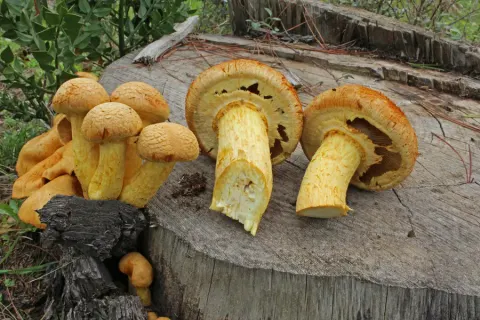
The fruit bodies of Gymnopilus cyanopalmicola have yellow, convex to plane caps 5 to 10 cm in diameter, with fibrillose scales that are erect near the center and appressed near the margin. The gills are crowded, ventricose, with adnate to decurrent gill attachment. The stem is 40 – 210 mm long by 4 – 21 mm thick, cylindrical, fibrillose, tapering at the base in larger fruit bodies. It is colored yellowish white, and turns purple, dark reddish or dark brown when bruised or dried. The stipe has a conspicuous but soon fading membranous yellowish-white annulus. The pileus trama is light yellow, similar to the color of the cap. The odor is fungal. The verrucose spores are ellipsoid to oblong, amygdaliform, thick walled, and lack a germ pore and plague, but have a superhilar depression. They typically measure 8.0 - 8.8 (-11.2) x by 5–6 (6 - 8) μm. They are dextrinoid, orange-brown in KOH, not metachromatic, and have cyanophilic ornamentation. Basidia are clear to yellowish, four spored, 26.4 - 37.5 x 6.4 - 7.7 μm, cylindrical to clavate, constricted in the middle, with sterigmata 3.2–4.8 μm long. The bases of the basidia have clamp connections. Cystidia on the gill edge (cheilocystidia) are clear to yellowish, sometimes with granulose yellow brown contents, narrowly lageniform with a subcapitate to capitate apex, and have dimensions of 21.6–28 × 6.4–7.6 μm, with an apex of 4.8–7.2 μm. The base of the cheilocystidia have clamp connections. Pleurocystidia (cystidia on the gill face) are extremely rare. When present they are clear to yellowish, utriform, 21.6–26 × 7 μm, with an obtuse to subcapitate apex that has a diameter of 3.4–5.6 μm.
Habitat dan peran ekologis
Gymnopilus cyanopalmicola adalah spesies jamur membentuk jamur dalam keluarga Hymenogastraceae. Found in tropis Meksiko, itu digambarkan sebagai baru untuk sains oleh Mexican mycologist Laura Guzmán Dávalos di 2006. Daging jamur ini berubah menjadi biru ketika memar, oleh karena itu epiteta spesifiknya.
- Habitat atau konteks temuan
- Informasi belum tersedia pada sumber rilis ini.
- Substrat
- Informasi belum tersedia pada sumber rilis ini.
- Peran atau konteks
- Belum dikategorikan pada rilis ini.
Reproduksi
The verrucose spores are ellipsoid to oblong, amygdaliform, thick walled, and lack a germ pore and plague, but have a superhilar depression. They typically measure 8.0 - 8.8 (-11.2) x by 5–6 (6 - 8) μm. They are dextrinoid, orange-brown in KOH, not metachromatic, and have cyanophilic ornamentation. Basidia are clear to yellowish, four spored, 26.4 - 37.5 x 6.4 - 7.7 μm, cylindrical to clavate, constricted in the middle, with sterigmata 3.2–4.8 μm long. The bases of the basidia have clamp connections. Cystidia on the gill edge (cheilocystidia) are clear to yellowish, sometimes with granulose yellow brown contents, narrowly lageniform with a subcapitate to capitate apex, and have dimensions of 21.6–28 × 6.4–7.6 μm, with an apex of 4.8–7.2 μm.
Catatan identitas dan cakupan
- Nama diterima mengikuti Catalogue of Life Base2026-09-11; uraian mempertahankan konsep dan nama sumber aslinya.
- Original geographic, specimen and life-cycle scope retained; source import awaits individual editorial review.
- Impor dan terjemahan otomatis belum diperiksa editorial per profil. Struktur reproduktif yang disebutkan tidak membuktikan seluruh siklus hidup diketahui.
- Pengukuran pada uraian mengikuti spesimen, kultur, dan metode sumber; angka tidak diperluas ke semua populasi.
Catatan distribusi dalam narasi mengikuti sumbernya. Dokumentasi spesimen atau foto mengikuti catatan sumber. Bukti wilayah Indonesia dan penilaian konservasi tidak disimpulkan dari gambar.
Melihat dengan konteks
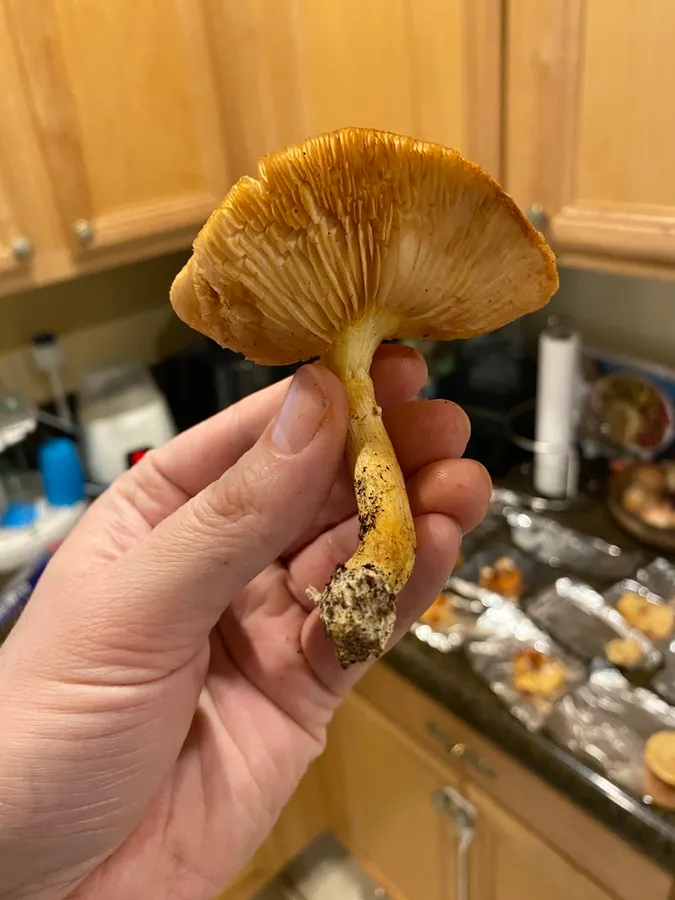
Dokumentasi Gymnopilus cyanopalmicola menurut asosiasi foto pada record takson iNaturalist. Kredit: soflofungi. Identitas mengikuti sumber; bukan penentuan spesimen independen.
- Jenis
- Fotografi
- Kredit
- (c) soflofungi, some rights reserved (CC BY), uploaded by soflofungi
- Lisensi
- CC BY 4.0
- Sumber media
- Buka entri sumber
Sumber profil
- [1] Gymnopilus cyanopalmicola — Wikipedia (en)
- [2] Catalogue of Life Base2026-09-11 — Gymnopilus cyanopalmicola
- [3] Dokumentasi visual — Gymnopilus cyanopalmicola
Rujukan halaman ini
Fungi. Gymnopilus cyanopalmicola. Rilis data fungi-2026-10-12-expansion-2. https://fungi-atlas.mgadib.chatgpt.site/jamur/gymnopilus-cyanopalmicola/.
Status: impor sumber; pemeriksaan editorial per profil belum selesai. Untuk klaim biologis, gunakan rujukan pada bagian terkait dan periksa konteks sumber aslinya.