Ciri dan struktur
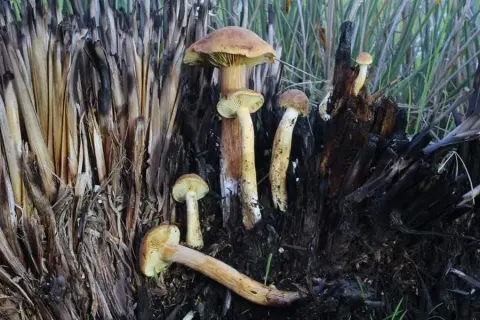
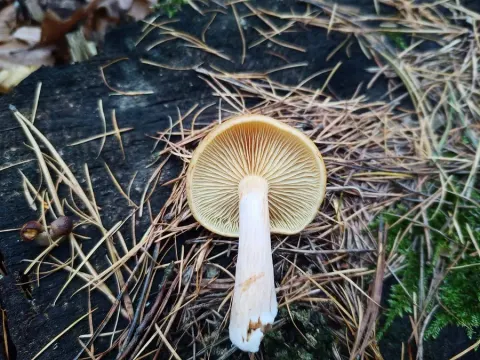
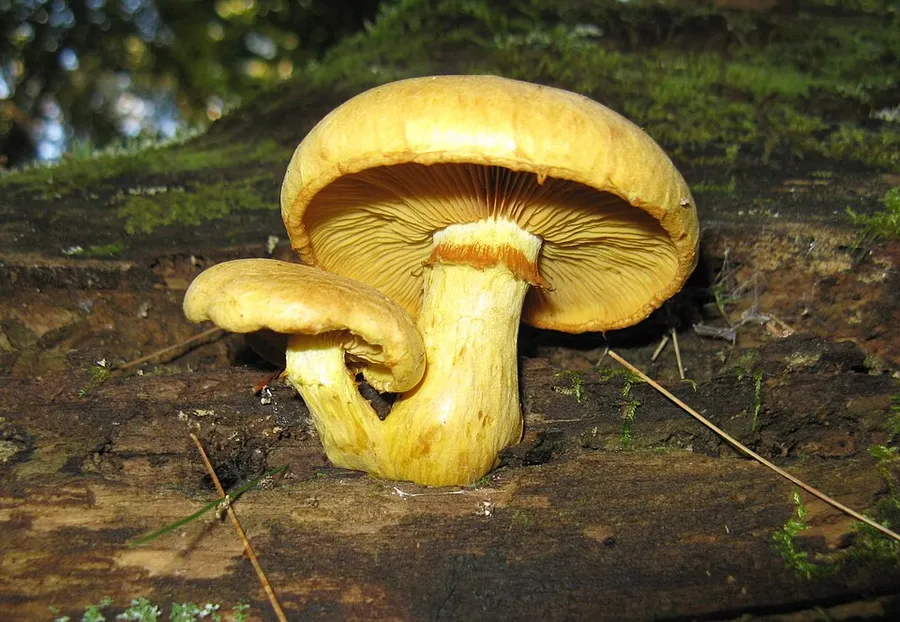
Pileus: 3—20 cm, convex-hemispherical at first, expanding to broadly convex, with an irregularly infolded and not incurved margin that slightly overhangs the gills. Buff yellow to warm buff orange, often slightly darker towards the center, dry, smooth, silky or finely floccose-fibrillose, sometimes floccose-squamulose toward the center, flesh firm, pale yellow. Staining orange-brownish or sometimes bluish-green where injured or on age. Gills: Adnexed, thin, close, pale yellow, becoming rusty brown with age. Spore print: Rusty brown. Stipe: 4—10 cm, 0.5–3 cm thick, equal to slightly enlarging below, solid, firm, colored like the cap, developing yellowish-rusty stains when handled, finely hairy, partial veil usually forms a fragile submembraneous ring or fibrillose annular zone near the apex. Staining orange-brownish or sometimes bluish-green where injured or in age. Taste: Very bitter. Odor: Gills have a strong odor of anise, which is one of the easiest ways to differentiate it from its close relatives. Microscopic features: Spores are 6.5–8.3 μm × 4.5–5.7 μm (average = 7.4 ± 0.5 × 5.1 ± 0.3), minutely warty, elliptical, slightly dextrinoid, surface finely roughened with irregular warts and short ridges, no germ pore. Pleurocystidia absent or very rare, cheilocystidia mostly lageniform to lecythiform but occasionally without a swollen apex; length = 19.3–35.4 μm (average = 27.3 ± 4.0). Caulocystidia abundant above the annular zone, produced as terminal cells of long hair-like hyphae, narrowly ventricose–capitate to cylindric–capitate, often cylindrical to clavate and without significant apical swelling; 30.9–66.9 μm.
Habitat dan peran ekologis
G. luteus ditemukan tumbuh sendiri untuk gregariously atau dalam kelompok kecil di pohon kayu keras mati, lebih memilih material lembab dan baik busuk. Buahnya berasal dari June to November, dan tersebar luas di Kanada Timur Serikat States and.
- Habitat atau konteks temuan
- Informasi belum tersedia pada sumber rilis ini.
- Substrat
- Informasi belum tersedia pada sumber rilis ini.
- Peran atau konteks
- Belum dikategorikan pada rilis ini.
Reproduksi
Pileus: 3—20 cm, convex-hemispherical at first, expanding to broadly convex, with an irregularly infolded and not incurved margin that slightly overhangs the gills. Buff yellow to warm buff orange, often slightly darker towards the center, dry, smooth, silky or finely floccose-fibrillose, sometimes floccose-squamulose toward the center, flesh firm, pale yellow. Staining orange-brownish or sometimes bluish-green where injured or on age. Gills: Adnexed, thin, close, pale yellow, becoming rusty brown with age. Spore print: Rusty brown. Stipe: 4—10 cm, 0.5–3 cm thick, equal to slightly enlarging below, solid, firm, colored like the cap, developing yellowish-rusty stains when handled, finely hairy, partial veil usually forms a fragile submembraneous ring or fibrillose annular zone near the apex.
Catatan identitas dan cakupan
- Nama diterima mengikuti Catalogue of Life Base2026-09-11; uraian mempertahankan konsep dan nama sumber aslinya.
- Original geographic, specimen and life-cycle scope retained; source import awaits individual editorial review.
- Impor dan terjemahan otomatis belum diperiksa editorial per profil. Struktur reproduktif yang disebutkan tidak membuktikan seluruh siklus hidup diketahui.
- Pengukuran pada uraian mengikuti spesimen, kultur, dan metode sumber; angka tidak diperluas ke semua populasi.
Catatan distribusi dalam narasi mengikuti sumbernya. Dokumentasi spesimen atau foto mengikuti catatan sumber. Bukti wilayah Indonesia dan penilaian konservasi tidak disimpulkan dari gambar.
Melihat dengan konteks
Dokumentasi Gymnopilus luteus dari Wikimedia Commons. Gymnopilus luteus ((Peck) Hesler) Notes: Gymnopilus luteus notes: These gyms were growing in three seperate places on a fallen hardwood. One of the groups of three had very slender stalks. So slender that I wasn't sure if they were even gyms. The other group of three were slightly thicker, and the group of two looked like a the other G. luteus specimen i've seen. Identifikasi mengikuti record berkas sumber.
- Jenis
- Fotografi
- Kredit
- John Carl Jacobs (JCJacobs)
- Lisensi
- CC BY-SA 3.0
- Sumber media
- Buka entri sumber
Sumber profil
- [1] Gymnopilus luteus — Wikipedia (en)
- [2] Catalogue of Life Base2026-09-11 — Gymnopilus luteus
- [3] Dokumentasi visual — Gymnopilus luteus
Rujukan halaman ini
Fungi. Gymnopilus luteus. Rilis data fungi-2026-10-12-expansion-2. https://fungi-atlas.mgadib.chatgpt.site/jamur/gymnopilus-luteus/.
Status: impor sumber; pemeriksaan editorial per profil belum selesai. Untuk klaim biologis, gunakan rujukan pada bagian terkait dan periksa konteks sumber aslinya.